Episode Transcript
[00:00:00] Speaker A: Hey. Hey. So is this me? Like, is this Bradley Charbonneau? Am I who I say I am? Right? I mean, like, can I prove it? Can I get, like, can I get Pepper in the view here? Right? Could this all be duplicated by AI? Sure. Sure it could. I'm sure the.
I don't know how to do it yet, but I'm sure I can make this video, you know, completely AI Right. Which I'm not going to do because this is me. So how do you know it's me? Why am I doing this? Right. Because you trust me. Me. And why do you trust me? Well, I'm assuming you trust me. Why do you trust me? Because I'm real.
Right. So what am I doing here? I'm going to introduce a video of two AI bots discussing the.
It's going to get weird here. The transcription that I recorded this morning as I'm working on my Las Vegas presentation for Author Nation in November at Author Nation. Author Nation is the biggest writers conference in the world, and I'm presenting YouTube 301. So I'm also presenting YouTube 101. Sarah Cannon is presenting YouTube 201. She's talking about strategies and different paths you can take on your YouTube strategy. And then I'm coming back with 301 with advanced topics. Right. For YouTube, for authors. Okay, so.
So what am I doing here? I. I've been working on my presentation. It's actually due in a couple days. I'm kind of late, but I, it's interesting because I've known my presentation for weeks, if not months, and I know exactly what I'm going to do.
And yet I have sort of a big idea that I'm gonna, that I'm gonna bring across at the presentation. And that is.
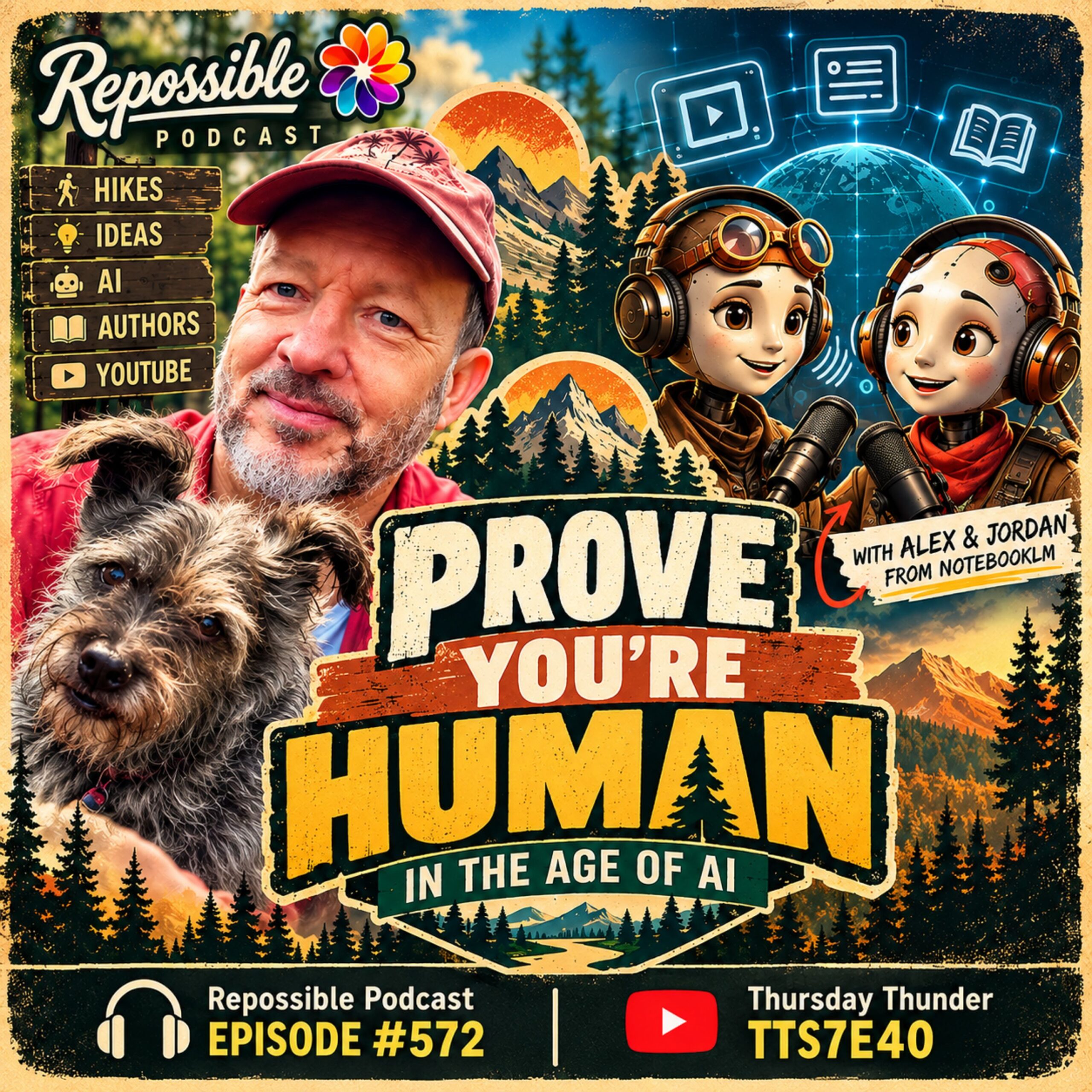
Well, you know what? All right, I'm gonna let Alex and Jordan. I call them Alex and Jordan. They are AI bots. They're from Notebook lm. I, I, I'm very transparent about the stuff I do. Right. I use AI a lot. I love it. I think it's fascinating.
And I am fully on board with AI. I fully understand from the creative perspective, stealing books and everything and. Right. As a good improv comedy player, I don't say but I try not to say. I say, but I say and, and, you know, this is the future, this is the present, this is the way it is. So, yes, it is what it is. Take that as you might hang. Hang up.
You might click away by now. But, hey, that's okay. I'm here to introduce Alex and Jordan talking about a big idea that I'm going to be presenting as part of my presentation at Author Nation 2026 in Las Vegas. I think it's November. I think it's 9th through 13th, 12th, something like that.
I think it's Author Nation Live. Anyway, look up Author Nation Vegas, Author Nation 2026. You'll find their landing page. You'd think I'd know it by now. All right, here we go. I'm gonna go. I'm gonna introduce Alex and Jordan. The reason I'm doing this is because I want to show you that I am authentic. I am real. There's Pepper.
Hi, Pips.
There's Pepper. This is me. I'm in the woods. I'm scruffy and looking. Oh, my God. This is not good. It's not. It's not a good look, Bradley. At least I don't have the red sunglasses on. I mean, come on.
So here we go. This is the real me. I'm goofing around. I'm improving it here, obviously.
And I'm gonna now share with you Alex and Jordan's presentation on a bigger topic that I'm going to be presenting in Las Vegas in October. In November. It's almost October. Oh, my God, it's almost like October. And I'm moving in three days. Bye for now. Enjoy.
[00:03:33] Speaker B: What if I told you that in three years an AI will recommend a business based entirely on a YouTube video with like only 20 views? And it will completely ignore the custom website that that same business spent $10,000 building?
[00:03:48] Speaker C: I mean, it sounds crazy, right?
[00:03:50] Speaker B: But it fundamentally rewrites the entire playbook.
[00:03:53] Speaker C: It really does.
[00:03:54] Speaker B: Welcome to the deep dive. Today we are exploring a massive and frankly, jarring shift in how we establish authority online.
[00:04:01] Speaker C: Yeah, we are basically watching the transition from a, you know, text based, search driven web to an AI curated, video verified ecosystem.
[00:04:11] Speaker B: And to anchor this whole exploration, we are focusing on a very specific mission today. We are looking at notes from Bradley Charbonneau.
[00:04:18] Speaker C: Right, the author.
[00:04:19] Speaker B: Yeah, he's an author and a presenter and he is prepping for a high level session. He actually calls it his YouTube 301 presentation at Author Nation 2026 in Las
[00:04:30] Speaker C: Vegas, which is a major conference for authors and publishers. Just for context.
[00:04:33] Speaker B: Exactly. So Bradley is planning to drop a rather bombshell idea on this audience. He's saying that YouTube is no longer just a secondary marketing channel, like, you know, where you just post a quick book trailer and forget about it.
[00:04:47] Speaker C: Right, the old way of doing it.
[00:04:48] Speaker B: Yeah. He is arguing it needs to become the absolute central hub for an author's brand, effectively replacing the traditional website.
[00:04:57] Speaker C: Which is definitely going to ruffle some feathers in a room full of authors. I mean, these are people who've been told for the last two decades that their personal website is the single most important digital asset they own.
[00:05:09] Speaker B: Oh, absolutely. So to figure out if Bradley is actually steering these authors in the right direction, we are synthesizing his pre conference notes with a pretty provocative manifesto from a YouTube coach named Wes McDowell. Yes, and the manifesto is ominously titled, you, Website won't matter in 2027.
[00:05:26] Speaker A: So.
[00:05:26] Speaker B: Okay, let's unpack this. Why is the traditional website dying in the first place?
[00:05:30] Speaker C: Well, to understand the decline of the website, we have to look at the mechanics of what a website was originally hired to do. Right?
[00:05:38] Speaker B: Right.
[00:05:39] Speaker C: According to WesMcDow's analysis, a traditional website historically had two primary jobs. The first was getting you found.
[00:05:47] Speaker B: Like SEO.
[00:05:48] Speaker C: Exactly. Traditional SEO. Stuffing keywords into blog posts and just praying to rank on page one of Google. And then the second job was building confidence through copywriting.
[00:05:58] Speaker B: Making you look like a pro.
[00:05:59] Speaker A: Yeah.
[00:05:59] Speaker C: Once a user finally landed on your page, your carefully crafted text had to convince them that you were the expert they needed.
[00:06:06] Speaker B: But both of those jobs are actively being outsourced by consumers right now. I mean, they are being handed over to AI assistants.
Wes shares this personal anecdote in his manifesto that just captures this perfectly. He needed a new accountant. Now think about the old workflow for that, you type accountants near me into a search bar.
[00:06:25] Speaker C: You get a map, pack a list of blue links, Right?
[00:06:28] Speaker B: Right. You open up 10 different tabs, you click through to their About Us pages, scan their generic corporate copy, and you try to guess if any of them actually understand your specific type of business.
[00:06:39] Speaker C: It was a tedious, highly manual filtering process, and it relied on the user doing all the heavy lifting.
[00:06:45] Speaker B: But Wes skipped all of that. He is a YouTuber who sells online courses, which means his tax situation is highly specific. So he just opened ChatGPT and laid out his exact criteria.
[00:06:56] Speaker C: He basically gave it a prompt.
[00:06:58] Speaker B: Yeah, he said, I need an accountant who specializes in content creators, YouTubers, and online course sellers. And the AI digested that hyper specific prompt, scanned the Internet, and gave him a curated shortlist of three names.
[00:07:11] Speaker A: Wow.
[00:07:11] Speaker B: He set up meetings with those three people.
He bypassed the Google search entirely. And more importantly, he never once looked at their websites.
[00:07:19] Speaker C: And the broader data shows Wes is completely representative of this massive behavioral shift. Currently, 43% of consumers are using AI assistance for pre purchase research.
[00:07:30] Speaker B: That's almost half it is.
[00:07:31] Speaker C: And even more striking, one in four people now say AI is their primary source for recommendations. I mean, they aren't treating AI like a search engine. No, they are treating it like a trusted advisor, which allows them to bypass company websites altogether.
[00:07:46] Speaker B: You know, it makes me think about traditional SEO as walking into a massive, crowded room and just shouting, I write sci fi thrillers and just hoping someone hears you over the noise.
[00:07:56] Speaker C: Right?
[00:07:57] Speaker B: But asking an AI that is like whispering to a highly connected personal concierge who already knows your life story, your reading tastes, your budget, and letting them go find the perfect match for you.
[00:08:08] Speaker C: That analogy hits the nail on the head.
And the underlying mechanism of why this is happening is so crucial. People are no longer typing clunky, disjointed keywords into a bar.
[00:08:19] Speaker B: No more gutter guard installation near me.
[00:08:21] Speaker C: Exactly. Users are having continuous, voice activated, nuanced conversations with AI about their highly specific situations. They provide context. The AI processes that context. And because it acts as an intelligent filter, you. You don't need to read the website's copy to figure out if it's a fit. The AI has already made that determination for you.
[00:08:43] Speaker B: So if the user is bypassing the website to ask the AI concierge, the next logical question is, where is the concierge getting its information?
[00:08:52] Speaker A: Right?
[00:08:52] Speaker B: Like, if it's not scraping your beautiful website to find the answer, where is it looking?
[00:08:57] Speaker C: This is where we see the transition directly to YouTube.
Because last year, YouTube quietly surpassed Reddit as the single most cited source in Google's AI answers.
[00:09:08] Speaker B: That feels like a massive tipping point.
[00:09:10] Speaker C: It is a foundational change in the architecture of search. I mean, almost 30% of all AI generated answers now feature a YouTube video as a core citation.
[00:09:20] Speaker B: But wait, if I want to scam someone or just exaggerate my credentials, I can lie to a camera just as easily as I can lie on a website page, Right?
[00:09:29] Speaker A: Sure.
[00:09:29] Speaker B: So why would an AI model naturally trust a video more than a website?
[00:09:34] Speaker C: What's fascinating here is how AI evaluates trust at a structural level. Yes, a human being can lie on camera, but think about platform weight and domain authority. Okay, right now, anyone can buy a random domain name for $10 and spin up a self serving website in an afternoon. You control that environment entirely.
[00:09:54] Speaker B: Yeah, nobody is fact checking my personal blog.
[00:09:57] Speaker C: Exactly. It has no historical track record.
And AI platforms know this. They know web domains are isolated silos that can be easily gamed. But YouTube. YouTube is one of the largest, most established platforms in the World.
[00:10:11] Speaker B: Oh, I see.
[00:10:12] Speaker C: When a piece of content lives in that robust indexed ecosystem, the AI can cross reference it against engagement metrics, transcription, data, channel history. It carries significantly more weight because it exists in an environment the creator does not independently control.
[00:10:29] Speaker B: Which brings to mind the story of Jonathan Skardin from the source material. He runs a gutter installation business down in Tennessee.
[00:10:35] Speaker C: Oh yeah, the gutter guy.
[00:10:36] Speaker B: Yeah, and apparently almost all of his new business now comes through AI search recommendations. But he didn't do it by gaming some complex algorithm or hiring a fancy SEO firm.
[00:10:46] Speaker C: What did he do?
[00:10:47] Speaker B: He just started making dozens of YouTube videos. He tested different gutter guards. He showed his actual installation process. He compared products on camera.
[00:10:56] Speaker C: Just raw, helpful content.
[00:10:58] Speaker B: Exactly. And the AI models absorb the transcripts of all that video content. So now when a homeowner in Tennessee asks their AI for a reliable gutter recommendation, Jonathan's name is the one that surfaces. And the AI traces its logic right back to his videos.
[00:11:13] Speaker C: So we really need to map Jonathan's gutter business back to Bradley Charbonneau and his AutoNation 2026 presentation.
[00:11:20] Speaker B: Right back to the authors.
[00:11:21] Speaker C: Right, because Bradley is speaking to authors. If an author wants an AI to recommend their book to the exact right reader, relying on a static $10 website isn't going to cut it anymore. Feeding their themes, their world building details and their unique personality directly into YouTube is the most efficient, trusted path into
[00:11:39] Speaker B: the AI's brain, because the AI is literally reading the transcripts of those videos. But there is a second layer to this. I mean, the algorithm isn't the one pulling out a credit card to buy the book. Even after the AI gives a recommendation, a human being still has to make the final choice.
[00:11:55] Speaker C: This leads us to what we could call the crisis of authenticity. Bradley points out a really stark realization in his brainstorming notes. Using tools like Claude or ChatGPT, anyone can now build an authoritative looking website with flawless, highly persuasive copy in about 10 minutes.
[00:12:13] Speaker B: Yeah, it used to cost thousands of dollars and take months of development to look professional online. Now it takes an afternoon and a subscription to an AI tool.
[00:12:21] Speaker C: Exactly.
[00:12:21] Speaker B: Which means having a slick website is no longer a differentiator. It is just the absolute baseline.
[00:12:27] Speaker C: And consumers subconsciously understand this, Right? They know text is cheap. Wes's data highlights this perfectly. 85% of people actively double check AI recommendations.
[00:12:38] Speaker B: They don't just blindly trust the chatbot.
[00:12:40] Speaker C: No, they verify. So when SimilarWeb tracked 1.3 billion outbound clicks from AI chatbots in a single month, the number one destination, by a wide margin, wasn't a news site or a corporate homepage.
[00:12:53] Speaker B: It was YouTube.
[00:12:54] Speaker C: YouTube beat Facebook, Wikipedia and Reddit combined as the destination of Choice after an AI interaction.
[00:13:02] Speaker B: Wow.
[00:13:03] Speaker C: And keep in mind, Google owns YouTube and Google is ChatGPT's biggest competitor. Yet ChatGPT is still routing its users
[00:13:11] Speaker B: to YouTube because that is what the human user is demanding. They want to see a face to verify the text. Wes references a brilliant concept from Marcus Sheridan's book, they Ask youk Answer.
[00:13:22] Speaker C: Well, that's a great book.
[00:13:23] Speaker B: Yeah. The core philosophy is that trust is ultimately built by whoever feels the safest and most familiar to the buyer. Seeing a face, hearing a human voice, watching how someone physically expresses their thoughts, that closes the trust gap in a way text on a screen simply cannot replicate anymore.
[00:13:39] Speaker C: It just can't.
[00:13:40] Speaker B: There is a great example in the notes about a California gym owner named Jay Hale. He operates a relatively tiny YouTube channel, but his business brought in over a million dollars last year because he closes 70% of his inbound sales calls.
[00:13:53] Speaker C: 70%.
[00:13:54] Speaker B: Right.
[00:13:54] Speaker C: That's insane, right?
[00:13:56] Speaker B: And why is his close rate so high? Because his prospects have already watched his videos. The selling, the trust building, the familiarity, it's all established before they ever pick up the phone.
[00:14:08] Speaker C: Because video is the new proof of life. In an age where a 10 minute AI generated website can feature perfect but entirely soulless copy, the ultimate luxury, like the definitive tiebreaker for a consumer, is proven human authenticity.
[00:14:26] Speaker B: Now, Bradley brought up a really interesting dilemma in his notes regarding his specific audience. He asks, okay, this strategy makes perfect sense if I'm Joe Schmo the expert, introducing myself to sell a plumbing service. But is this approach better suited for nonfiction, where the author inherently is the brand?
Like, can a fiction author really use YouTube as their central digital hub?
[00:14:47] Speaker C: It is a completely valid distinction to make. But if we go back to Marcus Sheridan's concept of human desire for safety and familiarity, the psychology applies universally.
[00:14:57] Speaker B: How so?
[00:14:58] Speaker C: Well, for a nonfiction author, yes, you are selling your direct, actionable expertise. You are the product.
But for a fiction author, you are selling a time investment.
You are asking a reader to spend 10 to 15 hours inside your imagination.
Readers want to know the mind that created that world. They want to hear you talk about your historical research, your character deep dives the weird inspirations behind your magic system
[00:15:25] Speaker B: that makes total sense.
[00:15:27] Speaker C: The trust gap in fiction isn't, do you know your facts? The trust gap is, will I actually enjoy spending a weekend in this person's head?
A video answers that Question instantly.
[00:15:39] Speaker B: It proves you are an engaging storyteller before they even read page one. Authenticity cannot be typed anymore. It must be demonstrated.
[00:15:46] Speaker C: Exactly.
[00:15:47] Speaker B: So if we accept that YouTube is the new central hub, what exactly is Bradley going to teach in his YouTube 301 class? I mean, if I'm an author sitting in that audience in Vegas, I'm probably panicking right now thinking I need to become a daily vlogger. What exactly is the strategy here?
[00:16:02] Speaker C: Well, it is actually much more structured than just random vlogging. Wes McDowell breaks down two essential types of videos you must create.
[00:16:10] Speaker B: Okay, two types.
[00:16:12] Speaker C: Yeah, and these videos serve a dual purpose. They feed the AI the exact data it needs to index you, and they simultaneously build that human trust we just talked about.
[00:16:21] Speaker B: Got it.
[00:16:22] Speaker C: The first category is what he calls logistical videos. These are designed to answer the exact granular questions people ask before they make a commitment.
[00:16:30] Speaker B: Oh, like the kind of questions a client usually asks on a discovery call. Or in an author's case, the reservations a reader might have before committing to a sprawling 10 book series.
[00:16:40] Speaker C: Precisely for service based businesses, One of the biggest logistical hurdles is pricing. Wes uses the example of a Michigan family law firm.
[00:16:50] Speaker B: Lawyers never talk about price, right.
[00:16:52] Speaker C: They notoriously hide their fees. But this firm created a highly successful video simply titled how much does a divorce cost?
[00:16:59] Speaker A: Wow.
[00:17:00] Speaker C: They didn't give a single flat rate, obviously, but they walked through all the variables. Custody, assets, mediation versus trial.
[00:17:08] Speaker B: So helpful.
[00:17:09] Speaker C: And the AI absorbs that rich context and serves the firm up as the definitive transparent answer for anyone in Michigan asking about divorce costs.
[00:17:17] Speaker B: He also mentions videos that focus on comparisons and processes. Like the Impact marketing agency. They made a video comparing the pros and cons of hiring an outside agency versus building an in house marketing team.
[00:17:29] Speaker C: Oh, that's smart.
[00:17:30] Speaker B: Yeah. They are literally an agency on camera telling people the specific scenarios when they should not hire an agency. That level of transparency builds immense trust for sure. Or look at the Austin therapy practice he mentions. They only have 6,000 subscribers on YouTube, but they have 300,000 views on a single video titled how to get ready for your first session.
[00:17:52] Speaker C: See, those logistical videos dismantle anxiety for the viewer while giving the AI incredibly rich metadata to index.
[00:18:00] Speaker B: What's the second category?
[00:18:02] Speaker C: The second category Wes outlines is what he calls claim jumpers. These are videos where you explicitly call out your specific niche and exactly who you serve best.
[00:18:13] Speaker B: So you stop trying to be for everybody.
[00:18:15] Speaker C: Exactly. Wes talks about Don, a financial advisor. Don does not make general how to save money videos. His entire channel is dedicated solely to answering retirement questions for federal employees.
[00:18:29] Speaker B: That's super specific.
[00:18:30] Speaker C: That's it. He never even has to formally announce I am the federal employee guy. His entire catalog of content does the heavy lifting, establishing his absolute dominance in that specific niche.
[00:18:43] Speaker B: Here's where it gets really interesting for Bradley's audience of authors. If we take this blueprint, logistical videos and claim jumpers and apply it to publishing a logistical video might be an independent author doing a full transparent screen share of exactly how much it costs to self publish a fantasy novel. From COVID art to editing.
[00:19:01] Speaker C: Oh, I love that.
[00:19:02] Speaker B: Or maybe an author doing a detailed comparison video weighing the pros and cons of traditional publishing versus self publishing based on their own career.
[00:19:09] Speaker C: An acclaim jumper video for a fiction author could be a thriller writer doing deep dives into unsolved true crime cases that inspire their plots. Or a hard sci fi author who only discusses orbital mechanics and theoretical physics on their channel.
[00:19:24] Speaker B: Right.
[00:19:24] Speaker C: By producing that highly focused content, the AI learns exactly the type of reader who will resonate with your work.
[00:19:31] Speaker B: So the AI is essentially playing matchmaker based on your niche content.
[00:19:35] Speaker C: Yeah. And if we connect this to the bigger picture, niching down is no longer just generic marketing advice your publicist gives you. It has become a strict mathematical requirement.
[00:19:46] Speaker B: A requirement?
[00:19:47] Speaker C: Yes. If your brand is for everybody, you are not the specific answer to anybody's AI prompt. Think back to Wes asking his AI for an accountant for course sellers. A generalist accountant, even a brilliant one with 30 years of experience was never going to win that prompt because they
[00:20:05] Speaker B: didn't claim the niche.
[00:20:06] Speaker C: Right. The AI pairs the hyper specialist with the hyter specific query.
[00:20:11] Speaker B: Okay, so we are telling authors to pivot their entire digital identity, taking their brand hub away from their website and putting it on YouTube. But there is a massive elephant in the room here.
[00:20:24] Speaker C: The time it takes.
[00:20:25] Speaker B: Yes. The conventional wisdom is that YouTube is a grind. Everyone says it takes three to six months, sometimes years, to see any algorithmic traction. If I'm an author, why would I abandon my website for a platform that takes that long to yield results?
[00:20:40] Speaker C: Because that conventional wisdom is based on the old YouTube algorithm. And the AI shift completely shatters that timeline.
[00:20:48] Speaker B: Really?
[00:20:48] Speaker C: Yes. Wes cites an AI citation study that proves views, subscriber counts, and traditional virality do not matter to the AI recommendation engines.
[00:20:57] Speaker B: Wait, they don't matter?
[00:20:58] Speaker C: The.
[00:20:59] Speaker B: That completely flips the script on how we think about building an audience.
[00:21:02] Speaker C: It does. The AI agents are reading and indexing the transcripts of your videos from day one.
An LLM is just as likely to cite a video with 20 views as it is to cite a video with 2 million views, that's crazy. Provided the transcript explicitly and accurately answers the user's prompt. Yeah, you don't have to wait for the YouTube algorithm to bless you with a viral hit. The AI discovery engine starts working for you the moment the video is processed.
[00:21:28] Speaker B: A 20 view video can drive the same targeted business as a 2 million view video.
That is a massive paradigm shift. So what actually happens to the old website then? Like if YouTube is doing the heavy lifting for discovery and trust, do we just take the website offline entirely?
[00:21:46] Speaker C: No, you don't delete it. But its function drastically changes and its physical footprint shrinks. The traditional website goes from being a massive 30 page mega site with a blog, an about page and endless copy down to a simple clean landing page.
[00:22:03] Speaker B: Because the education and the confidence building have already happened on the video platform.
[00:22:09] Speaker C: Exactly. By the time a user clicks the Link in your YouTube description to go to your website and they are already sold on you.
[00:22:16] Speaker B: Right.
[00:22:16] Speaker C: The website's only job now is logistical execution. Collect the email address, sell the book, book the consultation, and above all, do not get in the user's way.
[00:22:27] Speaker B: Wes puts a really urgent timeline on this transition too. He estimates we have a window of about 12 months, basically until 2027, before the wider competition figures this out.
[00:22:37] Speaker C: The clock is ticking.
[00:22:38] Speaker B: It really is. Right now, most businesses and authors are rushing to update their text based websites using AI tools, completely missing the fact the actual battleground for discovery has moved to video.
[00:22:48] Speaker C: Yeah, they're playing the old game.
[00:22:50] Speaker B: It is like compound interest. The authors who start feeding the AI their video transcripts today are going to have a massive entrenched structural advantage a year from now when everyone else finally catches on.
[00:23:01] Speaker C: But there is a crucial caveat here that Bradley must emphasize to his audience at Audio Nation.
Even though we are discussing the mechanics of making videos for AI discovery, you must always design the final product for the human who is watching.
[00:23:14] Speaker B: You can't just stare at the camera and read a list of SEO keywords like a robot.
[00:23:18] Speaker C: Precisely. Make it engaging. Make it vulnerable, make it authentic. The machine learning models are sophisticated enough to extract the context, the logistics and the niche from a completely natural conversation.
[00:23:31] Speaker B: They don't need you to sound like a textbook.
[00:23:32] Speaker C: No. If you only perform for the algorithm, the human user who eventually clicks on the video to verify you will immediately sense the lack of authenticity and click away.
[00:23:43] Speaker B: So what does this all mean? If you are Bradley Charbonneau stepping onto that stage in Las Vegas to deliver your YouTube 301 presentation. The core message is the era of hiding behind a beautifully typed, professionally designed website is over.
[00:23:59] Speaker C: Completely over.
[00:24:00] Speaker B: Because perfect text is now a cheap commodity generated by machines. In seconds, authenticity can no longer be typed. It must be shown. Yes, for authors, whether you are writing technical nonfiction or epic fantasy, YouTube isn't just a place to post promotional trailers anymore. It is the verifiable proof of your humanity. And it is the core engine that allows the AI concierges of the world to find you, understand you, and recommend your work to the exact right reader.
[00:24:29] Speaker C: It is a profound evolution in how we establish who we are in a digital space.
But, you know, looking at how fast this is moving raises an important question, something we haven't really touched on yet, but something that is looming right around the corner.
[00:24:43] Speaker B: Oh, what's that?
[00:24:45] Speaker C: Well, we've established that right now, in this current moment, video is the ultimate tiebreaker. It is the only reliable way to prove to an AI and to a human that you are a real, authentic expert. Right, But AI video generation is advancing at a staggering speed.
What happens to the concept of an author brand, or any personal brand for that matter, when AI video avatars become entirely indistinguishable from real humans?
[00:25:10] Speaker B: Oh, wow.
[00:25:11] Speaker C: If a machine can perfectly synthesize the face, the voice, the micro expressions, and the nuanced thought process of an expert, how will we prove we are real then?
[00:25:22] Speaker B: That is a staggering thing to consider. It means the very definition of authenticity is going to have to evolve all over again.
Something for you to mull over as you look at your own digital footpr and plan for the next few years. Thank you for joining us on this deep dive. Start thinking about how you are preparing for 2027 and we will see you next time.