Episode Transcript
[00:00:00] Speaker A: But the important thing is the quicker that we help people, the less likely they are to get to that point, 15 years from now, five years from now, what have you. So let's bring the resources we need and get people off the street right now. And we're not going to do that as people help us. People aren't going to help us unless they think the problem is fixable. And they're not going to understand that the problem is fixable unless they see what it really looks like.
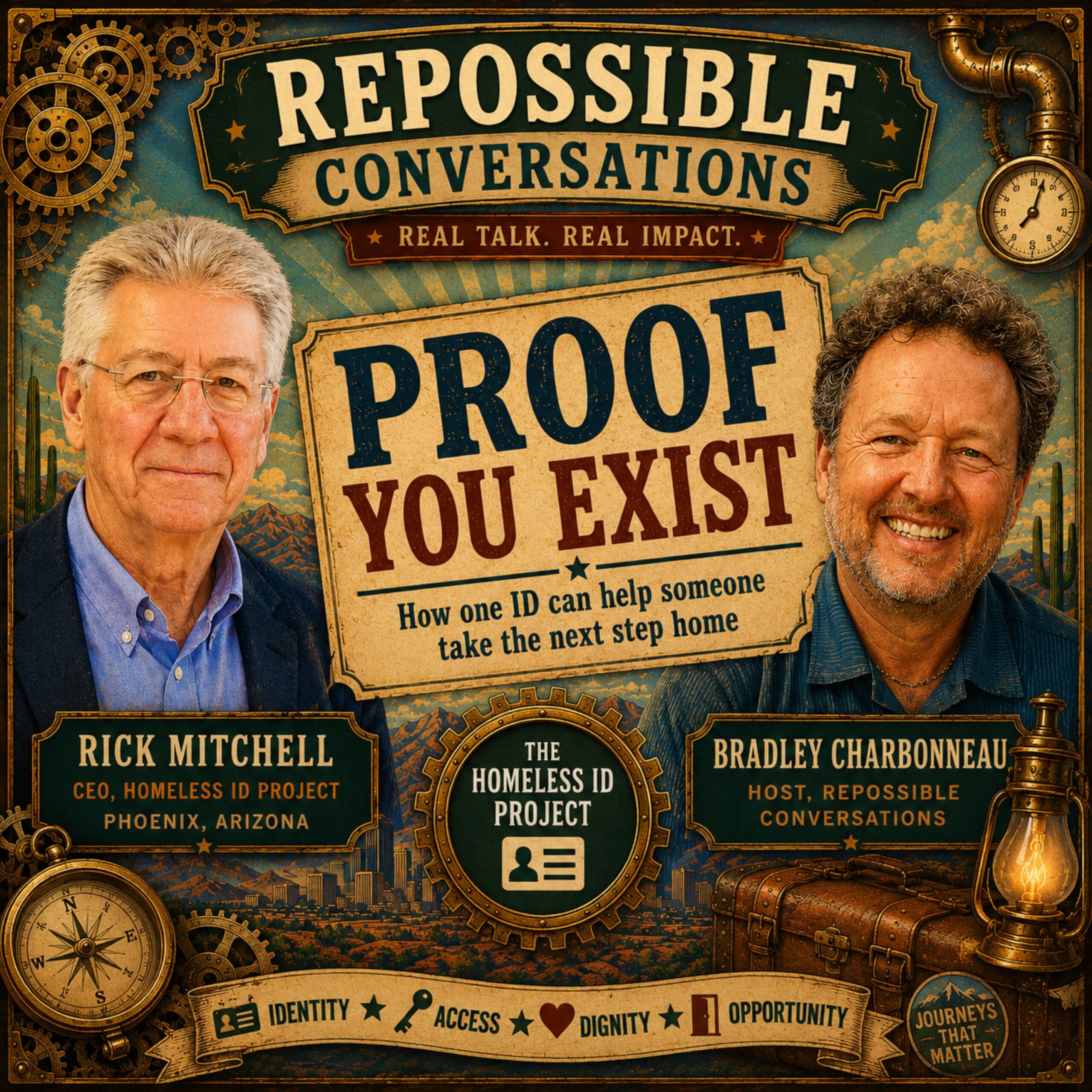
[00:00:27] Speaker B: Welcome, everyone. I am here today with the CEO of the Homeless ID Project in Phoenix, Arizona, Rick Mitchell.
Welcome to the show, Rick.
Thank you.
[00:00:40] Speaker A: Thank you for having me.
[00:00:42] Speaker B: I just a quick background on how we met. It is now midway through 2026 already and I was in Phoenix, Arizona visiting my sister and she brought me and my wife and my son to a location in Phoenix.
And because I was just asking you about this and there was a lot of organizations and I'm not even going to try to describe it, but the one thing that really stood out was this whole idea of people who don't have an id, like an identification card, I think, of any kind. So welcome. Rick. I'm going to let you introduce yourself a little bit and the project and let us know a little bit more. Like how did it come to be? How did you get involved? But really what I'm often getting at is.
Okay, all right, I am gonna, I am gonna say one thing.
I'm very much into storytelling. And there's a guy, Donald Miller, and he talks about there's a story brand framework and maybe we can walk through this a little bit as we talk here.
So it's based on the hero's journey because there's. So there's a hero with a problem who meets a guide who has a plan with a call to action, like what to do to avoid failure and achieve success.
The reason I'm saying these things is because every story, even the conversation we're going to have in a movie or a book, they often follow some version of this story. And the reason I say that is because often we, we're here talking and we ego driven humans think, well, I'm, I'm the hero of the story, but the best stories is when, when we are the guide.
So I see you, Rick, as the guide who has a plan for the hero who has a problem.
So I like to think in those terms and I've just laid it out. I don't always lay it out so clearly, but I'm laying it out clearly. Because I think it's such a fantastic framework and also can help us have a convers.
If, oh, you're the guide, who's the hero of the story and what's their problem and what's the plan to fix it? All right, there you go. There's your red carpet. Yeah, come on in.
[00:02:57] Speaker A: And so let me go to the setting of the story, because you alluded to it a bit ago, or one of a number of organizations. There's a thing in downtown Phoenix. It is called the Keys to Change campus. It's a 13 acre piece of land about three blocks from the state capitol.
And on that 13 acre campus are 16 different nonprofits, all working for the sole purpose of providing resources people need to end their homelessness.
Homelessness is a real, a real problem across the country, probably across the globe.
And so we've got, we've got a unique thing, a unique place where the story takes place in downtown Phoenix. Yeah, Homeless ID Project is one of 16. Now, if you don't have an ID, if you can't prove who you are, it's really difficult to make your way.
And so what we do is help people get those documents if you are a U.S. citizen.
And if we can get a U.S. birth certificate, and that would include each of the five territories, it would include citizens born abroad, typically on a, you know, a naval base, an army base, military base, or something like that. Yeah, we can get your birth certificate and then we can get a state ID for you. Once you have an id, then you can get a job, you can get housing, you can get access to benefits and that kind of thing. And without that, frankly, you are stuck.
[00:04:27] Speaker B: Wow.
So. So people, they, they just don't have an id. But if they don't have an id, do they have a birth certificate? How do they get the birth certificate?
[00:04:38] Speaker A: That so people, people come to us, they've lost everything. Give you an example. A guy from, came to us, this is probably three years ago now, and he is from Iowa, and he had a job offer in Phoenix, and he drove from Iowa to Phoenix. The job, while he was en route, the job fell through.
He was in Phoenix, his car was vandalized, his stuff was stolen, and he was in Phoenix with nothing. He didn't have an id, he didn't have any funds, he didn't have any way to get back where he, where he came from. So we came to see the homeless ID Project and we were able to work with him to figure out how to get his birth certificate. It's not always easy but we typically find a way to do it. And once we had his birth certificate, we could apply for an ID for him for the state of Arizona. And now he can either go back to Iowa if you wanted to, or he could get a job in Arizona, get housing in Arizona, unless he had the job, that sort of thing. But he wasn't going anywhere without an id.
[00:05:40] Speaker B: I can imagine some chicken and egg scenarios where, oh, do you have an address? You know, to get your id. Oh, to get your id you need an address. And because then if like that guy, he didn't have an address, I suppose, or can he? You do you guys, can you guys provide some kind of address or anything or how does that work?
[00:05:59] Speaker A: Back to the place. We have a 13 acre campus with 16 different organizations. One of those is a post office. And so everybody comes into campus that goes through campus, the campus intake process gets a campus badge, if you will, campus ID. And that gives them a street address. 232 South 12th Avenue, Phoenix, Arizona. And that's where his ID would be sent. That's where his birth certificate would be sent. And he could get other mail there. Yeah, until he has another address.
[00:06:26] Speaker B: Okay, wow.
[00:06:28] Speaker A: Let me talk a little bit about how, how this story got started.
[00:06:32] Speaker B: Yeah, please.
[00:06:33] Speaker A: Yeah. In, in 1987, a Presbyterian minister named Gerald Roseberry looked around Phoenix. There was an increase in the 80s, there was an increase in homelessness across the US and, and Jerry wondered where did that come from?
How did all that begin? And so Jerry grew a beard and marinaded a set of clothes and went and lived on the streets for 30 days.
And he spent two, two weeks in a place called Tent City that doesn't exist anymore. It was white military style tents up against the railroad tracks near where the campus is located.
And he spent a week in a shelter and then he spent another week down in Tucson.
And in that time he found people talking about the fact that they didn't have an id and that was preventing them from moving forward. I can't get a job. Here's a job offer. I don't have an id. I've lost my id. Now what am I going to, I don't know how I could possibly get it back again.
And so he, to overcome that, he set up shop in St. Vincent de Paul dining room in 1988 and began when he had funding, he began helping People get IDs and birth certificates. And when he didn't have funding, he was providing spiritual guidance.
He referred to his organization called his organization the Ecumenical Chaplaincy for the Homeless. And he was, as a Presbyterian minister doing a lot of chaplain work. And as time went on, it was all IDs, and we didn't have a chaplain. So in 2014, we changed the name to the Homeless ID Project.
Last year, we provided almost 15,000 documents for people. 11,000 state IDs, and 4,000 birth certificates.
[00:08:08] Speaker B: Wow.
Wow, wow.
That's a huge number.
I mean, 15,000.
Wow. That's hundreds per day.
[00:08:19] Speaker A: Wow. Yes.
Yeah. So. What?
[00:08:23] Speaker B: Wow. It's.
[00:08:23] Speaker A: It's.
[00:08:23] Speaker B: It's. It's. It's hard to even fathom the. If you think about it, how often do you need an ID for anything? Any kinds of official transaction of any kind. You need an id. And if you don't have. I. I just can't even imagine.
[00:08:37] Speaker A: Unofficial ones. Yes.
[00:08:39] Speaker B: Yeah.
[00:08:40] Speaker A: One of our. One of our clients famously said, the only thing you can get without an I.D. is arrested.
[00:08:46] Speaker B: Oh, that's bad. But. Yeah.
Wow.
[00:08:50] Speaker A: I mean, it's. It's not actually true, but it's almost true.
[00:08:53] Speaker B: Right, Right. Yeah. But it also, you know, it's not a funny joke, but it. It does really bring it home. Right? That's. Yeah, we don't have much.
[00:09:03] Speaker A: Wow. Yes.
[00:09:04] Speaker B: Okay. Speaking of bad jokes. But it's not a joke. So I live in the Netherlands, and the Dutch, their.
Their English is excellent. You. Excellent. But one of my nitpicks, I'm sort of a grammar guy, and many Dutch, and I correct them all the time. They will say the word oh, I. Light bulb above head.
I'm trying not to say the word yet. Id. E, A. I have an idea. Right. It is ide, three syllables. But the Dutch, four letters.
[00:09:36] Speaker A: Three syllables.
[00:09:37] Speaker B: Yeah. And they'll say, oh, I. I have an id.
I think we should buy Cheerios. I say, no, you have an id, like your driver's license. If you had an idea to buy Cheerios, that's an idea.
So, sorry. Bad. Bad reference here. But the word id, it's funny because I hear it so often because there's so many of the Dutch say this.
And it just makes me think, because your whole program is about id, and I. And. And we talked about identity as well. I mean, what does ID even stand for? I. Identification. I. Id. What does it stand for?
[00:10:16] Speaker A: Yes, yes.
[00:10:17] Speaker B: Identification.
[00:10:18] Speaker A: Yeah, it. It's identification. Yeah, it's short. Short for identification. Yeah, The I stands for I and the D stands for identification.
[00:10:27] Speaker B: Right.
You know, when I was visiting, I remember at the end, because we were. We were talking about it, and. And speaking of those letters and those Words that start out, we talked about identity and how this little piece of plastic that we, most of us probably take for granted that it is part of our identity. It says who I am. It says in the U.S. it says your address. Right. It says where you live on your id, Right. In the Netherlands, it doesn't.
So it says who. Who your name is. It's some. As a photo, it's got a bit of a description. Your height, weight, eye color, hair color, I think.
[00:11:11] Speaker A: Yep.
[00:11:13] Speaker B: Address.
So it is quite a bit of an identity. And I remember when. When you guys were giving us a tour and talking about that, I kind of hit me. I'm like, wow, that is.
You don't have this identifying piece of plastic, but which is really like almost proof of your identity.
And without it, we said, I think before we hit record, you know, do you exist? But of course you exist.
But not in the system, right? Not in the system.
Not in the.
[00:11:46] Speaker A: Prove that you exist.
[00:11:49] Speaker B: Yeah, yeah.
I didn't get into a hole, a philosophical discussion about that. But that's. That's really something. That's really a powerful, important service that you offer.
So. So how does it work? What is the process? They. They, like you said, there's a guy a few years ago, comes in vandalized and stuff stolen. He doesn't have anything.
And you. Will you work with them to go dig up records or contact, you know, the Iowa City hall or whatever, or. How does the process work?
[00:12:24] Speaker A: Yeah, the short answer is it varies.
The longer answer is if you've had an ID in Arizona before, it's relatively simple because you're in the system.
[00:12:35] Speaker B: Okay.
[00:12:35] Speaker A: And over a period of years, working with the State of Arizona Motor Vehicle Department, they have put MVD kiosk, in other words, a direct connection from our office to their office in our office.
So people come in to see us and we hook them up through a video feed, essentially with an MVD customer service rep that can look up their record, see the person there, and now they will send a replacement ID in real time.
[00:13:12] Speaker B: That person is. Even recognized them. That person says with this name and yes. Oh, wow. Oh, that sounds like it saves some.
Saves a bit of time, right?
[00:13:22] Speaker A: A long time. Yeah.
We're talking over each other. I'm sorry, but. But took a long time to get that to convince the. The state. And I. Convinced may not be the right word because I don't think we convinced them. I think we agreed with them that we could do this, to do it responsibly.
And so if at first the first, in the first step In July of 2023, they had a full time customer service rep from their organization in our office. And over a period of time they moved from the in person customer service rep to a kiosk where we're connecting to a customer service rep somewhere in the state of Arizona. Could be anywhere. Yeah.
And the experience for our client is exactly the same experience that they would have if they went to an MVD office. This.
Now, the state of Arizona has been reducing the number of MVD offices over a period of time. And, and right now the closest office to ours is about a 45 minute bus ride away and that's difficult for many of our clients to make that trip. So it's a very big deal having the MBD kiosk in our office. So back to your question.
Somebody comes in, they've had an ID in Arizona before. We sit them down in front of the kiosk, they talk to MVD customer service rep, everything is confirmed.
They print out in our office a temporary id. So now they've got a temporary piece of. They are. And then in five to seven days later that that piece of plastic shows up in the mail room. And as I said before, we're on a 13 new 13 acre campus, 16 different nonprofits. One of those entities on the campus is a post office. So that's where the individual's ID is mailed. If you have not had an ID in Arizona before, not so easy.
And the difficulty depends on your situation. If you were born in Arizona.
[00:15:25] Speaker B: Yeah.
[00:15:25] Speaker A: And you know, all of your information, it's probably a week before we'll have your birth certificate. Now we can get your id.
If you were born in Utah at home and the birth wasn't registered.
We see that occasionally.
[00:15:42] Speaker B: Yeah.
[00:15:43] Speaker A: Now, now we've got to work with the state or the county, depending on which state we're in, to, to get a delayed birth certificate. And that can take nine months.
Again, if we know all the information. It could take longer than that actually. If we know all the information from any other state.
And, and we, you know, there are other pieces to it, but just, you know, the, the broad swipe at this is if we can get all, pull all the information together, which we almost always can, not always quickly, but we almost always can, then we apply for the birth certificate. And Most states are six to eight to 10 weeks before we get a birth certificate. Some are extended very long. Connecticut. Last time I looked at the state of Connecticut in our office, pardon me, was about 10 months to get a birth Certificate from the state of Connecticut. So it varies depending on state. It varies depending on how much the individual knows about the information that's on their birth certificate.
And the, the information on the birth certificate is your mother's maiden name, father's name, you know, hospital, all those kinds of things. So if you know that I. Buying information.
Okay.
Yeah. Wow.
[00:16:58] Speaker B: You, you have a, you mentioned you have an event coming up.
[00:17:01] Speaker A: Okay, we do.
[00:17:02] Speaker B: In, in person event. Tell us about that.
[00:17:04] Speaker A: We have, we have an in person event on July 29th. And if you're familiar with Arizona, and in fact, even if you're not familiar with Arizona, it's hot on July 29th. So we say it's the hottest night of the year. We're going to have a sleep out.
And the purpose of the sleep out is to raise awareness in our community about the fact that there are people who are sleeping out at night. And it ain't easy. We did it last year was the first year, this is the second year. And we're also going to do the event down at Tucson this year. The event in Phoenix is going to begin with a kickoff sort of a here's what we're doing and here's why we're doing it event. And that will be at a place called Cul de Sac in Tempe, Arizona. And then as a part of the whole experience, we're going to ride the light rail from Tempe to an undisclosed location in Phoenix and we will spend the night. We will have some of our partner agencies that are on that campus and others that even that aren't on the campus with us and they'll talk about why they do what they do. We'll be live streaming.
I don't want to say all night, but we'll be live streaming for a good bit of the night.
We have invited media, so I think we will have at least two television stations that will come by at some point.
There's a radio personality, his name is Jim Sharp. He's on KTAR radio. He's actually going to go come to the kickoff event with us in Tempe. He's going to ride the rail with us. He's going to sleep out all night and he's going to leave us at 3 o' clock in the morning to go to his job as the morning radio guy on ktar. And I'm sure he'll be, if he's, if he's able to talk at all, he'll be talking about his experience.
So. And again, you know, this, this is it's an attempt to bring awareness. It's not, we know we're not recreating the experience of actually being was, but just pointing out the fact that it's, you know, how what people are up against if they do not have. Yeah.
A roof to sleep under.
[00:19:13] Speaker B: Yeah.
Wow. Well, it's just like you said, the key word being awareness. You know, I, when I went with my sister to visit your location, I had no idea about this ID thing, just the challenge of having an id. And so I, I can't even imagine what a, a sleep out would, would bring up as far as real experience for people.
[00:19:39] Speaker A: I think the whole awareness thing is it's really important because we have the wrong idea about what homelessness is even I don't know in your part of the world. But I know here and across the states the, the vision of homelessness. If I said to you picture in your mind a homeless person, you would probably picture a person who is indeed homeless, but probably chronically homeless. The old gray haired guy with a beard sitting on a curb, he's got a sign or he's on the side of the freeway with a sign, help, help, please help me, that kind of thing. And that person is homeless. He's probably one of the 15% who are chronically homeless.
But that's only 15% of the homeless population. 75% of the people who are homeless today in the US will not be homeless a year from now.
In the state of Arizona, half of the people who are homeless are in families with children.
There are 3,000 homeless teens in Maricopa county, which is where Phoenix is located.
So our picture of homelessness, which is not a pretty picture at all, may even be off putting. You say we want to fix that problem. And if that's how we define the problem, my goodness, what are we going to do about that?
Because that, that person who's been on the street for 10 years or 15, he's, what do I do? I can't possibly do anything except give them a blanket and a meal or something.
[00:21:10] Speaker B: Right.
[00:21:11] Speaker A: But, but the important thing is the quicker that we help people, the, the less likely they are to get to that point, 15 years from now, five years from now, what have you. So let's bring the we need and get people off the street right now. And we're not going to do that unless people help us. People aren't going to help us unless they think the problem is fixable. And they're not going to understand that the problem is fixable unless they see what it really looks like.
[00:21:35] Speaker B: Yeah, and just like me visiting your center there, I had no idea. And physically going there, really, I mean, if I could read your brochure or, you know, scan your website, but it's just not the same. I was really there and it was the real deal.
[00:21:51] Speaker A: Yeah. And when you say that, Bradley, for your, for your, for the, for the viewers, we have 802,000 people a day coming through there.
And, and, and probably if, if you didn't remember that number, that, that may surprise you because it's a calm. It doesn't feel like 800 to a thousand people the way it's set up, the way it's been structured and, and built out. It's a beautiful place and, and it's calming, I would say.
[00:22:15] Speaker B: Yeah, yeah, yeah, it was, it was a calm atmosphere.
Yeah. And it was November, So it wasn't 100 plus degrees.
[00:22:23] Speaker A: Right, right.
[00:22:24] Speaker B: Yeah. So speaking of helping out and awareness, what can, what can people do? So if they're watching this, how can they help your organization?
[00:22:33] Speaker A: Well, if you're watching this from Arizona, you, you can make a donation and get all that money back. Now what do I mean by that? There's a thing in Arizona called the Arizona State Tax Credit, and it allows individuals to donate to a qualified organization like the Homeless ID Project, up to $500 for an individual, $1,000 for a couple. When you file your taxes, you get all 500 as a tax credit, all thousands of tax credits. So make a donation, get it all back. Or you could just flat donate. You know, you can just make a donation from anywhere you are.
If you are involved in the human services industry or know people who are, or if you're volunteering there somehow and you're not in Arizona, ask people in your, in, in your periphery what they do. If somebody comes into your organization to get an id, what do you do for them? What do you tell them? Because they're not a lot of organizations like the Homeless City Project across the US and we're working with a group of, I think we're up to a thousand 1400 people on our email list right now. And we're having, we have quarterly seminars to sort of bring awareness to the ID issue across the country.
And, and slowly but surely we're, we're building that. So we've got an organization that has been built out in Baltimore City, one in Spokane, Washington, and different organizations, Pocatello, Idaho.
So there are different organizations that are beginning to spring up around this. But, you know, just creating awareness of the fact that People don't have an id.
What do they do about that? And I, I would say this, that if there's nothing in place in your city, what people are doing about that is they're figuring it out.
The case manager that's working with them is helping them to figure it out. They try it and they're, you know, pulling the fee together and getting the information together. And, and they may ultimately be getting it, but it's taking more time than it needs to take. And time is the enemy here. Time is the enemy because the longer people are homeless, that's the, that's the a predictor. The longer people are homeless, the longer they will be homeless. Okay.
[00:24:42] Speaker B: And I assume, like you said, somebody, it might take a week to get an id, and the other one with more complicated situation is going to take nine months plus.
[00:24:50] Speaker A: Yes, yes, absolutely. And because there's no, you know, someplace like.
Well, I won't name a city because I don't know sure. Who does and doesn't have them. But if you're in a city that does not have somebody who's helping people get IDs, the person who is trying to figure it out is not doing their job as a case manager because they're over here trying to figure this out. And so the cost of the thing in terms of time, and let me come to that is just a second. The cost is, is unnecessarily high. Last year I mentioned we did 15,000 documents.
We did that on a total budget of about $600,000.
If you do the math on that, it's about $40 a document. Well, if you're taking a couple of hours as a case manager to figure out how to get an ID for somebody, you just spent $40 worth of time trying to figure it out. Yeah, $50, $60, depending on how much the individual is being paid.
So we're pretty efficient that way. And, and I would encourage other cities who don't have something like this to set one up. If you're listening and you are interested in doing that.
[00:25:58] Speaker B: Yeah. And, and so those cities, they should also go to the Same website, homeless ID project.org.
[00:26:05] Speaker A: yes. They could also go to the site where, where we're running our national program from. It's, it's national conversation dot org.
[00:26:14] Speaker B: Okay.
[00:26:14] Speaker A: And there's another website out there that's called the National Conversation. That's not it. The, the national association.org is doing some weird political stuff.
Doing political stuff.
[00:26:25] Speaker B: Right.
[00:26:26] Speaker A: And so it's national conversation.org I see it.
[00:26:30] Speaker B: I see It. Yeah.
[00:26:31] Speaker A: And we will have a list of upcoming seminars and that sort of thing.
[00:26:35] Speaker B: Okay.
Yeah, Here we go. The inability to get a piece of paper or a plastic card should not be the cause of homelessness. Yeah. Okay. All right. I will share both of those links in the show notes as well.
[00:26:47] Speaker A: Right.
[00:26:48] Speaker B: Wow, Rick, this is. Well, I'm really glad we're finally catching up. When we met last Thanksgiving, I offered to help spread the word on my podcast and YouTube channel. We're finally doing it. Better late than never.
And thanks so much. Any parting words? Any last comments?
[00:27:11] Speaker A: I would just say that become. For. For your viewers. Don't assume that you know what homelessness is. Look at it. Become aware of it and. And. And engage. And, you know, people say, well, you know, do I say homelessness or unhoused? It doesn't make any difference. I mean, say. Say what you say. Do I. I see a guy on the side of the road and somebody said I shouldn't give him two dollars. Should I give him two? I don't know. There's no law against giving him two dollars. And it's, you know, if it. People want to help and want to do something that. That they think they're making a difference. And here's the bottom line on all this, and it's. Maya Angelou said this. Do the best you can until you know better. And then when you know better, do better and apply that. Do something doesn't make any diff. Do something. Help out. And the more you help out, the more involved you'll get, the more you'll understand, and the deeper and better your help will be.
[00:28:07] Speaker B: Wow.
Wow. Thank you so much for that. You know, what I really like about what you do is that it's very practical. It's. It's literally something that they can hold in their hands, and it's going to help them immensely.
[00:28:21] Speaker A: Yeah.
[00:28:21] Speaker B: And that's. I really like that aspect of what you do.
[00:28:24] Speaker A: That's what I like about it, too. I mean, you know, it's. People need food in a blanket. They absolutely do. And. And God bless the people who are doing that work. But to get somebody so they can get a job, that just feels. It feels right here.
[00:28:37] Speaker B: Yeah, yeah, yeah.
[00:28:39] Speaker A: For me.
[00:28:40] Speaker B: Yeah. Wow.
Rick, thanks so much for being on. And for anybody watching, please go check. I'll put the links in the show notes. Go check them out and see how you can help. And thanks again for. For being on the show, Rick.
[00:28:53] Speaker A: Thank you, Bradley. It was great to meet you in November and great to talk to you. Today.
[00:28:57] Speaker B: Great. Thanks. Bye, everybody.