Episode Transcript
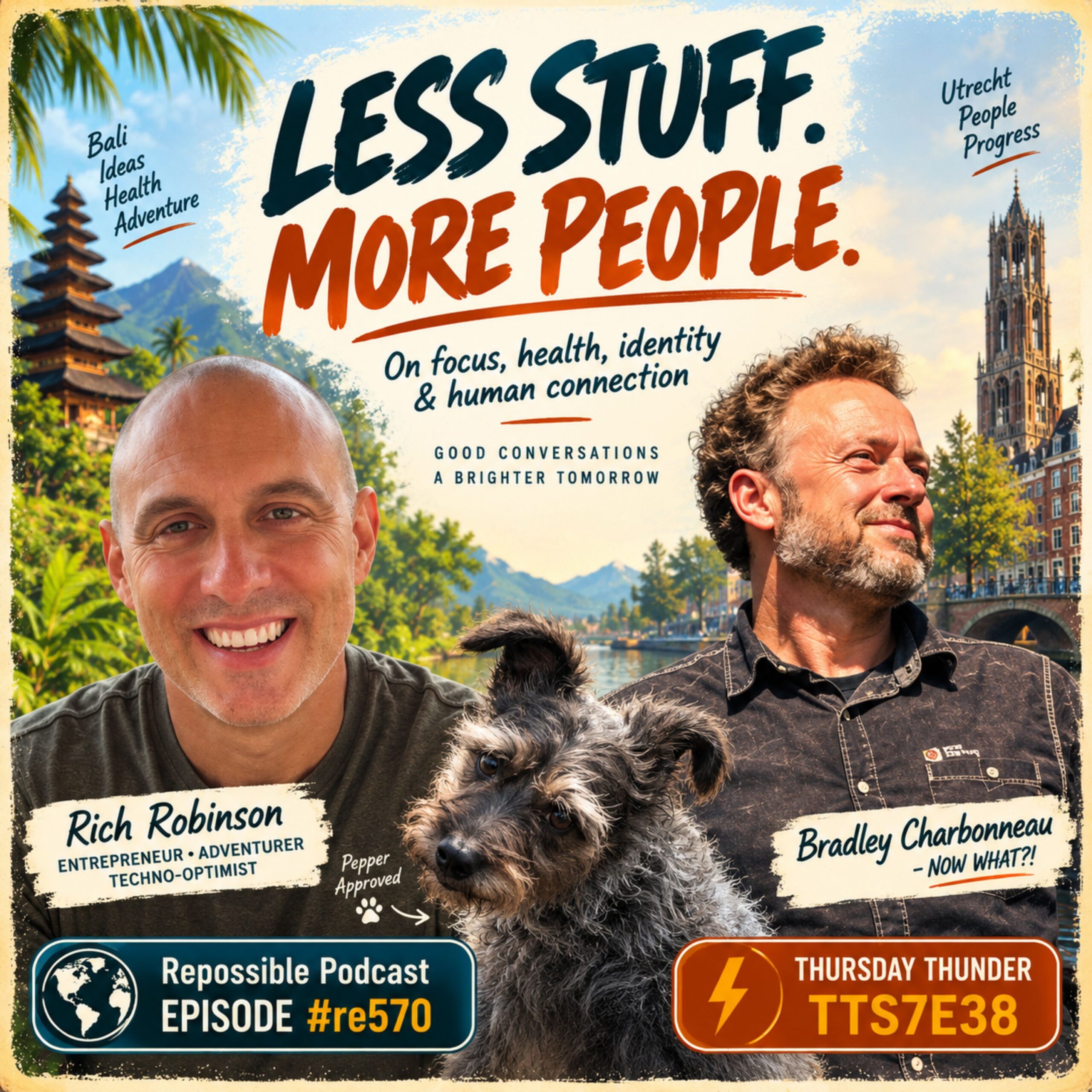
[00:00:02] Speaker A: And we're live. I'm here with Rich Robinson live from Bali. Whereas I am in the. Almost as exotic in the Utrecht.
[00:00:14] Speaker B: Oh my God. I think you just spit in my eye from across the planet with that. Wow. Bradley Charbonneau.
Go, go, go.
Bradley Charbonneau
[00:00:27] Speaker A: by Menon.
[00:00:29] Speaker B: That's his. That's your theme song now.
Never not good to see you, my friend.
[00:00:35] Speaker A: No, never. Always not good to see you. No, wait. No, always. Never. No, wait. It was never.
Okay, Rich Robinson here. Rich Robinson is the reason. Is the reason right now I'm not feeling it 100 because I'm still recovering from Tony Robbins.
Yeah. Oh, that's why things.
And I've been back a week, damn it. And I'm still not 100%. And it's kind of annoying, but I get it.
[00:00:59] Speaker B: I accept that's crazy because you're usually 180% sure.
[00:01:03] Speaker A: I know default setting, which is why it kind of.
It freaks me out because I don't. You know what's.
[00:01:12] Speaker B: Tony Dr.
Yeah.
[00:01:14] Speaker A: You know what's really weird? And this is going to be very condescending and sounds like I put myself on a pedestal. So I'm just gonna be better than me because I've already. Besides that. We already did that. But. So this is. This is gonna sound. I can't believe I'm even prefacing with this whole crap. I'm even putting myself in a bad place telling you. I'm going to tell you this terrible thing and then I'm just going to tell it to you anyway. So the past week, I don't have all my energy. Right, I meant like during the beginning of the week, I'm like at 30%, I'm. I'm crap. I feel terrible. So I'm also. I'm not confident. I'm not creative. I don't feel like meeting other humans. I don't feel like contact. I don't feel like talking to people. I'm just hanging out on my own, which is like a vicious cycle in itself. Right. And then. And physically, I don't feel like working out. Even though I know if I work out or run or move or whatever that will help me feel better. But I don't do any of that. And so it just. It just cycles on its own and it feeds itself.
And then here's the mean part.
I am normally, like you say, at 180%.
And so normally I'm the guy, you know, screaming from the rooftops, oh, you got to write a book and you got to create a video. And you got to make this and start your company and do this and do these daily habits and all these amazing things. Just do it. It's easy. I swear. I do it every day. What's your problem?
Right?
And then last week, when I'm not feeling at my 180%, I'm like, oh, oh.
So this is.
This is what people feel like. And this is the condescending part because I'm. I am kind of saying that I have more energy than most people, but you know what? I do.
[00:02:50] Speaker B: But you do.
[00:02:51] Speaker A: I do.
[00:02:51] Speaker B: There's a different. Different default setting on you. And you did a little bit of a factory reset. And then you're like, oh, that's.
If you know, you know, then, okay, I will give a little more grace too.
Other people who don't have that kind of Energizer Bunny extra gear.
Yeah, but I mean, that was called Unleash the Power within, right?
Yeah, yeah, yeah. So upw Tony Robbins, and you unleashed all the power within. And then you're like, okay, now I gotta refill my.
My battery cells next week or two.
So in some ways, like, congratulations.
[00:03:32] Speaker A: Are you saying, like, unleash, like, like I let it go?
[00:03:35] Speaker B: Give me that back. Okay. Yeah, maybe. Or maybe it just takes a little while to, you know, re. Re. You know, replete the energy.
[00:03:45] Speaker A: Yeah, okay. No, that's good. I kind of didn't.
[00:03:49] Speaker B: I. I remember when I did the same exact thing in Sydney, November of 24, I think. And I think I did 18,000 steps on day three.
And that was, you know, in front of my seat.
Like, it's, you know, it's physically like you're moving, you're bouncing a lot, but it's also very emotionally and cognitively and spiritually and sort of unconsciously draining, but, you know, hopefully in the best way possible.
We're talking a little bit about this Dickens exercise, right?
And you want to tell our dear listeners what that entails.
[00:04:40] Speaker A: So it's this. Everybody talks about it. It's like, oh, it's going to be the big thing on day three, right? It's a four day event. And it's on day three. Everybody's like, oh, the Dickens. Is it the Dickens process? They have a name for it. I can't remember Dickens something, but it's about Charles Dickens and the Ghost of Christmas Past and the Ghost of Christmas Present and the Ghost of Christmas Future.
And you're correct me if I'm wrong because I, I feel part of it. Like, I blanked out. It Is such an intense day. I'm like, but it's.
[00:05:14] Speaker B: It's.
[00:05:14] Speaker A: Get rid of the past and literally, like, shouting it out from the rooftops.
And then dealing with the present and forecasting the future or. What can you see for your future?
[00:05:27] Speaker B: Yeah, just like Ebenezer Scrooge got the shit scared out of him. He's like, yeah, I know the past. I know. I know present. Yeah, but then the future. He's like, whoa, I'm gonna die alone under a thin blanket. And he, like, throws open the window, you boy, buy me turkeys. And, you know, bring them.
Bring them over here. And, you know, he wants the. Wants to change his ways. And I.
As I remember the. You know, I made three goals. And then, you know, they really, really work it. Like you're in a stadium. I think I had 9,000 people. I think you had even more than that.
And they 13. And they dim the light, so it's kind of like a cathedral. It's like a rock show, revival, religious, you know, and rave. And then they're like, okay, goal number one. It's a year in the future. Like, how you feel. You haven't done anything.
[00:06:20] Speaker A: And then.
[00:06:21] Speaker B: And then now it's two years. Now it's five. Now it's 10, 15, 20. Now you're in your deathbed, and you haven't done it. How do you feel? And people, you know, and then you go back do the same thing for the second goal and the third goal. And by the end of the third goal, I happen to be with a group of Russian people.
There's one guy who lives here in Bali, and he has the distinction of having brought the most number of people to any Tony Robbins event. And there. This was. This was just after Covid, I think it was 23, actually November 23rd. Anyway, a lot of the Russians couldn't get visas because of the war, but some did. So I was kind of in the Russian crew, and they all had, like, translators, and they were just screaming, wailing, and flailing in Russian about the.
About their unrealized goals on their deathbed. And then he, you know, lights go on and spoiler alert, music comes up. And then he's like, okay, now you're back to present day, and you can make it all come true. You can make it better. What are you gonna do? And everybody's, like, kicking the doors open. Let's go.
Actually, now. Yeah. And it's quite inspirational, and it's a great regret. Minimalization framework, as Jeff Bezos calls it. Live your life by minimalizing your regrets. You regret more what you don't do far more than what you do do. So as long as it's not illegal, unethical, immoral, then just default do.
[00:07:57] Speaker A: Yeah, yeah, I know. I think I. I think I shared a couple screenshots during the event with you, Rich, as I'm sitting there, and.
Because some of the realizations I had during the weekend were. Was like, oh, I'm doing that. Oh, I already. I already do that. Oh, I'm actually doing that really well. Right. And that was kind of cool, kind of reassuring that I'm doing a lot right. So to speak.
[00:08:22] Speaker B: Sure.
[00:08:23] Speaker A: And that I. Because one of my favorite parts was. I mean, it's related to the dickens they talk about, that he had this sort of hierarchy. It was like, poor, good, great, excellent, outstanding.
And he's. He was saying how even if you. If you think you're doing a poor job, your peers or your boss or your company or whatever, probably even thinks, might even think even less. Right. And if you think you're doing a good job, you're probably being paid for a poor salary. If you're doing a great job, you're probably being paid a good salary. So basically they were saying, you think you're at this level, but maybe your peers see you at this other level. And basically what they were trying to do was get you not only up to excellent, which you might be thinking, oh, because that's where I think many things I'm doing. Oh, I'm already doing an excellent job. That's great. And he's like, yeah, yeah, yeah, that's not Good enough. Because 2 millimeters. And he had this endless story about 2 millimeters, how this guy won the gold medal in some race 90 years ago or whatever, and he won by 2 millimeters. And that changed everything in his life. So he. And then like a plastic surgeon, how 2 millimeter change of something or other made all the difference in the world. And so he's saying the difference between excellent and outstanding because he wants you to get to outstanding.
That was. It's kind of like the. The battle. The last battle.
What's the. What's the thing. The. Just beyond the last wall or whatever, just beyond the last battle of victory.
And so he was saying how you're. If you're at excellent, outstanding is just a tiny bit more.
So a lot of this for me also with the.
With the dickens thing, I thought, you know what? I'm.
It's funny because I'm being quite. I'm boasting at the moment, Right. Oh, my God, I'm doing something.
[00:10:18] Speaker B: Maybe because.
Well, no, but I think also we were chatting before and I was like, you know, you have a lot of people that I know. You've done a lot of self work and you've also been very good at doing things that really bring you joy and energy.
So you've already cracked the code in many ways. And it's not, you know, it's not a flex.
You're just like, okay, good. It's actually nice. Like, my wife and I went to a relationship coach. Not because our marriage isn't going well, it's actually going, you know, fairly well. But we want to, we want it to go even better. And, you know, just like Tiger woods doesn't have a coach, he has three coaches. One's looking at his head, one's looking at his shoulder, the other one's looking at his, like, hip or wrist. And we wanted to make things better. And I think it's a very important exercise to just take four days to really, really dive deep into yourself and what you could do better and what you're already doing. Well. And yeah, yeah, you're right. I mean, one of the things you talked about was focus. If you want to share that and not publicly, focus, shame you.
[00:11:31] Speaker A: Right, right. Well, it's not a, a big surprise, but the, yeah. One thing I, I came away with was that in the, in all that energy I have, I'll be working on 14 different projects and giving them all 80%.
Whereas I, I, I really did get it down to three. And even if by the end of the weekend I knew which three, and I want to give those 110% and that's a big step for me to try to. It's like right now I am cleaning up the crap. Ola. In my house, the clutter. O Rama. Right.
And it's hard for me to get rid of the crap because it's like if I Marie Kondo it and I get this and give me joy, does
[00:12:18] Speaker B: it spark a joy?
[00:12:19] Speaker A: Yeah.
[00:12:22] Speaker B: Yes.
[00:12:23] Speaker A: All this crap. Does I have a lot of joy, but can I have even more joy with less stuff?
[00:12:29] Speaker B: Yeah. Does it work? Outstanding. Joy.
[00:12:32] Speaker A: Exactly. And no. And then no.
And so if I judge it by a different, you know, Marie Kondo 201 version 2.0, then there can be some improvement.
[00:12:45] Speaker B: Well, I like what Steve Jobs says, you have to say no to things, but you have to say no to things that you really want to say yes to. And then that's really focus.
[00:12:56] Speaker A: Yeah.
[00:12:57] Speaker B: So maybe, maybe Those three things, maybe just sequence them and you're just. I'm going to do one at a time. I'm going to give that 150% and then go to the next one. And then go to the next one.
I think. I think that's one thing my wife and I have agreed upon is fewer better things in life.
[00:13:16] Speaker A: Yes.
[00:13:16] Speaker B: And that's experiences or even, you know, possessions or pursuits. And yeah, I think it's. It's something I suffer from as well, too. Frisbee, squirrel. Awesome person.
[00:13:29] Speaker A: My.
[00:13:30] Speaker B: My.
My inner spirit animal is a golden retriever. So I can definitely be a little bit distract. Easily distractible and excitable.
[00:13:38] Speaker A: Puppy. Golden retriever puppy.
[00:13:41] Speaker B: Yes, indeed. A big, sloppy, sloppy puppy. That's like wiping out as I, like, gleefully run towards something. Yes, yes, indeed.
[00:13:54] Speaker A: But one of the things is human connection, real human connection. And this is why I am thankful to this day, Rich, that I came to Bali a year ago already as we are, because another thing that you kicked my butt in, and I mentioned this on a regular basis, is that you kick my butt in getting my making health a priority. And that was a bit of a surprise for me to Tony Robbins, how focused they were on health and wellness and longevity and strength and muscle training and aerobic training and all the health and nutrition. And I just haven't been making that as much of a priority until you kicked my booty a year ago and said, hey, you need to get serious about this stuff. And since then, I have been. And it's just made so much difference.
And that was because we were in person. Because we were in person hanging out, and that makes all the difference.
Also, why you said before this call, I told you I'm not feeling that great. And you said, oh, didn't we want to record a podcast? Like, we could do it another time. I'm like, no, this is the priority. Right. This is. Even though we're just on zoom, but at least we're connecting a little bit and having a chat. And I'd still rather do it even if I'm 80%. Let's do it. Because this is the important stuff.
[00:15:15] Speaker B: That's great. Yeah. And I think doing stuff in person, you know, bai wambu, yi jian.
You can tell it's a Chinese expression, chengyu. You can tell somebody a hundred times, but they have to see it once and then they believe it and kind of seeing is believing in a way. And that's why I do these tours into China, for people to mop up the innovation ecosystem and Go and look at robotics and other things. And that's kind of our motto is, you have to.
Seeing is believing.
[00:15:48] Speaker A: Yeah.
[00:15:49] Speaker B: But on the health side, it's really interesting. Like, I made. It's been 20 years now. I'm 59. At 39, I kind of crumbled because I had two small, small kids, you know, three and one. I'm gonna, I'm gonna change the angle of this so that it's. It's less. Less fun. And I went through one of those almost like habit trails, you know, those, like, tunnels.
You know, it was like three. Three layers of tunnels and climbing through there all one, all day Sunday. And then by Wednesday, I still couldn't move. And I was like, whoa. Well, I'm like, I've completely just put on sympathy pounds with their mom as she was pregnant and eat all the leftovers. And I was like, I need to make a change. And I started to do.
I did four marathons in five years. And then I was like, okay, wait a second. There's cardio, there's strength, and there's also mobility. And I'm only doing one narrow section of cardio, which is endurance. I need to also do, you know, zone two and zone five, and I need to do strength training and I need to work on mobility. And then I really turned it into something that's, you know, not just. Not just a habit, but it's actually my identity now. And it's something where I can't imagine not doing it. And I think that's. That's where you really can crack the code when you make something part of your identity. And I think that's where a lot of people. I'm going to run a marathon. And then, like, I ran the marathon and now I'm going to get fat again. Or, you know, I'm going to do a diet. And I did the diet and now I'm going to go reward myself. And, you know, I think that's where goals and systems really diverge. But then goals are great, but then build them into systems and then build it into your actual identity, and then it just becomes, like, effortless and. Yeah, just something where I, I couldn't imagine not doing it, and I don't have to have any sort of decision fatigue. It's just I. I know exactly about when I go to bed, when I, you know, what I eat, what I. What I do for exercise. My, My big change in the last two years. Two years ago, I went to the startup society in Malaysia and I spent time with this guy.
You can see here. Don't die.
Ryan Johnson was living there with his son at this thing called network school.
So, you know, family and I did a few workouts with him over a few weeks and got to know his son Talmadge. He was the youngest at 19, I was the oldest at 57. And biologically Talmage, because he was Brian Johnson's son, he was actually two and a half years old, so you gotta take turns bottle feeding him. But I was like, I am not changing that guy's diaper. I'm not. No, he's, he was awesome. He introduced himself as Blood Boy. Just kind of like Eminem dropping the mic and 8 mile, right? Just like, I'm gonna insult myself first before you can insult us. But Brian Johnson, he's like, I am a professional sleeper. That's what I do. Like, that is absolutely the foundation. I have very consistent bedtime and very consistent wake up time. And he's like, what's my number one stat? My number one stat is one number which is my resting heart rate before I go to bed.
And he, he's really extreme in that he goes to bed at 8:00 every night or 8:30. 8:30 every night, 8:30. And he's, he's up at 4 or 4:30, can't remember, just naturally. But he's like, okay, you should not eat three hours before bed. And then he's like, okay, what if I donate four hours? Oh, sleep score better. Five hours, six hours.
So his last meal is at 11 and he finishes at 11:30 and then he goes to bed nine hours later and it gives him 100% sleep score every night. And so for me, you know, I, I don't do that. I actually don't skip meals. Well, he doesn't skip meals either, he just compresses them. But I, I make sure I'm done by 6:30 and then I'm in bed by 9:30 or 10 pretty consistently. And that's like my new thing is that I'm just like consistently and then I just wake up as I do, you know, seven and a half to, you know, eight, eight hours later.
And that's, that's the foundation of everything. And that was a tough, it was a really tough transition for me. But I have an evening ritual with a bath and Kindle and no screen time. And it's like, that's really created such an insane ripple effect.
And.
Yeah, so anyway, and plus, you know, you and I listen to Moonshots podcast, these techno optimists, the Moonshot Mates Peter Diamandis and they talk about longevity, escape velocity, this lev that is already starting to happen that probably by 2032, Ray Kurzweil thinks, but it's already starting to begin that we're going to add a year for every year you're alive. So to really like that's what Brian Johnson was saying. Like I don't know what's going to happen with AI who knows? But just don't die and then AI is going to make things so much better.
And I truly believe that. I'm quite a techno optimist and I do not believe that there's a P doom of more than 10%. I think the, I think we have P abundance. We're going into a absolutely post scarcity world.
Wow.
[00:21:17] Speaker A: What you're saying about identity, I, I only felt it like several months ago when I couldn't go to the gym for whatever and I missed it.
I thought, and I wanted to go, I thought, oh, what do you mean I can't go?
And then, and also I feel good being there, but I feel even better after.
It's really an easy equation when you get to that level where the going there is good.
But then the post effect is so good it outweighs the negative of not wanting to go, which is less and less these days. But the benefit.
[00:22:01] Speaker B: But then that post effect is attainable. I think at the airport I'll take stairs with my luggage. Like I'll, I'll get winded a little bit. I will, you know, do things at home. Like if I can't, I have some gear at home, but I'll just do body weight. Right. You can do push ups, you can do, you know, dips with the bed, you know. And a band, a simple band is insanely versatile. You can do so many things with, with one band.
There's pretty much, you know, not a muscle part that you can't, you can't exercise. And it's like a, you know, literally, you know, less than 400 grams that can fit in your luggage. And so there's really like, there's no excuse.
Yeah.
Like these, there isn't exactly kaboom town. Awesome. Possible.
[00:22:57] Speaker A: Yeah.
[00:22:58] Speaker B: Like all the data shows, it's just, it's just like the number one predictor of lifespan and is VO2 max. Your ability to be able to process the volume of oxygen in a certain time span. And I do zone two and zone five training for that. And then your health span is largely, I think informed by muscle. You know, the crazy thing about muscle is a lot of people think it's vanity.
That's partially.
Sure. It's nice to look good.
It's also sanity. The workouts are great. It's also functionality. But those are like number four, three and two. The number one reason to have muscle. What's the number one reason? Am I putting you on the spot? Did I talk to you about that when you're here?
[00:23:51] Speaker A: I don't know. I'm gonna guess wrong. Tell me.
[00:23:54] Speaker B: Glucose disposal. So basically, you want to be metabolically fit. So basically, your muscles are like giant mini, giant dumpsters for glucose. So when you eat, your muscles absorb glucose, and then that means that you don't have to give squirts of insulin to be able to balance out your blood sugar.
So it actually makes you incredibly metabolically flexible and fit if you have muscle. So that's why it helps you. And it helps reduce inflammation and helps you be less, you know, insulin sensitive. That's why. Absolutely. Just no, you know, I do air squats before meals and I always do a walk.
So for whatever, you know, calories I'm ingesting, if I do a simple 500 calorie eggs for breakfast, then I do double that. So 10, 10 minute walk.
And then, you know, 7, 700 calories, 14 minute walk. And if I do, you know, a thousand calories and I do 20 minute walk, and then that helps to even everything out. And then, you know, it's. It's super, super important. Those kind of like little, little wins make a. And it's just part of my identity and part of the habit of life. And it's great to have a dog, like we both do, to be able to justify those. That, that kind of movement. And then that's like the foundation. And then, then you can really just let it rip. And it's possible to have multiple projects, but I think it's really important to, like, pick one that you can really go, you know, all in on.
[00:25:37] Speaker A: Yeah.
Wow, there you are, throwing stuff at me that I can use again. What's up with that?
It's good stuff.
[00:25:52] Speaker B: It's one comedian, he's like, curse you, mom, and your unconditional love.
Damn it.
I love you too.
[00:26:03] Speaker A: All right.
[00:26:04] Speaker B: Giving you love and good vibes from the warm embrace of Mother Ubud here on the island of the gods.
[00:26:16] Speaker A: I could move my camera. I could show you the boxes of garbage and Pepper sleeping on the couch. That's about it.
That's all I got.
Pepper's really slowing down, by the way. I hate to.
He's.
And I think he's feeling this move, too, because, like, he. He feels when we're going on a holiday because the suitcases or whatever, and he will go. He will go sleep in suitcases. He's like, hey, hey, hey, take me.
But now there's just, like, boxes everywhere. And I think he's kind of freaking out.
Two weeks out of here in two weeks.
Wow.
[00:26:54] Speaker B: Huge move.
Huge move.
[00:26:56] Speaker A: Yeah.
[00:26:57] Speaker B: All the best. I think I'd rather help you move a body than move your house, but I would do both for you.
[00:27:05] Speaker A: Let me keep you posted, see what I can find.
[00:27:10] Speaker B: Never convicted.
[00:27:11] Speaker A: Another thing from. From Tony Robbins was that one of those things where I actually am doing. I am doing excellent. And that is just consistent action. Right? And I like one of my favorites.
And he says, progress is happiness.
Yes. I really like that. Yes, indeed.
[00:27:30] Speaker B: Yes, indeed.
[00:27:30] Speaker A: So that's also why, like, I'm on episode, you know, 542 of this podcast and. And season seven of my weekly videos, right. I've been doing for seven years. And so that's one thing where I know I'm being excellent. I'm going to go for outstanding. But it's also. It's going to be invitation back to you. Rich is also just keeping in contact and keeping this. Let's just have a chat every. Every, I don't know, quarter or whatever,
[00:27:57] Speaker B: as we say back in my hometown of the shitty Boston. Sounds wicked pisser.
I'm in.
[00:28:03] Speaker A: All right, let's do it. All right, that sounds good. I will leave you back to your. To your fake palm tree background there.
And I'm gonna go take these paintings off the walls, so next time I'll have a different background.
[00:28:20] Speaker B: Stop spitting in my eye.
I'm telling.
All right,
[00:28:26] Speaker A: Dewey.