Episode Transcript
[00:00:01] Speaker A: You just said something that would help creatives as well.
I'm a creative guy. Yeah, I want that.
I'm here with David Tislett. We are out in the office here. We've got our camera assistant back there.
Get away from that.
Our camera assistant back there, Pepper. He'll come into view here.
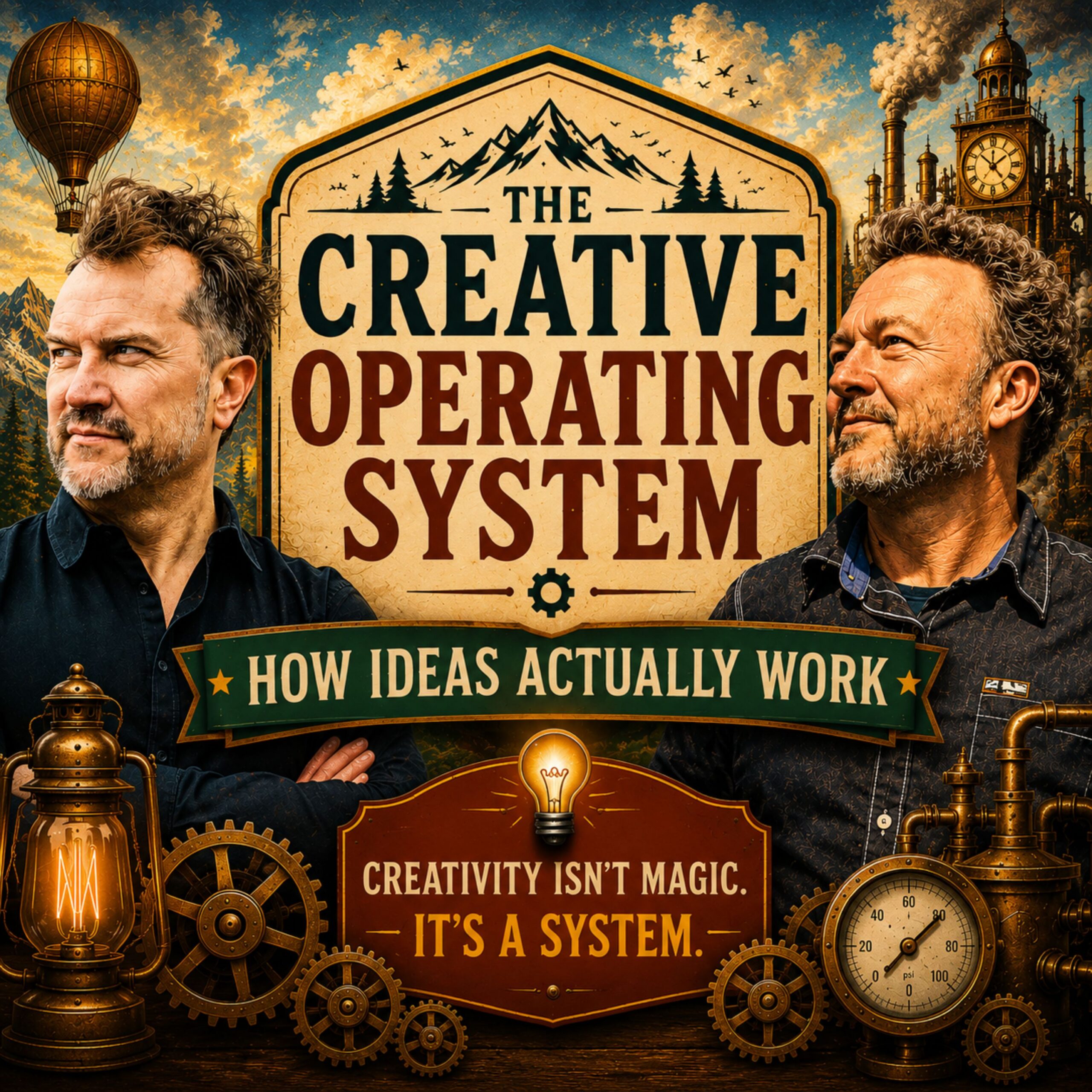
And Creative os, Creative operating system. Yeah, it's exciting, especially for me, who is a self proclaimed creative. And I want to hear more about this because we were talking earlier about how is creativity something?
Are there creative people?
Are some people more creative than others? What's the secret? All those people and there's a lot of them who say, I'm just not a creative person.
[00:00:47] Speaker B: Yeah, we're jumping in.
[00:00:50] Speaker A: Welcome, David.
[00:00:50] Speaker B: Thank you.
[00:00:51] Speaker A: This is it.
[00:00:52] Speaker B: I think the first thing to put out there is that there is no accepted definition of what creativity is because what are you talking about? The thing that results from the process or the conditions that allow it to happen.
And so what I've learned in the last few years is that speaking to people about their creativity is quite often basically a waste of time because.
[00:01:22] Speaker A: Well, that sounds like a sound bite to me.
[00:01:24] Speaker B: You're sitting wherever you work thinking to yourself, well, I'm not creative. I mean my job. I just do the same thing every day. I follow a process, I deliver the goods and that's it. And that is not creative.
Which on a certain level is true, except that most of the time what you're doing in any kind of work is problem solving, which requires you to figure out what the real problem is, come up with a bunch of ideas to solve that problem, figure out what the steps are in order to do that, and then go and do that.
And that's problem solving. And part of problem solving is ideation, thinking up a solution, which is creative thinking.
But what I just outlined is a system of problem solving. It's a series of predictable steps which you can use to get to the good stuff.
And I think what often happens to people is that they are unaware of their system, their process for getting to ideas, which makes it feel like it's not repeatable and therefore it's not worthy.
And the idea behind the creative operating system is to provide people with a framework which allows them to get more easily to their ideas so they can do more with them.
[00:02:40] Speaker A: Wow. You said repeatable. Because as the creative guy who talks to a lot of people who say they're not creative, their idea of creativity is the lightning strikes. And I have this once in a while, fantastic idea that is not repeatable.
And you're saying it can be repeatable. Right.
[00:03:00] Speaker B: So I mean the big myth is that indeed the lovely Greek women reach down from heaven and inspire you. And in fact the Greeks and the Romans saw creativity as external to human beings because of that factor.
But what we have learned from science is that there are conditions which make the reaching down from the heavens more likely to happen than not.
And those are within your control.
So it's true that there are people who get struck by lightning and have fantastic non repeatable ideas.
But it's also true that there are people who get up at 6am every morning and sit down in front of their computer and start typing and write hundreds of novels. One of them is called Stephen King.
[00:03:42] Speaker A: Okay, right. I love the quote. So just on the quote, because I love that quote, I use it a lot.
Do you know the quote? Exactly.
[00:03:51] Speaker B: Bum hits seat, writing starts or something like that.
[00:03:55] Speaker A: Because he's talking to the people who say, how are you so creative? He says, wow, you know, it's a funny thing, it's such a coincidence.
Every morning at 6 o' clock the creativity hits.
[00:04:03] Speaker B: Yeah.
So that is counter to our standard societal image of what creativity is.
That is not exciting, that is not rock and roll. That doesn't require genius or drugs or wild inspiration.
[00:04:19] Speaker A: Yeah, lightning spikes and Greek gods.
[00:04:22] Speaker B: It doesn't look on a neurological level.
We still can't quite map and explain exactly what happens in that aha moment. We're still not entirely sure it's a thinking mode that results from a wide ranging analytical and pattern making mode of thought.
But that's as close as we are right now. But what we do know is that if you have mental rest, if you're in a positive frame of mind, if you're not worrying about everything out there, but you're only busy with what's inside your head, you're more likely to have a good idea than if you're not.
[00:05:04] Speaker A: Okay, so you can alter the environment or optimize the environment to have a more creative setting.
[00:05:11] Speaker B: Exactly. And that's part of the operating system. When you start up a computer, a Windows environment opens or an Apple OS environment opens. Within that environment you run software that is based on the facility, the power of the environment.
Many creatives try to separate themselves from the environment waiting for magic.
So you've done this experiment before.
Where do people get their most, their best ideas?
[00:05:46] Speaker A: For me right here.
[00:05:47] Speaker B: Right. And if you say to most people, so what do you do to guarantee that you get more of those ideas and that you can record Them and hold on to them.
The answer is nothing. Mostly.
So a lot of people say they get great ideas in the shower.
[00:06:04] Speaker A: Yeah.
[00:06:05] Speaker B: So I always say, well, what have you got in the shower to help you record those ideas?
What do you mean?
You're not optimizing something that's happening all the time and therefore you don't think you're creative. Because just lost,
[00:06:20] Speaker A: I think it was exactly a week ago. I.
This is my office and studio here. You're welcome to. Welcome to come by Cappuccino machines a little on the fritz. But I. I was recording one idea because I do this all the time. And I'm audio. I'm walking with Pepper here, recording an audio idea. And I just kept recording. Not for public, not for anything. Just I had an idea and it's exactly.
You know what's really nice about this conversation is that as a creative guy, I do these things. But what you're helping me is see the system.
[00:06:54] Speaker B: Yes.
[00:06:55] Speaker A: In what I'm doing. So I hit record. I'm talking about topic A, which led to topic B, which led to topic C. Where the real magic was. The magic for me was topic C. I didn't know that until I started on topic A, which led to B,
[00:07:10] Speaker B: which led to C.
So that's a very familiar scenario. And that's mainly the big reason why in a lot of company or team environments, people are so suspicious of brainstorming because they stop too soon and so they only get to A and maybe B.
Whereas actually everyone needs to get to A and B at home or at their desk before they go to the brainstorm. And then we can get to D.
Wow. Through a process of iterating. Because it is just a process. One thing leads to another and if you try and isolate it.
[00:07:41] Speaker A: Hey.
[00:07:41] Speaker B: We're going to put the innovation team in a room for an afternoon and come up with great ideas.
[00:07:45] Speaker A: And get to D, please.
[00:07:47] Speaker B: Right. Chances are.
I mean, there is a chance. There's a chance, but they are limited.
Whereas if you say to everybody, this is what we're going to brainstorm about. These are the beginnings. Here's a bunch of reference material. Go home and start brainstorming on your own. Bring only your three best ideas into the brainstorming and we'll go from there. You'll get a pretty different result.
[00:08:09] Speaker A: Yeah. Wow. I have a nice.
It wasn't mine. I borrowed it from Shout out to Edwina. She said, from A to B to C and C is S. E, E. Yeah, I like that one.
[00:08:22] Speaker B: Yeah. So you know like you just said, these are things that we all actually do because it's human nature, right? We are hardwired to be creative.
It's a survival mechanism. You want to be able to think about things that don't already exist. So you can have an artifact or a strategy to help you navigate that situation when it occurs.
[00:08:44] Speaker A: So you can even.
What's the word? On demand. Yeah, see, because that's, that's. I think that's okay. I'm gonna get pushback on this, right? Because you say no, no, no, no, no. Come on. What about the lightning strike and the Greek goddesses?
So I can just, on demand, get this started, start this process.
[00:09:01] Speaker B: One of the things that freaks people who don't think they're creative, what freaks them out about people who are creative is that creatives have an ability to slip pretty supperly between.
Wow, what if we could actually go to the moon and we found gold there? How would we to. Okay, so practically we need to get to the moon and we need to do this and we need to do that.
That kind of modal slippage freaks a lot of people out because it first of all requires you to step into an environment where there are no rules, there are no limits, there are no boundaries. And on your own recognizance, decide what you're going to stick together and then take that out of the uncertain area. Treat it like an actual thing and build a concrete step by step plan for it to make it real.
Now when you are writing a poem or a stand up comedy piece or a piece of music or conceptualizing a game, that is what you are doing.
You're thinking this doesn't exist. So all bets are off.
I'm going to start somewhere and as I go, I'm going to figure out where this is going.
Now most of modern life doesn't work like that. We want it fast and we want it certain.
This is the goal, this is how you'll get there.
[00:10:16] Speaker A: Yeah, yeah. A to B, A to B. Yeah.
[00:10:20] Speaker B: Whereas to step out of that flow, you need a mechanism, especially if you're not used to doing it.
And everybody has a mechanism.
They just don't always realize that's what it is. So the, the OS is about helping people see what they're already doing, understanding its function, understanding what makes it possible. So you can manipulate the circumstances or your routines or your habits, you. In order to get more of that.
[00:10:46] Speaker A: You know, I just had a thought. It was this whole word, creativity and creative for non creatives. I think it really intimidates them or could.
[00:10:57] Speaker B: No, I think it does. I think the societal myths around the idea have become so entrenched, you know, first of all, you have to be a genius.
Second of all, you're probably a weirdo of some order.
Right.
And.
Oh, and it's chaos. Right. There's no predictability. There's no regularity. That must be really difficult life.
And therefore. Oh, your options are limited because now you.
And actually, all of those things are polarized, maximal positions which totally ignore the spectrum of options that are available along that.
So I have friends who laugh at me all the time because I have routines and I'm highly structured.
[00:11:41] Speaker A: Yeah. Yeah.
[00:11:42] Speaker B: I do that because I experience the outside world as chaos. And if I don't do that, I'm never gonna get anything done.
[00:11:48] Speaker A: Okay. You just landed on my world because I'm looking for little points for, like, so what do I do? What do I do? What's David gonna call it? Right. Cause, for example, I have my. I do a YouTube short every single day. I do a video every single Thursday. I have a newsletter every. Every 17th of the month.
That's my non. Chaos.
[00:12:08] Speaker B: Those are your handles that allow you to navigate the bigger picture.
[00:12:12] Speaker A: Yeah.
[00:12:13] Speaker B: So thanks to the onset of rock and roll, a lot of people seem to think that, A, you gotta take drugs. B, you've gotta be completely separated from society.
You know? And it's no coincidence that, just to stay with the music industry as an example, that the second album is a traditional stumbling block for bands.
Cause if you think about it, these people learned how to play guitar or what have you, when they were teenagers, eventually get the album out when they're in their early 20s, say.
So they've had five or six years.
[00:12:40] Speaker A: Yeah.
[00:12:41] Speaker B: To write 10 songs.
[00:12:42] Speaker A: Yeah.
[00:12:43] Speaker B: Then the album comes out, and what do they do? They spend a year and a half on the road playing that album.
[00:12:48] Speaker A: Okay.
[00:12:48] Speaker B: And all they experience is that bubble.
[00:12:51] Speaker A: Yeah.
[00:12:51] Speaker B: The road.
[00:12:52] Speaker A: Yeah. And the first album. The first and only album. Yeah.
[00:12:55] Speaker B: And they only speak to other musicians, their own bandmates, their manager, the bouncer, what have you. So the amount of dots that they have access to is highly limited.
Then the record company says, we need a second album, and they write one in six weeks, and it tanks.
[00:13:10] Speaker A: Wow. I love this. I love this. I've never thought about this.
Wow.
[00:13:14] Speaker B: It's because they weren't experiencing enough diversity to come up with something more interesting than what they had already done.
[00:13:23] Speaker A: Wow.
Okay. To stick with the music. This is super curious.
[00:13:27] Speaker B: Yeah.
[00:13:27] Speaker A: How do they have a better second album?
[00:13:31] Speaker B: Well, I think under a major label model, that has actually always been the challenge because they need to not just be touring for a year and a half, you know, they need to have. Be having. They need to be learning new stuff. They need to. Having different experiences, doing actual songwriting sessions. Yeah, yeah.
[00:13:51] Speaker A: Okay.
[00:13:51] Speaker B: Because an album, and this is true for a play a game, any artifact that you make is an output. It's the result of input. And so once it's out there, it's pretty much done.
[00:14:06] Speaker A: Yeah, yeah.
[00:14:07] Speaker B: And to move on to the next thing, you then need to tank, you know, to fill up your tank to get the fuel in so that the next product isn't just a watered down version of the first one.
[00:14:17] Speaker A: Okay. I'm really loving this because I'm recognizing so much stuff that I sort of naturally do.
But you're helping put it into a framework here, a system that helps me understand. Oh, I do that. And that's. And. But now you're helping me understand why it works as well. Like, for me, I don't just come out and hit record all the time, because that is me. Output.
[00:14:35] Speaker B: Yes.
[00:14:35] Speaker A: I need the input. Yes. And so in the afternoons, for me, morning is output and afternoons is input. Right. And so afternoon is listen to podcasts, listen to audiobook, maybe music.
[00:14:46] Speaker B: There you go.
[00:14:46] Speaker A: Have conversations. Yeah.
[00:14:49] Speaker B: So if you look at your life and you're a creative person, you're a maker, you're a content generator, you're whatever you are. The question is, do I have active time for input, for dots collecting, do I have time for assimilation and processing, and then do I have time for output? Because you need to move through all of those options to end up with anything.
And especially if you. If your motives are to do something different, to do something new, if you're trying to hit a pattern.
[00:15:24] Speaker A: Yeah.
[00:15:25] Speaker B: These things become less important.
[00:15:26] Speaker A: Okay.
Wow.
[00:15:30] Speaker B: But they are still important because you can't literally just do the same thing over and over. Yeah, that's boring. Even for people who, you know, if you like a particular genre of music or of art, if everything looks too much or sounds too much the same, you're going to get bored.
[00:15:45] Speaker A: You know, we were talking about keynote speeches and stuff, and there was this guy, Andrew Davis, who did a great talk in Las Vegas at a conference I went to last year, and I was fascinated. I thought, this guy is so good. He was so on time. He had the humor, he had the slides. Timing was perfect. Everything was fantastic. And I thought, wow, he's amazing. And I looked him up, find him on YouTube. And I find out that he's been doing the same talk hundred times.
[00:16:10] Speaker B: At least.
[00:16:11] Speaker A: At least. And I thought, what?
As this creative genius, I want a new keynote every week.
But I talked to the event organizer. No, no, no, no, no.
[00:16:22] Speaker B: That's not what we want.
[00:16:23] Speaker A: We want the thing that's tried and true. Right?
[00:16:26] Speaker B: So you're making a category error. You're mistaking one thing for another.
[00:16:29] Speaker A: Yeah.
[00:16:30] Speaker B: You're mistaking the keynote for a process, okay?
For an active act.
Whereas it's Creep by Radiohead.
If they don't play it the same, they're gonna get stuff thrown at them.
[00:16:43] Speaker A: Yeah, yeah, yeah, Right? Yeah.
[00:16:45] Speaker B: It's a hit single.
[00:16:46] Speaker A: Yeah.
And it's done. It's a finished product.
[00:16:49] Speaker B: Right. And it's taken an enormous amount of time to get it that on time, that much humor, the right shape and what have you. So you need to run it.
What's going on in the background, I guarantee you, is this guy is meeting loads of people, getting lots of interesting feedback, experiencing a whole bunch of other stuff, and working on the next one.
[00:17:06] Speaker A: Next one. Okay.
[00:17:07] Speaker B: But when you've gotten something like a keynote or a song down to that finely honed state, to have any impact in the world, you've got to deliver it as it is.
Let it do what it is intended to do. Don't mess with it.
[00:17:22] Speaker A: Yeah. This has been my challenge because I. And this is why, again, I'm thankful for this conversation because I think, oh, no, I have to have something new every week.
[00:17:31] Speaker B: No, you do not. Look, as a speaker, you're going to customize something. Maybe your initial intro, because this is a different audience to that. You can't literally say every word the same. But the spine and your signature thing that everyone says, oh, you're the balloon guy. Oh, you're the improv guy. You can't mess with that.
[00:17:50] Speaker A: They want that thing, right?
[00:17:51] Speaker B: I mean, you come out of the advertising world. Brand.
[00:17:53] Speaker A: Yeah, yeah, yeah.
[00:17:55] Speaker B: Can't mess with that.
[00:17:56] Speaker A: No Coca Cola light, Coca Cola Classic. No, no, no. We just want Coca Cola.
[00:18:01] Speaker B: So this gets onto one of the greater myths about creativity, is that everything has to be unique. Everything has to be original. And so we judge ourselves and say, well, I'm no good, because not everything I do is unique. It's not extra special and wonderful. Right?
[00:18:15] Speaker A: Yeah.
[00:18:15] Speaker B: It's like, well, how many works is Picasso famous for?
[00:18:21] Speaker A: A handful, right?
[00:18:22] Speaker B: Five, maybe 10. How many did he make?
[00:18:25] Speaker A: How many did he do? I don't know.
[00:18:26] Speaker B: 3,000 paintings. That's not counting the drawings.
[00:18:30] Speaker A: And the sculptures nobody ever saw or they crumpled up in a trash bin. Yeah.
[00:18:35] Speaker B: That you could probably buy for €10.
And so the. The apex creation gets deified and mythified.
[00:18:45] Speaker A: Yeah.
[00:18:46] Speaker B: And us mortals look at that and go, if I'm not doing that, I'm not creative.
And that is not an. It is an apex creation, which means it went through iteration after iteration after iteration to get to that expression.
[00:19:02] Speaker A: Yeah.
[00:19:03] Speaker B: It should not be seen in isolation, but we do.
[00:19:06] Speaker A: Yeah.
[00:19:06] Speaker B: Because we. That's what we want. Certainty.
[00:19:08] Speaker A: Yeah.
[00:19:09] Speaker B: And we expect speed. We expect ourselves to be able to get there.
[00:19:12] Speaker A: Yeah.
[00:19:13] Speaker B: Like overnight.
[00:19:14] Speaker A: Yeah. The Picasso masterpiece. Overnight.
[00:19:16] Speaker B: Yeah.
[00:19:18] Speaker A: Okay, coming. You mentioned mortals earlier. Coming back to mortals, coming back to Earth here. Because we're talking, if we're really talking Picasso, and if I don't achieve that by tomorrow, the Picasso masterpiece on my first try, by the way, then I am a total failure and I should just listen to podcasts.
So back to the mortal who's in a team, who works at a company who has to be, quote, unquote, creative.
How can they apply some of the stuff we've been talking about to their.
[00:19:46] Speaker B: Right, so real life from the creative os. I'm looking at a couple of interesting applications. The first one is actually for leaders of teams to understand that if you're expecting people to be innovative and to come up with interesting solutions, you can't always be banging on about certainty. You can't always want to have everything tomorrow afternoon.
You also can't shut down incomplete thinking.
You can't say to people, that's a bad idea. I'm like, well, we just thought of it. It's like, okay, no, that's not really it. Let's carry on.
[00:20:18] Speaker A: Yeah, Yeah. A to B to C. Right.
[00:20:20] Speaker B: Because your leader in any environment sets the environment. People respond to their situation. So if your wild creative thinking is rigorously shut down on every occasion, you're going to stop bringing it.
[00:20:34] Speaker A: You know, this makes me think of a totally different situation. But. But everybody knows it, so I'll say it. You're at the.
They barely even have them anymore, but the ATM or the money machine, and you have to think of your pin code for your. For your bank.
You're like, I forgot it. I don't know. And there's people behind me. Yeah.
[00:20:54] Speaker B: What do you do when that happens to you?
[00:20:56] Speaker A: Well, I try harder. I think harder. I've got. Okay, I've got to get it. I've got. No, I've got it. Hey, just a minute. I'm almost there.
[00:21:02] Speaker B: You know, What I.
[00:21:03] Speaker A: And then I don't remember.
[00:21:04] Speaker B: It is just close my eyes, look away, and move my hand and my fingers. Remember where the numbers are.
[00:21:09] Speaker A: Okay. You're more advanced than I am because I'm like, I'm sorry. I take my card away, I take two steps away.
The pressure is gone. And then I remember the number.
[00:21:19] Speaker B: Yeah.
Trying too hard is the. Because trying hard is driving towards certainty.
And when you try and be certain about new ideas, they squirm away into the shadows. It's like trying to smash a jelly with a hammer. It goes everywhere and it's still there.
[00:21:39] Speaker A: Yeah, yeah, that's way too visual.
[00:21:44] Speaker B: So as a leader, you've got to be aware of these parameters because it's your job to help set and patrol them and to hold them. There's a lot of talk about psychological safety.
If you want creativity, you must have psychological safety because you're gonna fail.
And if you are judged harshly and penalized for failing, you're not gonna try anymore. End of creative story.
But as a team, it also really helps if you are all aware of the fact that being creative, coming up with innovative ideas is a process that has steps. And we have a shared language to talk about where we are in the process.
So when John Smith is busy obsessively asking why but what else is going on and this and that, that Karen J. Doesn't throttle him because all she wants to do is go and actually implement the first idea that came out of the session.
[00:22:39] Speaker A: Yeah.
[00:22:39] Speaker B: Because both of those belong in problem solving.
But ideally you shouldn't be trying to do what Karen's doing until John's finished.
So it's clear so that we don't solve the wrong problem, you know, so if you're able to say, wait, we first need to clarify the situation before we can go and do something, then it was, oh, okay, then it's not personal anymore. Then it's not conflict. It's like, no, wait, we're here in the process.
And sure, you're going to go backwards and forwards. Not every situation is going to need every step. It doesn't have to be that rigid. But what it does, it's like your. Your hand holds.
[00:23:15] Speaker A: Yeah.
[00:23:16] Speaker B: It provides reference points for everybody to go. It's not about you. We're not attacking you. We're here in the process. We haven't got there yet, or we finished that already. Now you're going backwards. Let's work through together and then assess and maybe go back or carry on or what have you. So as a team this is really important.
[00:23:34] Speaker A: Yeah, yeah.
[00:23:35] Speaker B: And if you're an entrepreneur and your income depends on your creativity, how do you act and run a business in such a way that you don't lose that. That you're not so busy doing business? Business. Certainty, Certainty. Speed. Speed. Marketing. Marketing.
That all the ideas dry up.
[00:23:54] Speaker A: Yeah.
[00:23:54] Speaker B: The operating system in all three of those scenarios gives you a framework within to operate. And notice I say framework, it's not a directive system.
If A, then B, it's more like these are the variables that you need to be aware of, that you need to have an understanding and control of. So that. And this is the important part, you can set yourself free, not constrain yourself.
[00:24:23] Speaker A: There's some. What is it? Constraint breeds creativity.
[00:24:27] Speaker B: Yeah, it does.
But there are different types of constraint. So fight or flight situations, you need to think super quick in order to make sure that you're not going to die.
Right?
[00:24:40] Speaker A: Yeah, but.
[00:24:40] Speaker B: But because you need to think so fast, the amount of options you consider are entirely limited. So those solutions are often not unique, highly creative. They're practical, immediate and doable.
So if you put too much pressure, the thinking becomes homogenous.
If you don't put any pressure, the thinking becomes infinite and nothing happens.
Everyone has a different sweet spot and you've got to experiment a bit to find out where yours is.
I just read an article about a woman who bought herself the Pomodoro technique, a timer. And now that she has a timer, she gets everything done.
Without a timer she couldn't do anything. It's like.
But it's not so weird actually, because we all have something like that.
[00:25:23] Speaker A: So finding your own parameters or guidelines or guardrails, that works best for you or your team. That's. Yeah.
[00:25:32] Speaker B: Some people just want to come up with wild and crazy potential solutions to problems. Other people really want to understand the nuts and bolts and the nitty gritty detail of a problem. Other people, quite frankly, don't care about the idea or the actual problem. They just want to be doing stuff. Right.
[00:25:49] Speaker A: Okay. Also being able to place those people in the.
[00:25:52] Speaker B: Exactly. So if everybody understands themselves in that way and each other in that way, then we can go, geez, Jane, I tried really hard to solve this problem, but it's not happening. Maybe you can do a bit more analysis and we can all benefit from that.
Then you're playing to your strengths. Then you are creating.
Oh, this is the other thing is because none of this stuff exists in a vacuum.
[00:26:16] Speaker A: Yeah.
[00:26:17] Speaker B: Part of your environment is the psychological energy around you. There's A very good reason why major art movements from the 15th century onwards were centered in a particular physical location.
Because the environment was conducive, the conditions were conducive.
There was a benefactor family throwing lots of money in. As a result, there were lots of other artists. As a result, there was a lot of sharing, there was a lot of camaraderie, there was a lot of action. And as a result, there was a lot of pressure to produce. And all of a sudden, you've got Paris, you've got Vienna, you've got Florence, you've got New York, Andy Warhol, the Factory.
And that is what you're basically trying to do whenever you've got a team, is produce an environment which stimulates people enough to be creative enough and yet work really hard so that there are artifacts that come out as a product in the end.
And if you firmly believe that creativity is some kind of magic that comes from the heavens and is random and you've just got to get lucky, then that is all you're going to get.
[00:27:28] Speaker A: Yeah, baby. You're going to be waiting around for the heavens. Yeah.
The goddess reaching down.
We're talking about teams, we're talking about organizations and corporations and even me, the entrepreneur who loves. I just went to a retreat in Italy and so here's example of the timeline. There was. Thursday was workshops and all in a conference room and getting to know people a little bit. Friday, I had never really experienced this. Friday was tourist day. But not. You're off on your own. No, we're all. There's 26 of us. We're all going together and we're going to go see the Leaning Tower of Pisa. We did super touristy stuff, but we're together as a team. But now we're getting to know each other and we can work through some of that stuff yesterday. Whereas other conferences. Every day is workshop and work.
Input, input, input. Maybe a little bit of discussion between sessions, but this was a full day of assimilation.
[00:28:24] Speaker B: There's no.
[00:28:24] Speaker A: No work today.
[00:28:25] Speaker B: Yeah, we're playing.
[00:28:26] Speaker A: Yeah, it was. It was one of the best things I've experienced. It was fantastic.
[00:28:30] Speaker B: So a lot of my work at the moment is focused on organizations within the creative cultural sector.
[00:28:36] Speaker A: Yeah.
[00:28:36] Speaker B: Because again, what happens here is we got a bunch of people who have proven themselves to be successfully creative or very interested in creativity and culture coming together in order to.
[00:28:46] Speaker A: Yeah.
[00:28:46] Speaker B: Help other people do what they need to do to make sure that culture and creativity moves forward. But quite often those people are very similar to each other, have very Similar strengths and very similar vision and no real idea about how to think about the conditions to help. What are they helping other people with?
I'm sure you remember the whole story of why IBM lost market share to Microsoft way back when, because IBM promoted all their best software engineers into management.
And so they stopped engineering and they began managing, which they were not trained to do and probably didn't want to do and were bad at, whereas Microsoft just paid them more to carry on doing what they were doing.
And what you often see in cultural organizations in particular is successful cultural professionals suddenly having to manage.
And no insult, they don't really know how to do that.
[00:29:39] Speaker A: Wow.
So I'm getting so much from this as a creative person, because I am what you said earlier, you know, chaos and new ideas all the time. Yeah.
And I didn't really think I was going to think this, but I thought, ooh, this is useful, this is practical. Because I thought, ah, I'm doing fine. Right. I'm just creative guy and that's okay.
But is your target, is your ideal audience, is more.
Could it be creative?
[00:30:10] Speaker B: Absolutely.
[00:30:11] Speaker A: Okay. Because I thought, oh, no, no, we're excluded, we don't want us or we need to.
[00:30:16] Speaker B: I'm really, this is a big sort of pivot change that I've been making this year is I'm beginning to realize that I always assumed that other creative people would just be going, I don't need this stuff, like I'm creative, like go away.
[00:30:26] Speaker A: Right, right.
[00:30:27] Speaker B: But I'm talking about sustainable creativity now. I'm about to saying, hey, you know, probably the biggest thing any creative person worries about is if it all dries up.
[00:30:36] Speaker A: Yeah, yeah.
[00:30:37] Speaker B: And what do I need to do to make sure that doesn't happen or maybe it has dried up.
So I'm speaking to designers and drummers, fine artists, business consultants, entrepreneurs, administrators within cultural organizations, helping them to understand their place and their preferences within the broader creative environment.
So I'm also doing one on one coaching with people saying, because you know what often the problem is, is that we get in our own way.
[00:31:09] Speaker A: Oh yeah, yeah, yeah. Oh, for sure.
[00:31:11] Speaker B: So first of all, you've got to see that and then you've got to identify exactly where it's happening, see it and admit it. Right.
Which oddly enough, that's not often the issue.
[00:31:20] Speaker A: Okay.
[00:31:21] Speaker B: It's the, it's the doing something else to stop getting in one's own way, which can be really tricky because it sits deep. It's a habit. It's something we've done for a Long time. And maybe even it's connected to a belief, an identity related belief about the way things are and therefore the way I am.
I've had people have quite antagonistic reactions to me saying, yeah, sure, creativity can be like magic, but in essence, it actually is not.
I'm not allowed to steal that from people.
[00:31:54] Speaker A: I can feel that.
[00:31:56] Speaker B: So what I say now is that, look, it doesn't matter what creativity is or isn't. What I know will help you get more of what you want with a few tweaks.
[00:32:07] Speaker A: Wow.
Okay. And for the. For those who. So I think we agree on this, but I think everybody is creative. It's just how much do you believe you can be or how much you are or how much you're going to sort of even allow or surrender to the. Yeah, well. And in fact, what if you had a system that could help you be more creative? Yeah.
[00:32:26] Speaker B: I mean, that's what the morning pages are, right?
[00:32:28] Speaker A: Yeah.
[00:32:28] Speaker B: All the way back to the artist's way.
[00:32:30] Speaker A: Yeah.
[00:32:30] Speaker B: The morning pages are literally just a handhold.
[00:32:35] Speaker A: Yeah, yeah.
[00:32:36] Speaker B: Because from those morning pages, so much realization occurs which you then. But then it gets tricky. It's like, how do I then turn that realization into a thing?
[00:32:43] Speaker A: Yeah, yeah.
[00:32:46] Speaker B: So that's it.
Whatever you do shapes your environment, which in turn shapes what you do next.
So if you are unhappy with your outputs, quite often you shouldn't be worrying about the outputs. You should be worrying about your environment first.
Because your environment, if you change the environment, which is easier to do than you think, like literally just going to a different cafe.
[00:33:14] Speaker A: Yeah.
[00:33:14] Speaker B: Then how you act will change. And by changing how you act, your outputs will change.
[00:33:21] Speaker A: Wow.
[00:33:22] Speaker B: Yeah.
[00:33:22] Speaker A: That's a fresh perspective on that. I like that.
Okay.
Can I put you on the spot?
[00:33:30] Speaker B: Sure.
[00:33:31] Speaker A: So I think I told you that I've been fascinated with Donald Miller and Storybrand maybe. Okay.
And he took Hero's journey and made it shorter, kind of. And I find it more manageable and I like it. And if we could, maybe we can work through this real quick. So here I'm just gonna go through the seven steps and then we can try to do them for one of your audiences. So there's a. There's a hero who has a problem, who meets a guide who has a plan with a call to action to avoid failure, achieve success.
So if we were to try to.
And by the way, pro tip. Pro tip, all you leaders and presenters and writers and creators out there, you're not the hero.
David is not the hero of the story. David Hint. Pro tip. David's the guide.
So if your hero. Let's take the non. I was gonna say non creative person, but how do you address them? Because they're not non creative.
[00:34:32] Speaker B: They are people who are the person.
[00:34:34] Speaker A: The person.
So what's their problem?
[00:34:37] Speaker B: Yeah, what's in their way?
[00:34:39] Speaker A: What's in their way? What's. What's. So if we just walk through this now. So the, the hero is the employee. Could be the.
[00:34:45] Speaker B: The team member.
[00:34:46] Speaker A: Team member. Okay, team member. And what's his or her problem?
[00:34:50] Speaker B: Yeah, a lot of the time it's. It's because of the way things work. Not getting any fulfillment out of their work, which leads to a whole host of other problems.
[00:35:01] Speaker A: Okay. Oh, oh.
Lack of fulfillment from their work. Okay. Along comes a guide. Yeah.
Spoiler alert. That's David, who has a plan and I'm going to jump in. And that is creative os.
[00:35:16] Speaker B: Yeah.
[00:35:18] Speaker A: Call to action. So sort of one action they could take easily, quickly, anything you think, what
[00:35:24] Speaker B: can you do tomorrow that'll change things?
[00:35:25] Speaker A: Okay, what could you do tomorrow? Like one action. And then what is. What does failure look like? So if they don't do this.
[00:35:32] Speaker B: I don't like that step.
[00:35:34] Speaker A: All right. Well, sometimes it's not in there. They just say this step. But I know this is a little. It's a little salesy. It's a little bit the. Well, if you don't buy my product, this is what's going to happen to you.
[00:35:45] Speaker B: You see, I think if you never fail, what do you learn?
[00:35:49] Speaker A: Oh, yeah.
[00:35:51] Speaker B: So for me, it's not about avoiding failure, it's about persisting through failure because you're gonna fail.
[00:35:56] Speaker A: Okay.
[00:35:57] Speaker B: And every iteration is gonna teach you more. I mean, that's how you get to the apex. Picasso is by having done stuff that didn't work.
[00:36:03] Speaker A: Okay, then I'm gonna twist your words here and I'm gonna say.
I'm gonna say not avoiding failure, but taking your failure and learning from it. Yeah. How about that? Yeah. And then what does success look like?
[00:36:16] Speaker B: Right? And I think that's the question that a lot of people just don't know what the answer is.
[00:36:22] Speaker A: Okay.
Do you have an answer or a success?
[00:36:25] Speaker B: It's absolutely different for everyone. For me, quite often the best answer to that is a purpose related answer. Because if it's too specific, then you achieve it. And then what?
[00:36:37] Speaker A: Okay, okay. Well, with what we're talking about today, the system and the operating system, in this repeatable process framework, success looks like
[00:36:44] Speaker B: being able to carry on doing the work and to make it better and better as I go.
[00:36:50] Speaker A: That sounds good. Especially if you're somebody who's stuck.
[00:36:52] Speaker B: Yeah.
Or even somebody who's just not achieving their true potential.
[00:36:58] Speaker A: Okay.
[00:36:59] Speaker B: Like a ninja.
[00:37:00] Speaker A: Yeah, yeah.
You know, so there's another version where they say something like without. They'll say, like, lose weight without drugs. Right?
[00:37:10] Speaker B: Yeah.
[00:37:10] Speaker A: So here you could say in this scenario, without waiting for the hand of the goddess to come down from the heavens to.
[00:37:19] Speaker B: And for some people, without losing your identity, without becoming someone else.
These are all quite powerful drivers.
[00:37:28] Speaker A: I like that.
Without losing your identity.
That's cool. Because you're right. Because they might think, well, but I. I don't want to change who I am.
[00:37:36] Speaker B: I am. Okay. I mean, you don't want to become more structured because you're worried about losing who you are as a result of not being structured.
[00:37:42] Speaker A: Yeah. Right.
[00:37:43] Speaker B: So if I come in to say to you, bradley, you've got to wake up same time every day, and you got to do this from here, you're just going to say no.
[00:37:48] Speaker A: Right.
[00:37:49] Speaker B: But if I say to you, well, if you have a couple of handholds and a couple of tools or structures which will allow you to increase the amount of feedback you get from everything that you do do to better inform what you next do, you're going to. You're going to.
You're going to hockey stick your improvement graph, for example, and get closer to realizing your goals faster.
[00:38:15] Speaker A: Yeah, yeah.
[00:38:16] Speaker B: Then you might go, huh?
[00:38:18] Speaker A: All right.
[00:38:19] Speaker B: Might just try one or two of these things.
Right, Right. But I'm like, no, you're too chaotic. You need more structure. You're just going to go like, right.
[00:38:29] Speaker A: The best thing a coach ever told me was, bradley, you don't have to stop creating new stuff every day. That's okay. Yeah. Really? I can keep creating every day.
But then she said, don't write a book about every single topic every day. Yeah.
[00:38:42] Speaker B: So what I've. The biggest mindset that I. For my personal creativity, what I've said is, everything is an iteration.
[00:38:49] Speaker A: Okay.
[00:38:50] Speaker B: I'm no longer saying this is a thing. I'm saying this is the current version.
Because I've tended to get a little bit stuck on the. We need to have a thing.
You know? So even when I'm putting stuff out into the world now I'm saying, like, so I'm also developing a keynote. And I've actually been stuck for months because I was so worried about it not being good enough.
[00:39:11] Speaker A: Right.
[00:39:11] Speaker B: Which means that I never actually finished it.
[00:39:14] Speaker A: Yeah.
[00:39:14] Speaker B: But the whole point of Finishing a version is to take it out into the world to test it, to get the feedback, to improve it so that I can get to be this guy who gets hired to do exactly the same one for 10 years.
[00:39:24] Speaker A: Right, right, right.
[00:39:27] Speaker B: That's what success looks like. I'm worried about it being perfect now.
[00:39:33] Speaker A: Oh. Oh, that was good.
Yeah.
Okay. I like that. I'm worried about it being perfect now. That was a good one.
It doesn't get much more perfect in the Netherlands with this, by the way. We're sitting outside.
It's sunny. I'm sweating.
[00:39:51] Speaker B: Yeah.
[00:39:51] Speaker A: Don't say that very often in this country.
[00:39:53] Speaker B: It's like 10 in the morning.
[00:39:54] Speaker A: I know. And it's a. It's a gorgeous day. We've had a great conversation. I feel I. I really am surprised. I thought when we were. I know we're going to talk about. And I thought it was more for, like we said, the people who think they don't think they're creative, and I do think I'm creative. So I said, why do I need this?
[00:40:10] Speaker B: Yeah.
[00:40:10] Speaker A: But I'm really seeing the benefit also for creative people in what you're doing in this creative os. I like it a lot.
[00:40:16] Speaker B: And at the moment, that's the group of people I'm the most interested in.
[00:40:19] Speaker A: Okay. Wow.
[00:40:21] Speaker B: It's my tribe. It's where I come from.
[00:40:22] Speaker A: Yeah. Yeah.
Wow.
Thanks for being here, David.
[00:40:26] Speaker B: Thank you. It's been great.
[00:40:27] Speaker A: Yeah. Great. All right. Till next time. Not to last. See ya. Thanks for watching. Do all that subscribe stuff now. We're gonna see if it actually recorded.