Episode Transcript
[00:00:01] Speaker A: So what if you waited 33 years to finally do the thing you actually wanted to do?
That's Kimberly. Stable job, safe path, sensible life, and a quiet voice in the background saying, there's something more.
But like most of us, she didn't jump right away until something happened.
And that made someday feel a whole lot more real and a whole lot more risky.
In this conversation with Kimberly, you'll hear what finally pushed her to take the leap, the simple systems she used to stay on track, and why waiting might be the most dangerous plan of all.
Because the real question isn't if you'll change, it's when.
Enjoy my conversation with Kimberly Deady. Thanks for listening.
[00:00:59] Speaker B: So I worked in corporate America and banking for about 33 years and had reached the point, probably 10 years before I stopped of wanting something different.
And what started out just as a potential hobby to write.
I loved to read, but I wasn't finding the fiction books that focused on women like me, midlife, wanting something different out of life. All the protagonists were much younger, facing things I'd already lived through. So that was my inspiration to start writing, even though I was an accountant my whole career.
[00:01:43] Speaker C: We're in Las Vegas. Hi, I'm Bradley Schravino. I'm here with Kimberly.
[00:01:47] Speaker A: Deidi.
[00:01:48] Speaker C: And we are talking about my favorite question, now what?
And Kimberly is now what happened a few years ago?
[00:01:57] Speaker B: A few years ago now. About four.
[00:01:59] Speaker C: About four years ago. And you want to give a little story of sort of the now what, how that happened? What were the big. What was the change that happened? What is. What was it before and what is like now and then? We can also talk a little bit later about where that's going.
[00:02:15] Speaker B: Four years ago.
[00:02:18] Speaker C: Tell us what you do.
[00:02:19] Speaker B: So I worked in corporate America in banking for about 33 years and had reached the point probably 10 years before I stopped of wanting something different.
And what started out just as a potential hobby to write.
I loved to read, but I wasn't finding the fiction books that focused on women like me, midlife, wanting something different out of life. All the protagonists were much younger, facing things I'd already lived through. So that was my inspiration to start writing, even though I was an accountant my whole career.
So I was using the other side of my brain and loved the creativity that came with that.
But I found out all I could about writing. I studied it. I put about one to two books out a year for a number of years.
[00:03:20] Speaker C: You did while you were still working?
[00:03:23] Speaker B: While I was still working. And the first book I, you know, like, so Many of us. It sat in my drawer for a couple years, didn't know what to do with it.
My mother was very supportive of my idea of trying this.
[00:03:38] Speaker C: Okay, I'm just gonna jump in because. Was she very supportive and you should keep your day job? Was she like that, Very practical?
[00:03:48] Speaker B: Yes. Yes, she was practical, but she knew I needed something different, and she wanted that for me.
So it was 2017, and we found out she had a terminal illness. I didn't have my first book out yet, but it was written, edited, that kind of thing.
So that was really my push to get it out the door to actually publish it. I had no interest in trying traditional publishing route because I had this time frame, and I wanted her to hold her book, my book, in her hand.
And she did. I put my first book out, Whispering Pines, in September of 2017, and she passed in December.
And I. You know, when I first wrote that first book, I didn't know it would turn into a passion and a business.
But it did in the coming years. And I really wanted to. Even though mom was gone, I wanted to make her proud and keep going with it because. Because it was so enjoyable and such a change of pace from my day job.
But then I also am very practical and decided that I would stick it out at my day job until I turned 55.
[00:05:11] Speaker C: Okay.
But, you know, so yesterday I was mentioning the word someday, and as we learned this morning from Andrew Davis, he talks about specific deadlines for time limit and a creativity limit. And so you said 55. That's it. And also you had the deadline of your mother getting this diagnosis.
[00:05:34] Speaker B: Mom's diagnosis was my first timeline that I absolutely had to stick to, and that was in 2017. And then a few years later, I was probably 21, 22.
It was my 54th birthday, and I said, I have one year that I need to keep working. But I didn't want it to be a wasted year.
So I just kind of did some things to keep myself motivated every single week in that last year, not only to keep chasing my dream, but to make the most of that year.
So I try to always find something every single week. So I was very intentional about it.
That would either help me grow as an author or grow as a person or have a whole lot of fun that week. I wasn't real prescriptive as to what it had to be, but it had to be something, and it had to be something worth noting. And it really helped me to feel like I wasn't just sitting around wasting that year until I could get to this kind of arbitrary number of 55.
[00:06:40] Speaker C: So you made a conscious, conscious decision to take conscious action with a deadline.
I'm saying these words, I'm saying them consciously because I find it so important. Because otherwise you get to this whole someday idea of, oh, yeah, you know, maybe 55 or, you know, 56, and what's the difference?
[00:07:01] Speaker B: Exactly.
[00:07:02] Speaker C: And you'll just keep going. And then I. I hate to.
Not that I hate to say this, but is so true, is that we often wait for these bad. We do sometimes terrible occurrences in our life, and they're usually negative. And then, and only then, not only then, but the majority of time, that's when we take action finally.
[00:07:27] Speaker B: And I think we've all heard the comments of people on their deathbed where their biggest regrets are the chances they didn't take. And after seeing what my mom went through and another close friend, I just decided, I'm not going to be that person. I'm going to do this now, even if it doesn't make the most sense logically to walk away from a good paying, full benefits job to be an author.
[00:07:57] Speaker C: That's a biggie.
[00:07:59] Speaker B: But I did know because I chickened out before I thought I was gonna make the leap.
[00:08:04] Speaker C: Oh, at a different age or when I was younger.
[00:08:07] Speaker B: Yeah. And not necessarily. Yeah, you know, even before I started writing. But I'd chicken out.
And so I knew with this 55 finish line that I'd set for myself coming up, that I did one other thing. And I asked my best friend to hold me accountable, not let me chicken out at the last minute to give notice.
And.
[00:08:32] Speaker C: And you told the friend about 55.
[00:08:34] Speaker B: Oh, yeah, yeah, yeah. And I said, you can't let me chicken out. Because I knew she would hold me to it. And she did. And I even set up this kind of silly little thing for the last 30 days before I turned in my keys where I would feature, quote, that I found very inspirational and meaningful to my personal journey. And I posted on Instagram and, you know, to kind of share this with other people too, because that's a lot of what I write about in fiction. And I wanted to kind of walk my talk and show that, yep, we're never too old. It's never too late.
You know, I was an accountant for 33 years and now I write stories.
So I used to tell stories with numbers and now I use words and it's much more fun.
[00:09:24] Speaker C: Wow.
How did the.
You said you tried earlier.
I sort of tried earlier. And how did the 55 was that just a nice round number or did you have something specific in line with
[00:09:35] Speaker B: the 55 at the company I worked with because of my years of service, once I turned 55, I could technically retire.
[00:09:44] Speaker A: Okay.
[00:09:44] Speaker B: Even though it didn't really get me anything. But I wanted that personal milestone to be able to say I retired, not just quit, you know?
[00:09:53] Speaker C: Yeah. Oh, I see. I see.
You mentioned your confetti.
[00:10:00] Speaker B: Yes.
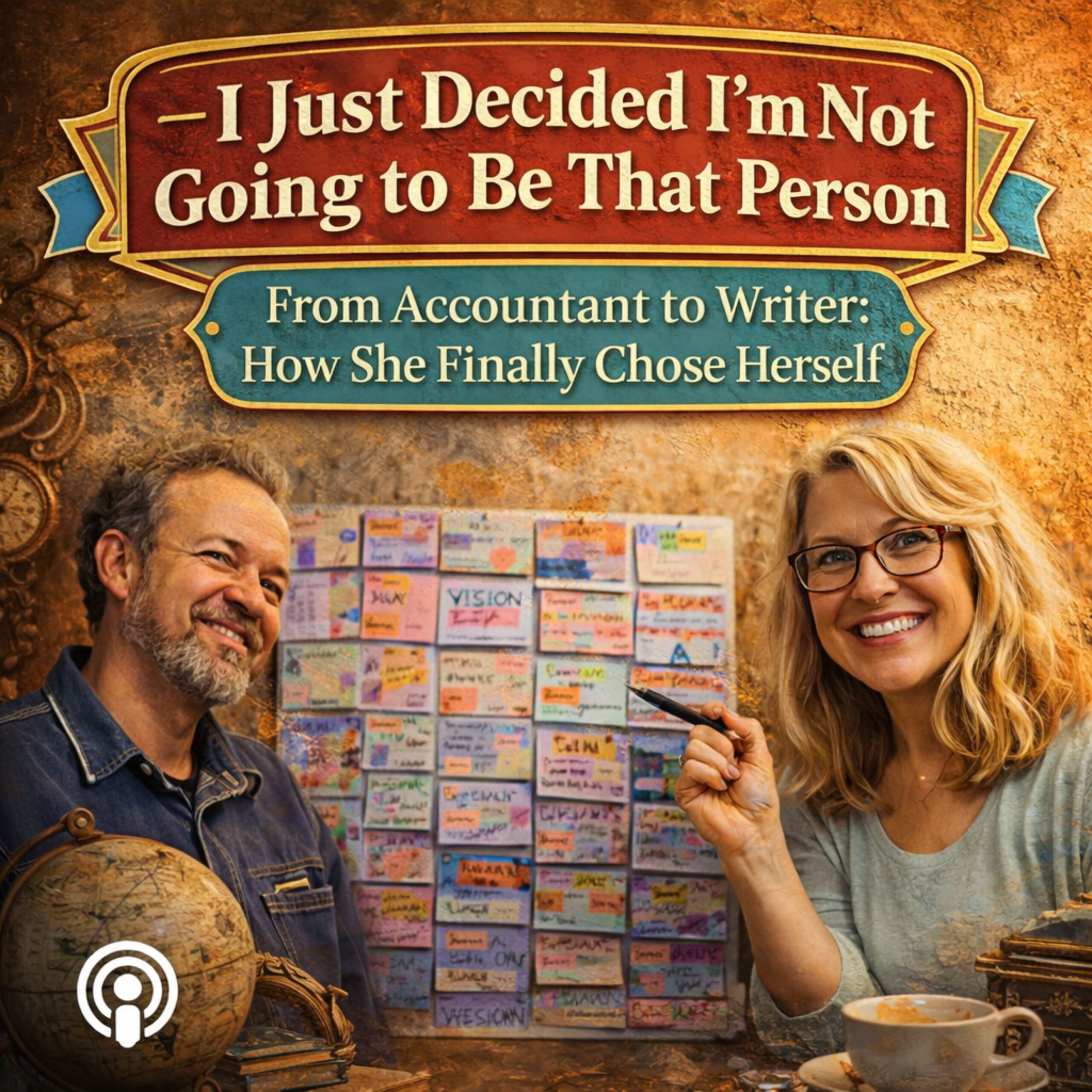
So it's my confetti boards.
[00:10:03] Speaker C: Confetti boards.
[00:10:04] Speaker B: That's what I did for that last year.
[00:10:06] Speaker C: Okay.
[00:10:07] Speaker B: I just set up a simple poster board and. And put 52 little wooden clips on there.
And for every single week, I would fill out a little 3 by 3 square.
I'd use my old scrapbooking stickers and stuff that I wasn't using anymore and just decorate a square and put it up there. And they were all bright colors, so I could see throughout the year that I was making real, tangible progress against this kind of arbitrary goal that I had set.
[00:10:41] Speaker C: Wow. You know, it's fun.
Of course, you wouldn't know this about me, but I started university as a mathematics major.
[00:10:49] Speaker B: Okay.
[00:10:49] Speaker C: So I have that also the analytical side and side.
[00:10:53] Speaker A: So I really.
[00:10:53] Speaker C: I really appreciate your. That idea. The 52 weeks, super visual up on the wall with the colorful squares. And you can see your point.
That's. That's such a biggie.
[00:11:05] Speaker B: It is. Otherwise, you just.
Too often we just think of it as just a wasted year. I have to wait another year.
This way I could see it. And all of a sudden I only had, you know, eight squares left or something, and it's like, oh, my gosh, I'm really gonna do this this time.
[00:11:20] Speaker C: And you didn't chicken out, obviously.
[00:11:22] Speaker B: I did not chicken out.
[00:11:23] Speaker C: Do you think that that board helped with the.
[00:11:25] Speaker B: I do, Yeah. I do.
[00:11:27] Speaker C: And.
[00:11:28] Speaker B: And like I say, some of it was tangible. You know, I here, I published my book.
I went to my first author conference in person.
I had a lot of really good, powerful things on that board, and that just helped fuel my journey.
[00:11:44] Speaker C: Wow.
You know, I'm not.
What's the word? Tangible enough.
Sometimes I'm too digital.
Techie guy. I like my digital stuff. I can see that power. You know, they often, often say, like, write in a journal with pen and paper.
[00:12:01] Speaker B: Right.
[00:12:01] Speaker C: And that's really different. And I totally believe it. I just don't always do it.
[00:12:05] Speaker A: I think.
[00:12:06] Speaker C: Well, recently I do more audio, which is a whole different medium, which I also like, but that I can just. I can see it. I can see your visual board. On the wall and the colors.
[00:12:16] Speaker B: Exactly. And even at this author conference now, I take notes in every session. Not because I'll necessarily look.
I won't even look back at some of them, but it's just a tangible way for my brain to process and internalize it, and that's just kind of my thing. So having that tangible board on the wall and seeing the progress and even just filling out those squares every week.
We heard from Becca Syme about little joys, you know, experiencing that throughout these journeys that we're on that are sometimes hard to measure. What does success mean?
Filling out each little square every week. Oh, my gosh. You know, this is forward motion. So it did help.
[00:13:03] Speaker C: You know something else we heard earlier from Drew Davis. He was talking about to give yourself, like, there's carrot in the stick. I can't remember what they called it, but he said something like, if you don't do the thing, you have to,
[00:13:16] Speaker B: like incentives or disincentives.
[00:13:18] Speaker C: Yeah. And did you have a thing? I was curious with the accountability friend who. If, hey, if I don't do it, then this happens.
[00:13:29] Speaker B: Nothing specific, because it wasn't. We didn't make that an option.
[00:13:34] Speaker C: Okay.
[00:13:35] Speaker B: Follow through.
[00:13:36] Speaker C: This is not an option.
[00:13:37] Speaker B: Yep. I'm just gonna. I have to do it this time.
[00:13:40] Speaker C: But it seems that you were just hearing your story now. It seems like you were pretty clear this is gonna happen.
[00:13:47] Speaker B: I was, but it took me years to get to that point once I got. You know, even in 2017, when I put my first book out, mostly so that my mom could hold it in her hands and give signed copies to her friends and such.
I still wasn't to the point where I think thought, I want to make this the next season in my life, the next season in my career, book writing. You know, it took a few more years of participating in conferences and writing more books and listening to more podcasts and learning from more people for me to really understand that that's what I wanted to do. So I guess I just like to assure people who get frustrated with themselves because, you know, Maybe they're early 40s or 50s and they feel like it's it. Yeah, it's never too late to figure out what might fill you up next.
[00:14:39] Speaker C: I hate to think of the idea that we are morbid thought, but just that we're waiting for something so terrible to happen.
And then I will do the thing that I really want to do.
[00:14:53] Speaker B: But what if that terrible thing happens to you and it's too late and now you never get to do it.
So, yeah, we can't wait. Even though that's our.
[00:15:01] Speaker C: You're right.
[00:15:02] Speaker B: Human nature to stay with what's safe,
[00:15:04] Speaker C: you know, that's what really got me with my dad. When my dad passed.
It sounds so naive, but I had the feeling that, wait a minute, I'm gonna die too one day. I was like, what?
[00:15:19] Speaker B: Nothing brings home the idea of our own mortality than to lose our parents. Yeah.
[00:15:26] Speaker A: Yeah.
[00:15:27] Speaker C: So I think we can. For talking to. Because I often talk. Try to talk to our earlier selves.
Think of, like, the audience sort of ourselves earlier.
Because my dad passed away in 2015.
And then in 2016, I had moved to Europe, closed my company and decided, I'm going to be a writer. Right? Boom, boom, boom. Just like that. Whereas any of those.
They were massive. Any of the three. And I did all three in one year. And it was very easy because my dad died and I scared me to. Well, scared me to death.
Scared me to pieces so intensely that I made that decision. I'm doing it. So I wonder how we can sort of inspire people, motivate people to not wait for somebody else to whatever, die or diagnosis or some terrible thing or who knows? It doesn't have to be medical or gas. It could be, I don't know, lose your job or.
[00:16:21] Speaker B: I think one thing to always try to be curious and just explore things, because you never know if that's gonna turn into something that you care enough about to change your life without it exploding or imploding or, you know, some terrible thing happens.
[00:16:40] Speaker C: Okay. But you said curious because. Curious. Curious. I love the word curiosity. It's super strong.
I see curiosity as more passive, where you took some serious action, you took some active action. You wrote books earlier, even if you put it in the drawer that you wrote them, and then eventually in that you want it in your mom's hands. And that seemed to be the really clear decision point or the right.
[00:17:04] Speaker B: I would like to think I would have eventually gotten it out, but I didn't.
You know that game. Maybe not. It could have been something, right?
[00:17:11] Speaker C: Such a passive phrase. I think I. I like to think I eventually would have gotten it out.
[00:17:17] Speaker B: But we all do, right?
[00:17:18] Speaker C: Analyze you that way.
[00:17:19] Speaker B: That's what we all think. Oh, someday I'll do it someday.
[00:17:22] Speaker C: Right?
[00:17:23] Speaker B: But yeah, sadly, sometimes it takes those.
[00:17:26] Speaker C: Yeah, yeah.
[00:17:27] Speaker B: Big life events. Positive or negative?
[00:17:29] Speaker C: Yes.
[00:17:30] Speaker B: Seems like most times they're negative.
[00:17:31] Speaker C: Yeah. I like to think of myself as. I'm a proactive guy and I can do it all and I'll get it Rolling. And I'll just willpower my way through it. But then look at me. I often whine about how I, you and I are writers. We hear at a writers conference and everything's about writing and how I did not.
I spent, I spent eight years not really writing and just whining about it and dreaming about the day I'm gonna be a writer someday.
My dad dies in the boom.
[00:18:07] Speaker B: I think part of the reason I actually acted in, you know, I've gotten 13, 14 books out now.
[00:18:16] Speaker C: You too?
[00:18:17] Speaker B: I do, but I think it's because I'm 59 years old. Right. And I don't know that I necessarily want to be working hard at 80, so I want to get those books out.
[00:18:28] Speaker C: Awesome.
So since you turned 55, have you just been. Have you been writing a lot? Are you.
[00:18:35] Speaker B: Yes. Not as much as I thought I would. You know, we always think when we have a full time job and then we're going full on in your passion that you'll be able to spend all your time doing that. But you know, there's life still and all that that comes into play.
[00:18:50] Speaker C: But yeah, no, I like to say I actually there's a guy here, Roland Denzel and I did a podcast with him a long time ago and the topic of the podcast was how we don't want to be full time authors.
And that's still my goal today. I don't want to be a full time author. And here it's almost blasphemy at this conference that I don't want to be a full time author. What?
But there's so much pressure of. The pressure of I want to be a full time author, make the full time income that's going to pay my bills and I got to make it happen.
Whereas I enjoy, speaking of joy, enjoy the beauty of writing and not having to worry about it, paying the bills well.
[00:19:32] Speaker B: And I say I write full time, which I do. I don't earn anywhere near what I did in my 33 year banking career, but I did a lot of planning and saving and investing so that I can afford to do this now. So, you know, full transparency.
I don't make what I used to, but I'm a heck of a lot happier. That is worth so much and I feel like I'm leaving a legacy. I'm showing, you know, we have three kids, two grandkids now, and I'm showing them that you really can find work, you love and enjoy it. And you know, my kids say all the time I'm a different person than I was when I worked my corporate job. I'm just so much happier.
[00:20:16] Speaker C: You just summed up, I think, the most beautiful, most powerful points.
You know, we're talking about money. How you made money earlier, and that allows you. That provides you the ability to now follow your dreams. Cliche phrase, but.
[00:20:31] Speaker B: But true. In this case.
[00:20:32] Speaker C: But true. And now. And you're happier and you're a different person, and you're doing what you want to do, and you're not dead, and I'm not dead. Not dead.
That's a good thing.
[00:20:42] Speaker B: Yeah.
So sometimes our midlife and as the years tick by, that's incentive in and of itself to get going, you know?
Can't wait any longer.
[00:20:54] Speaker C: No. Okay. That's. In fact, that's a nice title. I'm always looking for titles and can't wait any longer. I like that. I think that's a wonderful spot to wrap it up.
[00:21:04] Speaker B: Sounds good.
[00:21:04] Speaker C: Kimberly, this has been.
[00:21:06] Speaker B: Let's go learn more from some.
[00:21:07] Speaker C: Let's go learn more. I know. Yes. All right. Thanks for being on.
[00:21:11] Speaker B: Thank you for having me. This has been a lot of fun.
[00:21:13] Speaker C: All right. Bye for now.
[00:21:14] Speaker B: Bye.