Episode Transcript
[00:00:00] Speaker A: I want you to picture a really specific setting for a second. It's 5:30 in the morning.
[00:00:06] Speaker B: Okay, that is early.
[00:00:07] Speaker A: Yeah, very early. And it is pitch black outside. And I don't mean just, you know, street lights filtering through the blinds or whatever. I mean total absolute darkness inside the room too.
[00:00:16] Speaker B: Right, so no ambient light at all.
[00:00:18] Speaker A: Exactly. You are just sitting there. There's no phone, no computer screen glowing,
[00:00:23] Speaker B: no coffee machine whirring in the background.
[00:00:25] Speaker A: Nothing. Just you and a microphone recording in the dark to shut down every single ounce of sensory input.
[00:00:31] Speaker B: That sounds almost intense. Like, is this some kind of sensory deprivation experiment or, I don't know, the beginning of a hostage situation?
[00:00:41] Speaker A: No, neither actually. It's the daily creative process of a guy we're focusing on today, Bradley Charbonneau. He literally records his thoughts in the dark.
[00:00:49] Speaker B: Oh, wow.
[00:00:50] Speaker A: Yeah, and he claims he does it to access this very specific state of mind. Something he says you just, you can't really get to when the lights are on and the rest of the world is awake.
[00:00:58] Speaker B: You know, it's really interesting. You start there because that environment, that darkness, that super early hour, it's actually the perfect entry point for the tool we're diving into today, which is the
[00:01:08] Speaker A: mission of our deep dive today.
[00:01:10] Speaker B: Right. It's called the Repossible Treasure Map.
[00:01:13] Speaker A: Repossible, that is quite a mouthful.
[00:01:15] Speaker B: It is a bit of a mouthful, yeah. It's a made up word essentially, meaning, you know, making the impossible possible again.
[00:01:21] Speaker A: I like that.
[00:01:21] Speaker B: Yeah. But the map itself, it's not an app. It's not some digital journal you just swipe through. It's an entire philosophy on how to navigate your future self, but doing it without burning out.
And it all starts with this concept Bradley calls kairos.
[00:01:36] Speaker A: Okay, Kairos. I've actually heard this term thrown around a bit in productivity circles. Usually it's just a fancy word for good timing, isn't it?
[00:01:43] Speaker B: Well, sort of, but Bradley uses it to distinguish between two completely different ways of experiencing time.
Because, you know, most of us live our whole lives in Kronos, which is
[00:01:54] Speaker A: basically clock time, right?
[00:01:55] Speaker B: Yeah, exactly, yeah. It's chronological, it's linear. The meeting is at 2pm the deadline is Friday. TikTok. TikTok, it's a finite resource that just continuously runs out.
[00:02:06] Speaker A: Right.
[00:02:06] Speaker B: But kairos is different. In ancient Greek it meant the critical or opportune moment. But in the context of this treasure map we're talking about today, it's really about energy management, not time management.
[00:02:18] Speaker A: So we're talking about the flow state
[00:02:19] Speaker B: Then it's the flow state, but it's also about the leverage of that state. It's the idea that one single hour of work done in Kairos, like at 5:30am in the pitch black, when your brain is purely, completely creative, that one hour is worth three or four hours of sluggish work done at say, 2pm After a heavy lunch.
[00:02:38] Speaker A: Oh, I totally feel that 2pm slump. So the argument here is that we're basically trying to cram our creative ambitions into chrono slots and that's exactly why we end up failing.
[00:02:47] Speaker B: Precisely. We try to schedule a breakthrough, but you can't schedule Cairos. You, you have to create the conditions for it to happen.
[00:02:53] Speaker A: And that's what this treasure map is actually designed to do.
[00:02:56] Speaker B: Right. It's a visual dashboard to help you find those little pockets of magic in your life.
[00:03:01] Speaker A: Okay, so before we unroll this map, and I definitely want to get into the specific widgets on this thing because they are pretty wild, we should probably establish who Bradley is. I mean, is he just a guy who likes hanging out in the dark or does he have some actual backing for this?
[00:03:16] Speaker B: He's actually a bit of a paradox, which is exactly why I like him.
On the surface, he presents as this sort of free spirited artist. I mean, he's written over 40 books. Wow. Yeah, and he's published something like 5,000 videos.
[00:03:29] Speaker A: 5,000?
[00:03:30] Speaker B: Yeah. His output is massive.
[00:03:32] Speaker A: That is an unbelievable amount of content.
[00:03:34] Speaker B: It really is. But what he rarely mentions, mostly because he thinks it ruins his street cred as a creative, is that he actually has an mba.
[00:03:43] Speaker A: Ah, the secret suit.
[00:03:45] Speaker B: Exactly, the secret suit. So you have this constant tension in his work. He's got the soul of a freewheeling artist, but he's got the brain of a structural engineer. He actually calls himself a math magician.
[00:03:55] Speaker A: A math magician. I'm going to assume that's not someone who does card tricks with a graphing calculator.
[00:04:00] Speaker B: No, definitely not. It's a formula he lives by, actually.
[00:04:02] Speaker A: Yeah.
[00:04:03] Speaker B: Math plus magic equals momentum.
[00:04:06] Speaker A: Okay, let's break that down a bit for everyone listening.
[00:04:08] Speaker B: Sure. So the math is the structure, it's the habits, the systems, the science of getting things done.
And the magic is the spirit, the unknown, the kairos we talked about.
His whole theory is that if you only have magic, you're just a dreamer with zero output. You have all these great ideas but nothing gets finished. But if you only have math, you're
[00:04:30] Speaker A: just a robot with no soul, you're just grinding away.
[00:04:33] Speaker B: Exactly. You need the structure, the Math to actually hold and direct the magic that makes perfect sense.
[00:04:39] Speaker A: I think a lot of people feel that exact tension. They either grind themselves into dust with that whole hustle culture structure, or they just sit around on the couch waiting for inspiration that honestly never comes.
[00:04:50] Speaker B: And Bradley learned this the hard way, too. He actually started his teaching career with a course called how to write your
[00:04:56] Speaker A: best book ever, which sounds like every standard promise for an online writing course ever made.
[00:05:01] Speaker B: It does. But he says it was an absolute, total disaster.
[00:05:04] Speaker A: Really? I mean, who doesn't want to rate their best books?
[00:05:07] Speaker B: Well, everyone wants the result.
But when you tell someone to sit down and do their best, you are effectively inviting three distinct demons into the room with them.
Perfectionism, procrastination, and imposter syndrome.
[00:05:20] Speaker A: Because the bar is set at perfection before you've even typed a single word.
[00:05:24] Speaker B: Exactly. People just froze. They couldn't even start. So he realized this and did something really counterintuitive. He pivoted entirely and launched a new program called how to write the worst book ever.
[00:05:35] Speaker A: Worst book ever.
[00:05:37] Speaker B: And it completely worked.
[00:05:39] Speaker A: I love that. Because I guess you can't really fail at writing garbage, right?
[00:05:42] Speaker B: That's the secret. It lowers the stakes to zero. It entirely bypasses your inner critic. If your goal is just sheer quantity and badness, you just write. You get words on the page. And once you're moving, once you have that momentum we talked about, then you can steer the ship. As Bradley puts it in his notes, perfection is the speed bump of completion.
[00:06:01] Speaker A: Perfection is the speed bump of completion. That is a great quote. So he moves people from these massive, scary goals down to microhabits. He talks a lot about these shorter projects. Right. One word books, postcards, phone wallpapers.
[00:06:14] Speaker B: Right. He's really big on physical reminders, little things you can touch or see every day.
[00:06:18] Speaker A: But the evolution continues. Right, because he realized that while a keychain that says focus is nice to have, it isn't actually a map.
[00:06:26] Speaker B: Exactly. It tells you what you want to be, but it doesn't show you the terrain at all. It doesn't show you where the obstacles are or how to actually navigate the path to get there.
[00:06:35] Speaker A: Which brings us to the repossible treasure map. So paint the picture for me, because we are definitely not talking about some basic spreadsheet on a laptop, you know?
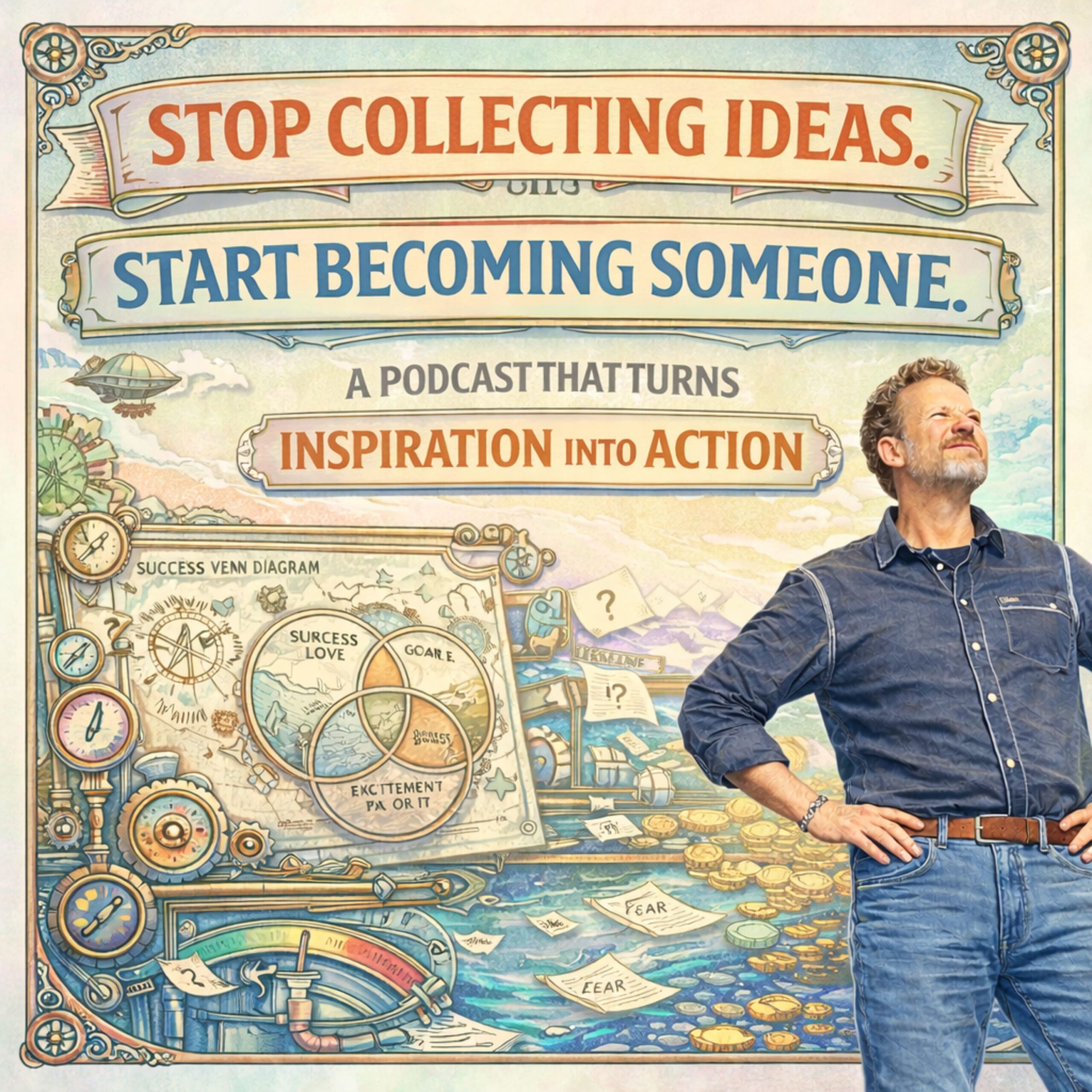
[00:06:44] Speaker B: Absolutely not. We are talking about a physical, tangible object. He insists that you print this thing out, ideally on a three paper. So, like, poster size. You frame it. You hang it prominently on your wall. It needs to be big, and it Needs to be visible every single day.
[00:06:58] Speaker A: And the actual design of it matters, too. Right. I saw in the notes he mentions two very specific design styles for this map. Vintage travel poster and steampunk.
[00:07:08] Speaker B: Yes, and those aesthetics aren't just for decoration. They tie back into his core philosophy. Yeah, the vintage travel poster style. So think 1930s south of France. Pastel colors, really sharp contrast, bold, romantic fonts.
[00:07:22] Speaker A: Right.
[00:07:23] Speaker B: That represents the magic. It's the destination. It's the romance of where you're ultimately going.
[00:07:29] Speaker A: And the steampunk aesthetic that represents the math.
[00:07:31] Speaker B: So you're looking at gears, pulleys, levers, brass pipes. It represents what he calls the factory of your future. The mechanics of your daily movement.
[00:07:39] Speaker A: Okay, but why steampunk specifically? Is it just because, you know, gears and brass look cool on a poster?
[00:07:46] Speaker B: It's actually a lot deeper than that. Think about a physical machine with gears. If a gear gets stuck in an engine, do you yell at the machine and call it lazy? Do you sit there and tell the machine it has a fundamental character flaw?
[00:07:57] Speaker A: No, of course not. You just get some oil or you replace the broken gear.
[00:08:00] Speaker B: Exactly. The steampunk aesthetic is a psychological trick. It helps you view your habits as a mechanism.
[00:08:07] Speaker A: Oh, I see.
[00:08:08] Speaker B: Right. So if you miss a day of working out, you didn't fail as a person. Your workout gear just slipped a little bit. You just need to tune it. It completely depersonalizes the struggle and turns your self improvement into an engineering problem.
[00:08:23] Speaker A: That is actually an incredibly healthy way to look at self improvement, taking the shame right out of the equation. So let's look at the specific widgets on this dashboard. If you're listening and you want to build your own map, what actually goes on it?
[00:08:36] Speaker B: Well, one of the very first elements he discusses is a Venn diagram, the
[00:08:40] Speaker A: classic business school circle chart. That's the MBA showing it is.
[00:08:44] Speaker B: But he applies it directly to personal purpose. So you draw three circles. Circle one is what you were good at. Circle two is what you genuinely love doing.
[00:08:51] Speaker A: And third, circle what people want, or
[00:08:54] Speaker B: more specifically, what people will actually pay for.
[00:08:56] Speaker A: So the goal is to find yourself right there in the center, where all three overlap.
[00:09:01] Speaker B: Right. And having it on the map forces you to be brutally honest about where you currently are. Think about it. If you're only operating in the good at and paid for circles, but you're not in the love circle, it's just
[00:09:14] Speaker A: a regular job that you're eventually going to burn out on.
[00:09:16] Speaker B: Exactly. And conversely, if you're in the love and good at circles, but absolutely no one wants to pay for it.
[00:09:21] Speaker A: Then you have a hobby, which is
[00:09:23] Speaker B: perfectly fine to have.
[00:09:24] Speaker A: Totally fine, but. But you need to know it's a hobby. You can't be sitting there expecting it to pay the rent and getting frustrated when it doesn't.
[00:09:30] Speaker B: Right. The diagram visualizes those gaps for you. Now, moving on, we have another widget that I think you are going to be a little skeptical of. The Gantt chart.
[00:09:38] Speaker A: Oh, I am immediately skeptical. Gantt charts are basically the stuff of middle management corporate nightmares.
Why on earth would I want that on my personal treasure map?
[00:09:49] Speaker B: Because as humans, we are notoriously terrible at understanding dependencies in our heads. Our personal to do list is usually just a massive pile of stuff we want to accomplish right now.
[00:09:59] Speaker A: True, everything feels urgent, but a Gantt
[00:10:02] Speaker B: chart is like a row of dominoes. It forces you to visually acknowledge that you literally cannot knock over the last domino until the first one falls. It maps out task dependencies. Clearly, you cannot do step B until step A is totally finished.
[00:10:18] Speaker A: So it's essentially a tool for patience.
[00:10:20] Speaker B: It's a tool for reality.
Bradley uses a great runners analogy here. You cannot run a marathon until you run a 10k, and you cannot run a 10k until you run a 5k.
[00:10:30] Speaker A: Makes sense, right?
[00:10:31] Speaker B: A Gantt chart visualizes those exact steps.
So when you look at your wall, you don't feel like a total failure because you haven't finished writing the whole book yet. You can see clearly that you are currently in the chapter three phase, which means you are exactly where you were supposed to be.
[00:10:46] Speaker A: Okay. I can actually see the value in that. It stops that constant heavy guilt of thinking, I should be done by now. I should be further along. But my absolute favorite part of this whole steampunk concept has to be the meters and levers.
[00:10:58] Speaker B: Yes, this is where the math magician concept really shines. Imagine you have this beautiful vintage brass dashboard gauge right there on your wall. He suggests creating actual visual meters for completely intangible feelings.
[00:11:14] Speaker A: Like what kind of feelings?
[00:11:15] Speaker B: The absolute best example he gives is a lever that slides back and forth between fear and excitement.
[00:11:20] Speaker A: Why those two, specifically?
[00:11:22] Speaker B: Because physiologically speaking, they are almost the exact same sensation in your body.
[00:11:26] Speaker A: Sweaty palms, heart racing, shallow breathing.
[00:11:29] Speaker B: Exactly. All of that. Your nervous system initiates the exact same arousal response. The only real difference between the two is the narrative your brain decides to attach to the feeling. If your brain says this is dangerous, you experience fear. But if your brain says this is an opportunity, you experience excitement.
[00:11:46] Speaker A: So this lever on the map is basically a manual override.
[00:11:48] Speaker B: For your brain, it's a physical check in. You look at your wall, you feel those intense butterflies in your stomach, and you actively ask yourself, am I afraid right now?
And you consciously decide, no, I am actually excited. And you can mentally or even physically visualize sliding that heavy brass lever over, all the way over. From fear to excitement.
It powerfully reframes that raw energy that is profound.
[00:12:14] Speaker A: Instead of trying to make the uncomfortable feeling go away, which never works anyway, you just completely relabel it and use the energy.
[00:12:20] Speaker B: Right. He also suggests adding meters for things like your confidence, your creativity, or your financial well being. Just simple low to high gauges.
[00:12:27] Speaker A: Like checking the oil in your car.
[00:12:29] Speaker B: Precisely. It's a status check. You look at your wall and think, okay, my creativity tank is hovering right on empty today. I need to go to an art museum or just read a good fiction book for an hour to it back up.
[00:12:40] Speaker A: It fundamentally treats your energy like a finite resource that just needs regular refilling rather than the standard approach, which is just assuming you should always be operating at 100% capacity all the time, which
[00:12:51] Speaker B: is how you get burnout.
And to keep this entire map from getting too overwhelming, because let's face it, mapping out a whole year of your life is incredibly daunting. He breaks the year down into seasonal quadrants.
[00:13:03] Speaker A: So, literally, winter, spring, summer and fall.
[00:13:06] Speaker B: It sounds so obvious, right? But it basically aligns your personal Kronos, your chronological time, with nature's rhythm. Winter isn't meant for harvesting. Winter is for planning. It's that dark, quiet phase, the 5:30am of the year, if you will.
[00:13:21] Speaker A: And spring is for planting, starting those new habits.
[00:13:24] Speaker B: Exactly. Summer is for tending to those habits and doing the work. And fall is finally when you harvest the results.
[00:13:30] Speaker A: So the big takeaway there is if you aren't seeing massive results during your winter phase, you aren't actually failing. You are just demanding results in the wrong season.
[00:13:38] Speaker B: Exactly. It gives you profound permission to just be slow when you genuinely need to be slow.
[00:13:44] Speaker A: I really love that perspective. Now, I want to pivot just a bit to the psychological frameworks he layers onto this map, because it's clear this isn't just a fancy to do list for getting chores done. It's heavily focused on who you are actually becoming in the process.
He talks about this concept of moving from A to B to C. Yes.
[00:14:02] Speaker B: This is brilliant. This is his antidote to what, what I call the now what syndrome. Usually when we set goals, we just map out A to B. I am here at point A. I want to lose 20 pounds. That is point B. B is the ultimate goal.
[00:14:15] Speaker A: Right. And what happens is once you actually hit point B, you usually relapse pretty quickly because you have absolutely no plan for what comes after the finish line.
[00:14:23] Speaker B: Precisely. You hit the goal and then you're lost. So Bradley introduces C and he actually spells it S E, E, C. Oh, like visualizing. Right. It's about visualizing the distant horizon far beyond the immediate goal. Who are you? After you finally publish the book? What does your daily life actually look like after you've lost the weight and kept it off?
[00:14:42] Speaker A: So you're essentially aiming through the target rather than just aiming at the target.
[00:14:46] Speaker B: Yes. If you don't visualize that Core Identity Shift, you will reach the goal and honestly just feel completely empty. And this transitions perfectly into another major widget on the map, which is his hero's Journey triad.
[00:15:01] Speaker A: Now, we have all heard of the classic hero's journey and storytelling, but he adds a really unique twist to it for personal development.
[00:15:09] Speaker B: He does. He breaks our internal journey down into three distinct Personas. First, you have the villain. Now this isn't some external bad guy trying to ruin your life. It's your own internal resistance. He actually personifies it and calls her Procrastination Patty.
[00:15:24] Speaker A: Oh, I think I know her very well. I'm pretty sure Procrastination Patty lives entirely rent free in my head most days.
[00:15:29] Speaker B: I think we all have a Patty in there somewhere. So then you have the second Persona, which is the hero. That is who you actively want to become. He calls this one Action Alex. That's the idealized version of you that successfully overcomes the villain's resistance.
[00:15:43] Speaker A: Okay, so far this is pretty standard self help stuff, right? Identify the bad habit, be the hero, overcome it.
[00:15:48] Speaker B: True.
But Bradley argues that stopping at the hero phase is a huge mistake.
Because if you stop at the hero, you are still entirely focused on yourself. Your journey is too self centered. He says you have to reach the third and final stage, which is the guide.
[00:16:04] Speaker A: The guide. So kind of like Yoda.
[00:16:06] Speaker B: Exactly like Yoda. The ultimate goal of your year isn't just to do the hard thing for yourself. The goal is to evolve into the person who turns around and helps others do the hard thing.
[00:16:17] Speaker A: Why is that progression so necessary for the map though? Why can't I just be the hero, achieve my goals and enjoy my hard earned spoils?
[00:16:24] Speaker B: Because becoming the guide acts as a psychological lock in mechanism.
[00:16:28] Speaker A: How so?
[00:16:29] Speaker B: Think about it. You can't easily slide back into being Procrastination Patty if you are out there actively teaching other people how to be action. Alex.
[00:16:36] Speaker A: Oh, wow, right.
[00:16:37] Speaker B: It cements your new identity. There's this old saying that when you teach something, you finally master it.
[00:16:42] Speaker A: That is a really interesting point. It fundamentally shifts your motivation from this selfish I want to get better for me to a much deeper grief.
I need to get better so I can be of service to others.
[00:16:53] Speaker B: And we know from psychology that external motivation, being of service to a community is almost always much stronger and more resilient than sheer personal willpower alone.
[00:17:05] Speaker A: So looking at this whole system, we have this giant map. It's got steampunk gears, it's got vintage posters, Venn diagrams, hero arcs, Gantt charts. Honestly, it sounds like an incredible amount of work just to set the thing up. But Bradley insists on using a very different word to describe this whole process.
[00:17:22] Speaker B: Yes, he does. He insists on the word play, play not work. Right. At the very end of his recording, he heavily emphasizes that we need to invite a lot more play and what he calls surrender into our daily lives.
He makes the argument that treating everything like strict work just leads straight to burnout. But treating it like play, approaching it with curiosity, that leads directly back to Kairos.
[00:17:44] Speaker A: It leads back to that magic flow state where time just bends and you lose yourself in the process.
[00:17:49] Speaker B: Exactly. And he gives a really concrete, everyday example of how to make this math and magic combination virtually automatic. He talks a lot about his dog Pepper.
[00:17:57] Speaker A: Right. The habit stack. This is a great example of the math side of things. He walks Pepper every single day simply because the dog needs it. That is a completely non negotiable anchor habit. In his day, the dog has to go out. So he decided to cleverly stack a new creative habit right on top of that existing one.
[00:18:16] Speaker B: Making a YouTube short.
[00:18:17] Speaker A: Exactly. Every time he walks the dog, he
[00:18:20] Speaker B: records a video which is brilliant because he doesn't ever have to wake up and decide to be creative. Today the dog looks at him, he grabs the physical leash and that action automatically triggers the video creation process.
[00:18:33] Speaker A: The math directly leads to the magic. The rigid structure of the daily dog walk creates a safe, reliable container for his spontaneous creativity. It proves that you really don't need endless willpower if you just have a solid system in place.
[00:18:46] Speaker B: And speaking of magic and hidden systems, there was actually a really fun little Easter egg buried deep in the source material we reviewed for this. Remember, he recorded this entire audio log in the pitch dark at 5:30 in the morning and he was kind of wondering out loud if anyone would actually stick around and listen to him. Ramble all the way to the very end.
[00:19:03] Speaker A: He did, right? He dropped a secret word just for the true listeners who made it.
[00:19:07] Speaker B: He did. The secret word was moonlight.
[00:19:09] Speaker A: Moonlight.
[00:19:10] Speaker B: Yeah. And it fits that 5:30am Pitch black vibe so perfectly. It beautifully represents that quiet, unseen, liminal time where all the real profound internal work actually happens. It's that soft, subtle light that guides you when the sun hasn't even come up yet and the rest of the world is completely asleep.
[00:19:28] Speaker A: I love that. So if we pull all the way back now and look at this entire repossible treasure map concept, we. What would you say is the real core takeaway here for the listener? Because realistically speaking, we aren't all going to become prolific YouTubers or write 40 books like Bradley.
[00:19:44] Speaker B: I think the universal takeaway is all about the power of externalization. We just keep way too much of our identity and our goals trapped inside our own heads. Or we bury them in these hidden digital apps on our phones where we frankly never look at them. We walk around with these vague floating desires to just be better, but we never actually map out the terrain.
[00:20:03] Speaker A: So the key is to get it completely out of your head and onto a physical wall.
[00:20:07] Speaker B: Yes. Make it completely undeniable. Make it a tangible physical object taking up space in your actual environment.
Treat your life like a complex mechanical project that can be smartly engineered. Which brings us back to those steampunk gears. But also treat it like a beautiful, romantic journey. Which is the vintage poster. You need both.
[00:20:27] Speaker A: And crucially, don't just measure the final outputs. Don't just obsessively measure your bank account balance or the number on the scale. Measure the daily inputs. Measure your transition from fear to excitement. Measure your slow evolution from the villain to the hero to the guide.
[00:20:43] Speaker B: Because if you can clearly visually see it, you can actually navigate it. But if it remains just a vague feeling in your gut, you're eventually going to get lost in the woods.
[00:20:51] Speaker A: Absolutely. So here is our final thought for you to chew on today. We want you to mentally visualize your own personal dashboard. If you had a single blank page, a massive A3 poster to map out your entire upcoming year, and you could use any combination of brass gears, heavy levers, and vintage art, what three specific things would absolutely, undeniably need to be on that page?
[00:21:12] Speaker B: Right?
Is it a meter for measuring your daily stress levels? Is it a strict Gantt chart mapping out that scary career change you've been constantly putting off? Or is it simply a picture representing the guide you hope to eventually become?
[00:21:28] Speaker A: Think about it. Maybe just sketch it out on a napkin during your lunch break today. Hey, maybe even try waking up and doing it at 5:30 in the morning in the pitch dark. You honestly never know when kairos might strike.
[00:21:39] Speaker B: Thanks as always for joining us on the deep dive.
[00:21:42] Speaker A: We'll see you next time.