Episode Transcript
[00:00:03] Speaker A: I'm here with Shell Honaker and we are gonna blow your minds. There you go again.
[00:00:10] Speaker B: Again.
[00:00:11] Speaker A: Again.
Yet again.
Was the last time we were on video? Was that December on your. Out on your back patio on the back porch?
[00:00:19] Speaker B: Yep.
Wow. We call it back porch in the south, honey.
Sorry.
[00:00:25] Speaker A: Back porch.
Get my vocabulary straight.
Okay. All right, everybody. Shell, to To.
I just went through. I cannot. I cannot.
What's it called? Hold Back My inner Donald Miller and Story Brand.
And I. I pretty much put everything into this framework lately and I gotta say, it kind of works. So there's a hero who has a problem and along comes a guide who has a plan to.
With a call to action for the hero to avoid failure and achieve success.
So if we were to apply that shelter, what we're about to talk about. Yeah, I know I'm putting you on the spot here, but can you fill that in the blanks with what we're talking about here, you being the guide?
[00:01:19] Speaker B: Yeah, for sure. I think our hero is a content creator, right? Novelist, writer of some sort. Creator of some sort. And the problem is, is that they have to do all of the things. In indie publishing, we are publishers that write and not writers that publish. And that's kind of a well documented. That's. That's the opportunity. But also the downside is that we are responsible for all of the things.
Right. And the. The problem has been continuously. It's tough to do it ourselves. It's also tough to find resources and hire or delegate those things. It's, you know, there's been a constant roadblock for us to do all of the things because one side of it is very creative and a lot of people are very good at that. And the other side is very business centric and some of us are very good at that. It's kind of how our brains work left and right.
[00:02:12] Speaker A: Yeah.
[00:02:13] Speaker B: But in this business we have to do both. Right? And so that is the problem is how do you do all of it?
[00:02:21] Speaker A: All of the things.
[00:02:22] Speaker B: All of the things.
[00:02:24] Speaker A: And then along comes Shell.
[00:02:25] Speaker B: And along comes Shell. And I have been writing Author Automations the newsletter now for nearly two years.
And in that time I really saw the possibility of Automations being able to pick up the piece and being able to delegate to a bot the things that you wanted to do.
With that came AI and it sped it up and we were able to chat back and forth with AI and say, Hey, I need to create 20 captions for my social media.
And that was great. So you chatted back and forth then along came the ability to do imagery and that made it better. Although lots of hands had six fingers.
Yeah, six finger hands.
But. But I will say, in December, a huge shift happened and, and this is where it gets interesting for our hero, because now there is the ability to allow AI to agentically be. Do the thing. So before it was chat, you chatted back and forth, you copied and pasted, right? You, you created Excel spreadsheets and you asked it to look at data and you had to do a lot. You were the, you were the orchestrator and the bottleneck in both positions.
But back in December, a shift came into place with agentic. AI and anthropic in particular has been kind of on the case with this. And it came out with what's called
[00:04:00] Speaker A: cowork and code and just, just one secentic agent.
[00:04:10] Speaker B: Yes. Meaning it will do something as opposed to just tell you about something.
[00:04:16] Speaker A: So there's an agent that can take action.
[00:04:19] Speaker B: Correct.
[00:04:20] Speaker A: Okay, right. Okay.
[00:04:21] Speaker B: With your permission, with the parameters that you set. Those are kind of important caveats there.
[00:04:27] Speaker A: Okay.
[00:04:28] Speaker B: But cloud cowork in particular came out and it's getting better. It hasn't been great in the past, but it's getting better and better and better. And it allows you to connect it to your things, right? So you can add connectors like Google Drive or Canva or Gmail or airtable.
It can also take control of your Mac if you're on a Mac.
And you can connect all of the things that you use, and there's a ton of them, I'm just pulling up a few of them here. But you can connect Notion, PayPal, Stripe, Wix, and then, and then agentically, this agent can go do things for you. For example, if you connected Canva, you could have it create images in Canva for you. If you connect Gmail, you can have it give you a summary of your email that's come in overnight. You can connect Google Drive and it will create Google Sheets from the data that you're chatting to it about. So it can do things instead of just talk about things. And it makes huge difference.
[00:05:44] Speaker A: So if this. And I'm not going to, I promise I won't fixate on, On Story, Brand and Donald Miller the entire time, but just because I want to get that nice framework, even just for myself.
So we now have the hero is the content creator, right? Author, content creator. And the problem is they have to do all the things right.
Guide is Shell. And I'm just going to stick with Shell for a moment.
Could we say the Plan is as simple as.
The plan's not Claude.
[00:06:18] Speaker B: The plan could be Claude. Right.
The plan is how do you outsource all of the things that you need to do? Okay, the plan is you have a business, a creation, content creation, author business.
And you have to do social media and analyze your sales and put things up for sale and do covers and edit your book and. Okay, send out a newsletter and all of the things. So your plan is, how do you manage your business in. In the macro sense.
[00:06:53] Speaker A: Okay, so the plan is. Okay, plan is how to manage your business.
[00:06:57] Speaker B: Yep.
[00:06:57] Speaker A: Then a call to action could be, I'm giving away a little bit here, but could be join the summit on April 21st and 22nd. 21st. 22nd. Yeah, yeah, that could be the call to action because it needs to be like a doable, easy. Okay, just tell me what's this one thing I gotta do Exactly. Join the AI summit Shell's hosting on April 21st, 22nd, which is what we're really talking about here today. And then just to wrap this up in a nice pretty little bow for me here, then what is. Because we're looking at then to avoid failure. So let's talk about what failure looks like and then achieve success. And I'd like to see what does success look like? So what does failure look like?
[00:07:40] Speaker B: Failure looks like burnout. Failure looks like low sales despite massive effort. You know, failure looks like you've been hacking away at this for years with a great book and can't get eyes on it. You can't get discoverability, you can't get traction. That's what failure looks like. It's, it's. Yeah, it's really painful for me to see authors that have amazing books that can't get traction.
[00:08:09] Speaker A: Okay, ouch, that's. That's painful. Okay. And then success. What does success look like for the hero with the problem and the guide and the plan? What is what, what could success look like?
[00:08:22] Speaker B: So success could look a little like this. You are able to open up your dashboard in the morning, see that your ads are not performing as well as they were the week before, and your Claude cowork can go in and create new ads and change those out for you without you having to log into something else to do.
Can look a little bit like, you know, you need to send a newsletter and you need to send some follow up newsletters, but you're not sure how you can log into Cowork, and Cowork will connect to your email service provider, draft an amazing newsletter for you and Draft maybe three or four different versions of it, depending on the audience that you want to send to. So that they're highly customized, so that the reader that gets your newsletter feels like you've written it exclusively for them and they take action to buy your book or leave a review or whatever your call to action is, it is being able to update your website more than once every six months. Right.
Six years. Just by going into cowork and saying, I need to add my latest book to my website.
Here's the COVID And it already knows everything about your site. So it's not being able to do more.
Right. It's being able to do more.
More efficiently. You're able to do all the things without the burnout. You're able to reach more readers, potential readers. You're able to get in front of more readers without burning out.
[00:10:04] Speaker A: So if the.
The failure.
The simple sort of emotions or feelings that I had with failure, from what we're talking about was you mentioned burnout, overwhelm,
[00:10:21] Speaker B: pain.
[00:10:23] Speaker A: What then are some. What might the hero feel with success, accomplishments?
Oh, wow.
[00:10:33] Speaker B: Productivity.
I mean, just the. I know when I feel like I've accomplished something or I've knocked something off my list, I feel far more productive. I feel like I've succeeded in a way that I set out to succeed. I don't feel like I'm behind. I feel like I'm ahead of the game.
[00:10:53] Speaker A: Wow. Wow.
[00:10:55] Speaker B: Yeah.
[00:10:55] Speaker A: Wait, wait, wait. Okay, I think. Okay, sorry. That one struck a nerve because. Did you say, oh, dir. I don't feel behind. What? I don't. Does not compute. Does not compute.
[00:11:09] Speaker B: So. So in the interest of being a storyteller, let me tell you a story.
When I first discovered how these tools work and I was kind of exploring what their capabilities were, I sat down on a weekend and I sat down with Claude Code because Cowork hadn't come out yet. And Claude Code is kind of a cloud coworker supercharged. Right. And I can explain that a little bit better in a. In a different context. But I sat down to see what I could do with it, and I had a backlist of about 20 to 25 tasks on my notion task list that I.
It's my. Someday maybe, like, I'll never get to it. I didn't think I would ever get. Get to them. They included things like I wanted to go through all 13,000 images on my computer, and I wanted to put them into some kind of structure so I could find them. I wanted to have keywords. I wanted to get rid of duplicates. I wanted to really just clean up this, you know, dumpster fire of.
[00:12:15] Speaker A: I want that. I want that too.
[00:12:18] Speaker B: Okay, that's. That was one task. The second task was I knew that I needed to do better job of SEO on our website. I knew that having better SEO, having better accessibility, having alt tags on my images, like all the things I knew was going to take me weeks. And I wasn't. If ever, I wasn't ever going to be able to really, truly get to it. So I was trying to formulate a plan to like, break it up and do like 10 pages a month of things, right? And we have.
Granted, we have 1300 articles on indie Author magazine in particular, but I knew that we needed to do that. So that was task number two.
Task number three was I needed to update some of those images, and we needed to get off of this really expensive paid plan that we were on to house those images. We were paying like $200 a month for that. So. So my goal was always to get rid of that expense. Okay, so those are three huge things. Three things that I knew I needed.
[00:13:23] Speaker A: Any. Any one of which sounds like it could take a month.
[00:13:27] Speaker B: Any one of which would have. Oh, months. More than months. Four months. Four months.
[00:13:31] Speaker A: Okay.
[00:13:31] Speaker B: I sat down on Saturday morning at 9am and typed into claude code. This is my objective. And claude code said, right, connect this, connect this, connect this. Walked me through how to make those connections. I had to connect to our website so it could take action on our website for me. Not me pasting and changing things, but it could do it itself.
I needed to connect my.
What's called glacial storage, right? So that it knew how to get those images off and put the. Those images in a different place so we could cancel that $200 a month subscription. And then I needed to connect my desktop so that it could go in and categorize all of the images that were sitting on my desktop.
I started all three of those tasks in parallel. It's called in parallel. So all three of them, I had three bots working by themselves on my computer.
[00:14:32] Speaker A: And it's totally separate stuff. One's doing this photo organization thing, website thing.
Okay. All right.
[00:14:38] Speaker B: Yeah. Yep.
And it said, go away. Go have some coffee. Go have some breakfast. Go do your thing.
And so I came back in about two hours, and task number one was done in two hours. It had already categorized the images on my desktop, and it put them into folders and it renamed them. In some cases, it added metadata to them, and then it created a spot spreadsheet for the team so that they could search was.
It went above and beyond and it was done. So that was done. I went away for another couple hours. I came back and it had asked me a couple of questions. It said, do you want me to do this, this and this, which was extra. And above and beyond one was, do you want me to rename the images so that they better have. They have better keyword strategies? And I said, sure, while you're in there, go ahead and do that. So Instead of saying image1.jpg it said image of an author at a keyboard, JPEG so it had more keyword relevance.
And it did all the alt tags. And then it said, I noticed that your responsive sizing on your site is just a few pixels off. Would you like me to fix that? And I said, absolutely. And can you make me a cup of coffee while you're at it? Like, what are the limits? It did that and then it went in and it had moved all of the images. Now, this took Almost a full 24 hours to move all the images out of our glacial storage into another space.
And then it asked me, do you want me to cancel that subscription for you?
What? Yes.
[00:16:23] Speaker A: What?
[00:16:23] Speaker B: I said no. I said, no only because I don't allow it to do anything that has to do with money or subscription.
I really look at agentic AI, sort of like I would look at an intern, right?
[00:16:36] Speaker A: What permission?
[00:16:38] Speaker B: What do I give an intern? And it has to earn my trust before I let it do all the things. But those things, four months worth of work, $200 a month, immediate savings immediately in just a weekend. And, I mean, I did actually more than that over the weekend. And I did write about it in Author Automations, kind of what I did that whole weekend. But I was absolutely blown away by the possibility and by the actual results that I saw in just really two days of experimenting with it. Now, that was in January.
Imagine how much smarter it is because we're talking about degrees of, you know, okay, dumb as they're gonna be today, today is dumbest they're gonna be.
[00:17:29] Speaker A: Yeah. In Zoom Chat, I just shared a file with you. I don't know if you could share it on the screen here. Yeah, and it's. It's. That's actually my strategy for when I was gonna. When I'm gonna get those photos organized on my computer and if you can share the entire strategy here with everybody watching, because it's quite. It's quite brilliant, actually.
And.
Yeah, but I'm going to share it with Everybody. Just because that's, you know, the giving guy that I am.
And this is when exactly it's going to happen.
And yeah, I just thought I'd, you know, be generous like that. There it is. Yeah.
[00:18:09] Speaker B: Yeah, that's it.
[00:18:10] Speaker A: That's right on the calendar.
Yeah, that's when it's going to happen.
[00:18:14] Speaker B: And it's a calenday. That's great.
[00:18:16] Speaker A: It's a calenday. Yeah. And it's Saturday, Tuesday, Wednesday, Thursday, Friday.
[00:18:21] Speaker B: Someday, who knows?
[00:18:23] Speaker A: This is actually a perfect example, Shell. I think I created this image, I don't know, a year ago.
[00:18:29] Speaker B: Yeah.
[00:18:29] Speaker A: And. Right. Look at that. Misspellings and odd letters or whatever. Although I love the post it note. It's great.
And for me, this is the pain.
This. This is the pain. It is Someday is when I'm going to accomplish the tasks that you mentioned, all three of them, which you got done so quickly.
And they're still on my Sunday calendar.
[00:18:53] Speaker B: Yeah.
[00:18:54] Speaker A: And someday is, of course, never.
[00:18:56] Speaker B: And those tasks sat on my, on my. I mean, they'd been there at least six months, Right. They're just like a. Oh, gosh. I. At some point we need to do this. Right? So at some point I need to do this.
At what point would I have gotten to it? Probably never. Probably never. I'm all. I was continuously putting out fires and I was always working in the urgent, necessary box. And you know, the, the grid of. Wow, what is it? I can't remember what that grid is called, but it. But I was always putting out fires and I could never get to the work that I wanted to get to. I couldn't get back to writing, which is what I wanted to be doing. Right. I wanted to write. I didn't want to be sitting there optimizing SEO. But also that's kind of a necessary thing, and that moved the needle. I will share this.
Since I've done that, our Traffic is up 26% on our site.
So it's a. It was a small thing, but 26% more traffic on our website is a huge thing. It's led to more advertisers, it's led to more, you know, deals. It's. It's led to all kinds of things, but I couldn't get ahead of it to be able to do that until I was able to outsource it to bots that could do it more efficiently and better than I could. Much better than I could. The time. The time it would have taken me to create, craft a plan, probably delegate it to my team, probably have them, you know, do it between things. It never would have gotten done.
[00:20:28] Speaker A: Yeah, yeah. Or. Or here. I would have gotten done on this day here. Someday.
[00:20:31] Speaker B: Someday.
[00:20:32] Speaker A: Which is the same as never. Some days it's a nicer way to say never.
[00:20:36] Speaker B: Yeah.
So I was able to clean up my backlist and get that done. And then I was able to do things like craft a Pinterest strategy and have it create all of the Pinterest pins for me, because those are long tail things. So when I say I got ahead, it wasn't that I caught up on what was in front of me. I really did get ahead and do things that set me up for success in the future.
Future. Shell is really impressed. Future.
[00:21:05] Speaker A: You just said those English words and I'm pretty good at English, but you said get ahead and I just. I don't know. I don't really understand.
[00:21:10] Speaker B: No, I didn't know what they meant either, Bradley. It just came to me.
[00:21:14] Speaker A: Yeah, get ahead. I'll look that up later.
[00:21:17] Speaker B: Well, I sort of joke. I mean, there's been a running joke for years. People have said, could you just clone yourself?
And I've always, hahahaha, look, I did. I just cloned myself. I legitimately just cloned myself.
[00:21:30] Speaker A: Yeah.
[00:21:30] Speaker B: And I gave it to my team. Now my team has Shellbot, so they can ask questions and it answers as well as I do. Like there's all kinds of benefits for this agentically now because before it was just again, chat back and forth. Now when Karen wants to write a newsletter for indie author training, she just goes in and says, I want to write a newsletter for indie author training. Check the calendar and set it up. It goes on to the calendar, it sees who's next in our list, it drafts the blurbs, it puts it into fluentcrm and it waits for her to approve it and send it out. Right. We could send it out manually, but I want that human in the list loop. So you don't. Yeah, but you could.
[00:22:15] Speaker A: Okay, so if you're listening or watching and. And wondering, like if you're also like me and wondering get ahead. I. You know, does not compute. I don't get it. I'm just behind.
So.
And. And you're listening to Shell here and you're like, I want a Shellbot. I want. I want to talk to Shell more. How do I learn from Shell?
So what do we got going on in a few weeks?
What is.
What's going on? What are you doing?
[00:22:39] Speaker B: Yeah. So we've got an AI for your author business. It's a two day virtual summit. And it's really the questions that I've been asked, the possibilities that I've seen. Everything that I think an author needs, I've put together into a two day summit. The first day is free and we're going to talk about airtable, which is where all the stuff sort of has to live. It doesn't have to, but it's optimized.
[00:23:05] Speaker A: Tiny interruption. Sorry. Yeah, I know it's. You say author here.
Could you, could you replace that with creator? Like me, YouTuber creator, content creator. Is that okay?
[00:23:20] Speaker B: Yeah, anybody that creates content. This, this is a huge help for. Right? Because first day one, you're going to understand the concepts of things, right? Where to put all of your content, where to put all of your articles, right? Swap out articles for books, swap out videos for books, your releases, your tasks and your revenue. And I'll show you exactly how I have it set up so that I track all the things in one place. There's been a ton of disparate, you know, services and things that have come into play, which is fantastic. But having everything in one place makes a huge difference, especially.
[00:23:59] Speaker A: And for those who don't know airtable.
[00:24:02] Speaker B: Yeah, it's a basics. Airtable is just like a bunch of Excel spreadsheets in one place, but smarter.
[00:24:10] Speaker A: Okay. Okay, great. I know you're a huge fan, so this is.
[00:24:14] Speaker B: I'm a huge fan. Only because you can see. I'll show you my air table. I have. I track all of my series here. I track all of my titles here. I track my chapters and scenes and characters. I track all my marketing assets, my campaigns, my socials, right? I track literally everything. Now, you might not need this granularity, but I like, I track all of my email contacts so that I have a working backup anytime, right? So I have every, literally everything in one place.
[00:24:46] Speaker A: Super duper steroids spreadsheets, right?
[00:24:50] Speaker B: They're kind of like super duper spreadsheets, but also things can be done. What's called a lookup. So it can. All of these are interconnected.
Harder to have them all connected, but in airtable, you can have them all connected. The other thing that's really cool about airtable is that it's free for most people's use.
[00:25:14] Speaker A: Okay.
[00:25:14] Speaker B: Yeah. That's kind of why I loved it at first, is that it's, it's easy and free.
[00:25:20] Speaker A: So. Sidebar. And I'm also trying to play devil's advocate a little bit here, Shel. But yeah, sidebar is.
Whoa, whoa, whoa. Overwhelm what are all those tabs? What is this?
[00:25:30] Speaker B: Yeah.
[00:25:31] Speaker A: Is this summit?
Is it also.
How techy do I need to be for the summit?
[00:25:37] Speaker B: Beginner friendly. So you're going to. You're not going to actually build this? I'm going to give this to you. You can. You can have this version of it. So you can fill it in as much or as little as you want. You'll have the full capabilities.
But if you just want to put in, you know, just your social stuff and just have your social media in here, or you just want to use it for, you know, like your character sketches, then you can just use it for as much or as little as you want to use it for. You don't have to use it to its fullest capacity. You can also start small and then grow into it. The cool thing is one, it's free. And two, here's a template. Use it as you see fit.
[00:26:17] Speaker A: Okay? Free. Here's a template so you can use it even better. Okay, Y. Y. We're on day. We're on day one. Airtable.
[00:26:23] Speaker B: It's already like, wow, more on day one. The first session.
[00:26:29] Speaker A: Okay. Day one is free.
[00:26:31] Speaker B: Day one is free.
[00:26:32] Speaker A: Okay.
[00:26:33] Speaker B: Absolutely.
The second session is one of the things that people often complain about are the AI isms that creep in so that all of the copy that you write with with the help of. Of AI sounds the same. And we've all seen it, right? It's the. It's the rhythm devices that AI uses, like the fragmented questions. Not this, but this. This. It's you. Once you. Once you hear it or see AI writing, you can never unhear it or unsee it. Right? Okay. But I'm going to show you some techniques that train AI on your voice so that your copy comes out sounding exactly like you and not like AI. And there are some very specific ways that you can do that, including having brand guides, style guides, social media guides, and copywriting guides. So I'm going to give you a tool, a free tool that lets you do that as well.
[00:27:31] Speaker A: Okay?
[00:27:32] Speaker B: Because nothing takes credibility faster than copy that reads like a chat bot wrote it. So your blurbs sound like you, your social media sounds like you, your newsletters sound like you, everything sounds like you.
[00:27:45] Speaker A: Okay? And for the record here and for the.
If you don't know Shell or don't know me, we are not talking about using AI to write your books.
[00:27:54] Speaker B: No, no, I use AI for business.
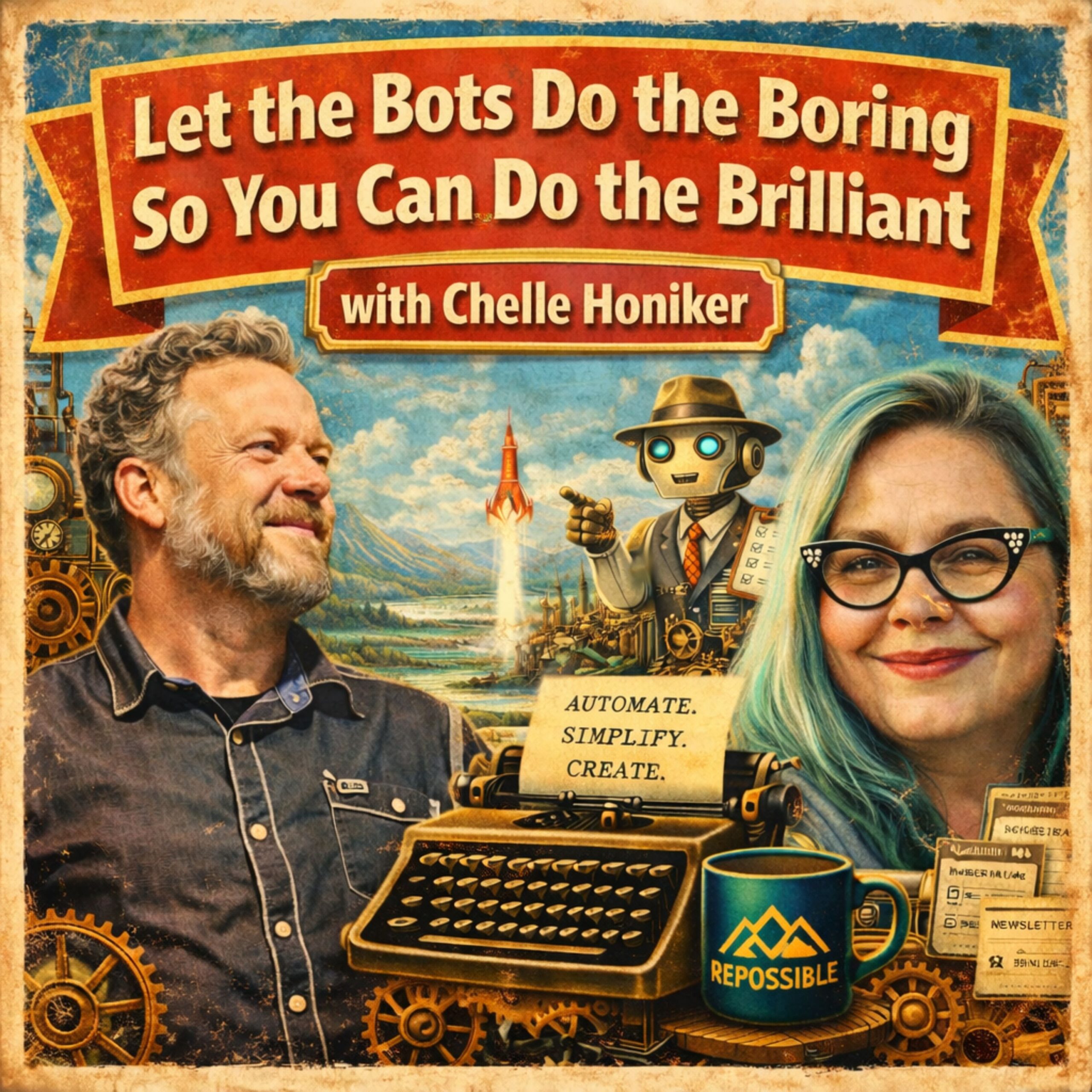
I think that is the most important distinction. I say let the bots do the boring so you can do the brilliant meaning you can get back to the thing that only your brain can do, which is create stories and tell stories.
So, yeah, I use AI specifically for business and marketing purposes.
[00:28:14] Speaker A: Okay, awesome.
Okay.
[00:28:17] Speaker B: The next thing we'll talk about are social graphics and a book trailer. So you can use free tools step by step on the screen. So can create trailers for your books, short marketing pieces for your books. One of the changes that Facebook Ads has made is that they actually look at your creative and then they decide the audience that that creative serves. So you want to have social graphics and book trailers that look like the audience that you want to attract.
So that's a huge step forward.
[00:28:51] Speaker A: And you say free. Free tools. So on day one, which is free, and then for. Am I going to have to pay anything for to get started with these AI tools?
[00:29:02] Speaker B: So a lot of these AI tools have free credits that you could take advantage of so that you can decide if they're right for you. So that's what we're leveraging are the free credits, free trials. Once you get started, you will. There are paid versions that will do what you need it to do, but they're nominal. So most people will get into the $20 a month Claude plan and the pay as you go plan for the image and video. I use Freepik for that. And last month, my very, very, very, very heavy use of it was $22, and that was because I was generating 30 videos at a time.
[00:29:42] Speaker A: So 30 videos at a time. And your bill was $22 for the month.
[00:29:47] Speaker B: $22 for the month.
[00:29:48] Speaker A: $22 for the month. Whoa. Okay. Wow. All right.
[00:29:52] Speaker B: And that's. And part of that, too, is that you want to be sure that you're doing it in an optimized way, because you can burn through tokens, credits, dollars, euro, whatever you're spending there pretty, pretty quick. But I'm going to show you how you can do this without that.
[00:30:10] Speaker A: Wow. All right.
[00:30:10] Speaker B: So you can step through it and kind of learn from my mistakes.
[00:30:14] Speaker A: Yeah.
Wow. Okay, Cool. All right.
Hey, do you have to go at the top of the hour? Are you good to keep going?
[00:30:22] Speaker B: I'm good to keep going.
[00:30:24] Speaker A: Cool. Awesome. All right.
[00:30:27] Speaker B: And then the last day, last session, that day, we're going to talk about how to take one post, a blog post that you've written or a chapter of your book or an idea that you've got, and we're going to turn it into a week of social content. So that's going to be a different post for every one of the different places you're going to post. So different. Blue sky is different than Facebook. It's different than Instagram. It's different than LinkedIn, Pinterest, Telegram, Threads, TikTok X, Twitter.
[00:30:55] Speaker A: Wait, wait, wait, wait, wait. It's not just the same post posted to these different places?
[00:31:00] Speaker B: No, because each of these are different places. Right. Instagram is a far more visual medium than Threads. Threads is very descriptive and text heavy. So you don't want to have one thing in each spot. You want to tailor it to each audience there. So you'll, you'll put what your objective is. You can upload parts of your book. You can decide how many days of content you want to create. Create. You can choose which things you want to post to, and then you can choose if it's only videos or a full mix. And then this creates a campaign for your entire, however many days of social media content you want to create.
[00:31:42] Speaker A: Okay, so I keep jumping in because I'm like, have the devil's advocate hat on.
[00:31:46] Speaker B: Yeah.
[00:31:47] Speaker A: And I'm trying because I know you Shell, so. But I, I'm trying to think. Okay, I don't know, Shell, and what is all this stuff? Like, where are we right now? What is this?
What is this page we're on?
[00:31:56] Speaker B: Yeah, so this page is Author. Yeah, this page is Author Automations Social. This is a companion to my newsletter@author automations.com and I built this so that you had. Instead of using Claude or Claude Coworker Claude code and doing it sort of more manually. I built this so that you could do it all in one place and see a content calendar of all of your posts in one place.
And then if you wanted to create things, you could, you know, create things. But. So this is the, this is a paid app, but the concepts are exactly the same. And you can do this with Quad Co work using their 20amonth plan. Just completely. Okay. It's, it is a, it is a Choose your own adventure. You can do it with Claude Coworker, or you can do it with my tool, which kind of gives it to you in a more structured way so you don't have to focus.
[00:32:53] Speaker A: Okay. And we'll learn about this tool, the pros and cons of this tool versus cloud code on the first day, I suppose.
[00:33:00] Speaker B: Yes. Yeah.
[00:33:00] Speaker A: Okay. All right.
[00:33:02] Speaker B: And that tool, that tool is, like I said, I built it specifically for people so that they could have everything all in one space and have it all, you know, there. But again, if you want to use Cloud Cowork, you can absolutely use Cloud Cowork. To do this, you don't have to use my tool, you can use cloud
[00:33:22] Speaker A: code to do it, but you have created something that does Cloud Cowork, but in this way for creators.
[00:33:32] Speaker B: Yeah.
[00:33:33] Speaker A: And relevant to all the stuff we've been talking about.
[00:33:37] Speaker B: Yeah, for sure. And partly because when you use Cloud Cowork, you have to connect all of these different social media accounts separately and go through all of the headache of creating developer accounts and connecting all of them yourself.
[00:33:51] Speaker A: Yeah.
[00:33:52] Speaker B: This way. I created it so that you can do it for each of them. And if you have separate pen names, you can connect your separate pen names in here too. So I was, I was just getting a lot of feedback from folks and I said, hey, I can build this, no problem. So I did. That's.
[00:34:07] Speaker A: So rather than me going into Claude Cowork and trying to figure it all out, because you created something that does. Has the features of Claude Cowork, but you've made it more custom and nice pretty package with a bow on it for us to use.
[00:34:22] Speaker B: Pretty much, yeah.
[00:34:23] Speaker A: Okay. All right. Wow.
[00:34:25] Speaker B: But again,
[00:34:28] Speaker A: you can do it all.
[00:34:29] Speaker B: You can do it all. You can do it all.
[00:34:31] Speaker A: I can also go to Home Depot and build a house.
[00:34:38] Speaker B: Great analogy. I agree with you.
[00:34:43] Speaker A: All right. Wow. Okay, this is. And this is. We're still on day one. We just finished day one. Wow. Okay. What is day one? Like 77 hours for the. How long is day one?
[00:34:51] Speaker B: It is, it's a. It's a, I think nine hour day, all told.
[00:34:56] Speaker A: What?
[00:34:57] Speaker B: Are you serious? Yeah, it's a long day. There's a lot there, but I've recorded everything, obviously. Right. So there's recordings and videos and you can stop and pause it and you can skip through different sessions as you will. I'll show you the schedule down here. All right, so it's, you know, airtable AI, copywriting, generative imagery.
Oh, we're also doing a book covers. How to create your own book covers.
Putting it all together with automated social media. It says make.com, but actually it's not. Now, when I first started this, this is how fast the technology is going to. This isn't going to be done with make.com. it's going to be done with Cloud Cowork now because it's just not that much better. Right. And then we'll wrap it up and everybody will get a copy of the Airtable template, which is here. It keeps everything in one spot.
[00:35:48] Speaker A: So day one. So these are scheduled times.
[00:35:54] Speaker B: Yes.
[00:35:55] Speaker A: And they're videos that we could Then watch and pause and. And stuff. Right?
[00:35:59] Speaker B: Okay.
[00:36:00] Speaker A: All right. Yeah, but they open up at that time.
[00:36:03] Speaker B: They open up at that time.
[00:36:05] Speaker A: Okay, all right. Got it, got it.
All right. I'm keeping up. I'm trying to keep up.
[00:36:12] Speaker B: It's a lot. But I think, you know, I've recorded them in very specific orders of operations so that you can take them at your own pace.
Pepper.
[00:36:23] Speaker A: Yeah, he's butting my ankles. He wants to go on a walk. Pepper. Pepper. It's day two. It's day two. We can't leave now.
[00:36:33] Speaker B: Day two is. Day two is the deep dive into how all of it works. So day one is really conceptual. You'll get a lot out of it. But day two is where we sort of supercharge it and we talk about cloud code and coworker and how it actually is going to take control. You'll also have how to connect things, how to use Inbox zero, how I get my email down to Inbox zero, how to write your newsletter, how do you update your WordPress website, and then how one newsletter becomes a faceless YouTube video podcast, 26 pieces of social media content, and how it will post everything. So it really walks you through. Day one is the. This is what's possible. But day two is how. How we do it. How. This is how you actually do it.
[00:37:19] Speaker A: Really showing.
Are we sort of looking over your shoulder and this is how you do it?
[00:37:25] Speaker B: Yes, exactly right. Exactly right. How do you connect things? How do you set them up? What should you look for? How you should evaluate some security risks? How do you avoid, you know, some of the pitfalls that are in the news that are being reported with security concerns? Right. How do you avoid all of those? I want to walk you through that. That so that you really, really understand both the possibility, but also the cautionary tales.
[00:37:52] Speaker A: Yeah.
Wow.
Yeah. Okay. I like the Operate Business operations center. Wow.
Email and task management. Okay.
[00:38:04] Speaker B: This is where I've cloned myself, to be honest, because I can wake up in the morning and it will look at my notion tasks, my to do list, and say, what do you. What do I need to get done today? And it will say, all right, you're. Based on what I know about you, you do deep work in the morning and you do admin in the afternoon. So in your deep work, go ahead and, you know, work on these. Write this, edit this, do your deep work now. And then these tasks will be here in the afternoon, and I can do some of them.
Okay, go do that for me.
[00:38:39] Speaker A: So I was talking to A friend of mine today and fellow speaker and we were talking about AI and we were talking about how X years ago when sort of, you know, Internet and whatnot. And the very beginning, early on, people were scared. I'm not, I'm not going to put my code into that, you know, computer, into that website because I'm scared. I'm, I'm going to drive down to the shop and you know, hand my credit card over manually and get my, my product. And that's of course was the beginning of sort of Internet, Internet shopping and stuff. And, and now, you know, we don't think a second about handing over the credit card. I mean even people listen, watching this are probably like, what are you talking about? But we don't think for a second about handing over the credit card to some online store. Right. Well, well, except that we should for the scammer sites out there. But, but now, because we're talking about here you said, you know, operations center and email and task management and giving it less or more authority to do things and make decisions ever. And whereas now even me, I mean, you know, Michelle, I'm not a techie dude and I'm all good with this stuff, but still, even some of it is like, whoa, you're going to take over what and do what?
You know, even me, I'm, I don't want to say uncomfortable, but I'm, I'm not skeptical because I know. Well, I know you also and I trust you and I know, you know, know how to do this. Not only know how to do it, but you do it.
And so this is, I think it's so exciting to have you also guiding us here and to, to what's the future. But the future's already here.
[00:40:26] Speaker B: Future's already here. But also there's a lot of hype out there. There's a lot of tech bros that want to, you know, sell you on a school S K.
Right. And they, they are, you know, they're, they're, they're, they have some hidden agenda for it. And, and to be clear, I mean day two is a paid day two, right. It's also a step by step how to guide and I want to be sure that you don't fall victim to somebody that's telling you, oh yeah, just hook everything up and let it go. And you'll wake up the next morning to, you know, $4 million in sales. And, and you can because, because you could. There are. There, there exists the ability for you to give an agent your credit card and it couldn't take action on your behalf and sign you up for things and create subscriptions and do all of these things. I, I'm not there yet.
[00:41:21] Speaker A: Right.
[00:41:22] Speaker B: Even though I see the possibilities, I still want to give it only what I would give the most new intern in my company.
[00:41:31] Speaker A: Right. Right.
[00:41:33] Speaker B: And I'm not going to give them the ability to delete anything. I'm not going to give them the ability to wipe out my hard drive and start fresh. I'm not going to give them the ability to read my tax reports or anything that's, you know, confidential or sensitive
[00:41:50] Speaker A: information or shut down that, that 200amonth image storage service.
[00:41:55] Speaker B: Exactly. Exactly.
[00:41:57] Speaker A: Okay.
[00:41:57] Speaker B: Yeah.
[00:41:58] Speaker A: So I, I, I'm glad you say that also because Shel and I are writers and we know each other from the writer community and there are, I just see so much junk on Facebook now where so many scams, so many, you know, hype, like you say hype. And I think this is why I wanted to talk with you today also because I know you and I trust you. You know, there's no like and trust and I know like and trust me, us, shell. And so that's what, that's why I wanted to talk today, to see, because you're a trusted Persona in this industry, but what's so neat about you is that you have the, the writer, creator side and yet, and then in addition, you have this tech AI future side and you're then bridging that gap.
And for a lot of people, this is so scary. I mean, just like handing over that credit card, beginning of the Internet and now we're kind of handing over as much or as little control as we're comfortable with. And you're going to walk us through how to make all this happen so that you can do that phrase I'm still trying to understand, which is be ahead.
Be ahead of things and not just be scrapping and behind on everything and, and, and getting things done. Because I'm still back to the organizing my photo thing. I'm so, I'm impressed with that.
[00:43:20] Speaker B: Someday. Someday. No, I just, I think it's important that people understand it so they can make business decisions for themselves. Right. I, I'm not here to persuade you. I want you to understand all of it and I want you to understand the, the opportunity, but also the pitfalls so that you can decide, hey, I'm comfortable doing this, but not this. I'm comfortable doing all of this or none of this. Whatever you're comfortable with. I want you to have the best information and the best resources so that you can make those decisions.
[00:43:53] Speaker A: Yeah. Okay.
Can you scroll back up to the part you had a.
I just love your opening of something like the. The text.
Hey, overwhelmed friend. There we go. Hello. Hey, overwhelmed friend.
[00:44:08] Speaker B: It's the royal we. I'm speaking to the. Speaking.
Yeah, it's. It's, you know, again, it's the. We are publishers who write and not writers that publish. And because we are publishers that write, it is incumbent upon us to brainstorm our titles, write blurbs, draft social posts, you know, edit, set up our books, set up direct sales, be sure it's published on kdp, be sure it's published wide, be sure it's, you know, all the things. And then monitor how things are going and set up ads and create bundles and translations. All of that is. Can be very overwhelming if you don't have a plan for it and you don't have some help.
[00:44:52] Speaker A: Yeah. Well, the author industry, I think that's one.
It's interesting. I think I told you this, Shell, but I'm going to say it in the past tense. I used to coach nonfiction authors.
And I say used to because your first word, overwhelmed. Right there. Because my, my honest, like, coaching advice was, hi, potential nonfiction author. Do you want me to tell you the thousand things that you quote, unquote, should do?
[00:45:26] Speaker B: Yeah.
[00:45:27] Speaker A: Or. And like. Or do you want to hear just a hundred?
And he said, I want like 10.
Like, yeah, yeah, maybe we shouldn't do this.
Maybe, maybe we should think again. Maybe you should go back to being a dentist.
[00:45:43] Speaker B: Yeah. Or, or create a substack newsletter instead of writing a book. Right.
[00:45:47] Speaker A: Yeah.
[00:45:48] Speaker B: There's ways. There's creative outlets. But I think, I think people come into this sometimes believing the hype and they don't get straight information. And I think that's doing a disservice to them because there's. It is a. It is a hard, hard thing to be a creator. It is a hard thing to be a storyteller and to want to make a good living from it. And there's nothing wrong with that. You should make money for your, you know, commerce. You should have. You should have a good living from the things that you produce and create
[00:46:23] Speaker A: because you get also, well, even. Even more from fiction author, fiction authors than nonfiction authors. But many fiction authors will say, you know, I don't want to do any of this marketing or business stuff. I just want to write. I just want to create.
And I think. And not to oversell, not saying, oh, you never have to touch anything ever. Again, but if that's your goal, this is kind of one plan closer step to that goal of. Because that's. Again, we were talking about what does the success look like? Well, I think success, especially for fiction authors would be more time to just write.
[00:47:01] Speaker B: Yeah.
Yep. Let the bots do the boring so you can do the brilliant.
[00:47:08] Speaker A: Yeah, yeah.
I love it, Shell. All right, so it is now early April. And this is how. Let me see, I'll. We'll put a link down AI for your author business two day virtual summit, 14 days from right now. I will put a link in this video to. To go to. Well, technically to a landing page of mine. And we will. And you just then sign up. You just register. It's free to.
You can choose to. What if you first want to go to the free day before you decide whether or not you want the paid day? Is that okay?
[00:47:43] Speaker B: Yeah, absolutely. Absolutely. At the end of the day, there's a link and if you want to register for day two, you can absolutely sign up for day two. The end of day one, there's no. We're not gonna. We're not gonna close it off. I want as many people as possible to be in there to know.
[00:47:57] Speaker A: Yeah. You know, I mentioned the scams and stuff because there's just so much, you know, we in the. In the publishing and writing and author business industry.
It's. The saddest comments I get are, I was at a conference recently and somebody came up to me and it's like, oh, I just wish I had heard from you first because I just spent $7,000 on this thing. And it wasn't necessarily a scam, but. And I looked at it, I'm like, yeah, that's probably worth like $700 of, you know, actual work. But you paid 7,000? Yeah. Oh, well. Ouch. That sucks. She's like, you know, I swallowed it. It's okay, I'm moving on. But like, what do I do now? How do I do it Right. So to speak. And that's what I really appreciate about you, Shel, is that you're just kind of telling like it is. And like you said, you're not persuading. You're just saying, here it is, here's what exists.
Here's like, you know, one option to do this stuff.
[00:48:56] Speaker B: Well, my ecosystem is Indie Author magazine to inform, Indie Author training to educate, and wide for the wind to have a community. Those are the three sort of pillars of, of what I want out there for people so that they can make better decisions.
[00:49:15] Speaker A: Yeah, that's good. I like that. I like better decisions.
I like better element of the, of the success, what the success look like.
[00:49:24] Speaker B: Make better decisions, learn from my mistakes, but also the mistakes of others. And also we just live in an ever changing industry. Our industry changes all the time. We are constantly thrown into, you know, the pit of despair with new, new things coming at us all the time. And, and I think, you know, AI is, is.
It can be perceived as a threat. It's. It is, you know, it is. It's a big change. But how do we leverage it? How can we as storytellers and as publishers who write, leverage it to improve our business and leapfrog ahead and stay relevant and have our books be discovered by the people that will love them in the future?
[00:50:10] Speaker A: Yeah.
Wow.
Okay, Shel, this has been fantastic. This is just great. I'm looking forward to it. Just in a few weeks, we'll have a link below to sign up.
There's been Shell Honaker from Indie Author magazine. It's been, it's been great to hear you here today, and this is really a fantastic day. I'm looking forward to hearing it and watching it.
[00:50:33] Speaker B: Always fun to hang out with you, Bradley.
[00:50:35] Speaker A: All right, Shell, Thanks.
[00:50:36] Speaker B: Everybody on my back porch would be even better
[00:50:41] Speaker A: in December. In December, we'll head on that back porch again.
[00:50:45] Speaker B: Sounds great.
[00:50:46] Speaker A: All right, thanks, Shell. Thanks for everything.
Bye, everybody.