Episode Transcript
[00:00:00] Speaker A: Hi, Elizabeth Hyder. How are you?
[00:00:01] Speaker B: Hello, Bradley. Lovely to see you. I'm doing really well. Thank you.
[00:00:05] Speaker A: Just briefly, we're here to talk about your new book, but I have a sort of tangent because you had asked, oh, what am I up to? And stuff before we hit record.
And at the end of this year, my wife and I are planning on moving to Southern Italy.
[00:00:23] Speaker B: Really?
[00:00:24] Speaker A: Yeah.
[00:00:24] Speaker B: Which place? Which area?
[00:00:26] Speaker A: Like Puglia.
[00:00:27] Speaker B: Oh, Puglia. Okay. Yeah. Nice. Gorgeous area. Very nice.
[00:00:31] Speaker A: Yeah. Yeah.
[00:00:32] Speaker B: Permanently. You're gonna move there?
[00:00:33] Speaker A: Yeah. No. Well, so I stopped even use the using the word permanently for anything.
[00:00:39] Speaker B: Yeah.
[00:00:39] Speaker A: Because, like, I was supposed to go back to the States for one year, and we stayed for 17 years. I was gonna come back to Holland for one year, and we've been here for 10 years, so I just don't.
[00:00:50] Speaker B: It's. We're going make a commitment. You're just gonna kind of like edge into it nicely, just kind of look at it through your periphery and sort of end up there. That' that's exciting. Yeah, that's wonderful. My friend and I took a drive out there, actually, and we went over to. To the east coast of Southern Italy and. And spent time there because I. I hadn't really spent much time there. I. I lived in Naples, which is on the west coast. Yeah.
[00:01:17] Speaker A: Right.
[00:01:17] Speaker B: So. But it's a beautiful area you're gonna have.
[00:01:20] Speaker A: Yeah, yeah.
[00:01:21] Speaker B: Nice.
[00:01:22] Speaker A: So. So you lived in Naples?
[00:01:24] Speaker B: Yeah, yeah, yeah, I lived there for three years.
[00:01:26] Speaker A: Oh, wow.
Okay, now it's coming together.
[00:01:30] Speaker B: Yeah. I was stationed there, so I used to be an analyst with the United States Navy, So I was a civilian analyst. And I would assess, like, operations and exercises and missions and stuff. And so I was part of a mission called Africa Partnership Station, which was like, training and engagement with.
With the African navies. And so I deployed on a ship in 2009 down the west coast of Africa, and then they ended up taking me on as, like, the assessments program manager for three years. And that was based out of Naples, Italy, which is the headquarters of US Naval Forces Africa.
So that's where I was at. Yeah.
[00:02:09] Speaker A: Wow. I just learned, like, 47 things in one minute. Wow.
[00:02:13] Speaker B: Yeah.
I mean, this is. I love the area. It's so nice. I actually have friends there now. I love them. So I go back there as often as I can. Yeah.
[00:02:23] Speaker A: You know, it's so interesting. So you and I. Were you also. Were you born in this? In the US I was.
[00:02:28] Speaker B: I was. I was born in California and raised in Utah, so I grew up just south of Salt Lake in a little place called South Jordan. Yeah.
[00:02:36] Speaker A: Okay. Because we were just talking about how we're from the States, but we no longer live there, and life in the States versus life here. And I often get. When I'm in the States, I was just in the States and I get questions about.
It just seems so far away for Americans to live anywhere abroad. Right. For most Americans living abroad, that's just. No way. That's just. They might. Well, it's usually like go for a week and holiday.
[00:03:01] Speaker B: Like, it's. You don't know what the logistics are for what it. What would it, what would it take to move? Right.
So I think if you, if you visit first, you sort of. It starts to become more feasible. And then I had the advantage when I moved of having support because I had, you know, the military support and also the support of the company I worked for.
So when I first moved to the, To Italy, I was, I had that. So then I knew I could do it. So when I moved to the Netherlands, I kind of did that on, like, I mean, I had a job offer, but I really figured out how to get myself over here. Right.
So it's like, I think you have to sort of break the seal and then it becomes possible.
[00:03:36] Speaker A: Yeah, that's really cool. I like that because first visits, you know, go on holiday or whatever, then I guess you have to have the curiosity or the passion or the desire.
[00:03:46] Speaker B: You just have to feel like, this is a place I want to be. Right. Like, because you visit some places and you're like, nice to visit, don't want to stay. And then some places you're like, oh, there's something here of home. Right. And so Italy is a place like that for me, like, especially the further south I go. So I love Rome. I love Naples. Like, and so when every time I go back, there's like a part of my soul that just is like, oh, I need to live here.
And I love the Netherlands too, which is why I'm here, you know? Yeah.
[00:04:12] Speaker A: Well, that's sort of part of our plan because I love the Netherlands too.
And so part of our plan is to. This is sort of so cliche, but be in Italy for most of the year or much of the year and be here for other part of the year.
And speaking of the sun that is going to go down in a minute here at 5pm like, less of that. Less of the darkness.
[00:04:36] Speaker B: Yes.
[00:04:37] Speaker A: And the dreary gray.
[00:04:40] Speaker B: Yeah. And just also sort of there's a funny transition. Like, there's a. There's a, of course, the Dutch airline, Transavia. And if you fly direct from the Amsterdam airport down to Naples, like, you know, you get this funny mix of Dutch people and Neapolitan people, and there's just a totally cultural difference. It's hugely different. And so, like, when you fly with a bunch of folks from Naples and that the plane lands, everybody applauds.
[00:05:04] Speaker A: Right.
[00:05:05] Speaker B: It's really cool.
I don't know if you've ever been on a plane where that happens, but that's just. It's a cultural thing, and it's fabulous. And then everybody stands up before the plane is finished taxiing and they're getting stuff out and the attendants are yelling at them, like, it's just a thing that happens. So it's just a. But the Dutch are very much like, okay, we're going to make sure we follow the rules and we're not going to get out of our seats too soon. Yeah, it's really fun to see the difference.
[00:05:28] Speaker A: Okay, so on that note, I was just. We were talking about the states, and I. I just spent two and a half months in the states, and I'm sure you get this as well, but also because you lived in Utah. Well, you also live in California, but also in Utah. And I find Utah. What do you call people in Utah? Utah Utahians. You. You call them Utah Utahs. Seriously?
[00:05:51] Speaker B: Yeah. Yeah.
[00:05:52] Speaker A: I've never heard that. Okay, that's so funny.
And so. And now we have Netherlands and South of Italy.
[00:06:00] Speaker B: Yeah.
[00:06:00] Speaker A: And one.
I mean, we get this from especially the Northern Europeans, but the Northern Europeans, they're. They're more, you know, strict and proper and follow the rules and all that. And then you get these.
Yeah. And then you get the. I mean, what the Northern Europeans usually make fun of stereotypically with the Americans is, hey, how's it going, Elizabeth? You know, hey, do you want to come to barbecue on Sunday?
[00:06:24] Speaker B: Yeah.
[00:06:24] Speaker A: I barely know you, but I'm going to invite you to the barbecue because, hey, why not? See you there. Come on. Come on by. Right. And they actually mean it. They actually would be happy if you came to their barbecue.
[00:06:34] Speaker B: Right.
[00:06:36] Speaker A: So is. Is Southern Italy more like that, or is that more open and welcoming and not.
[00:06:44] Speaker B: In some ways. Yeah. I mean, I think there. I mean, I felt. So there was a language barrier. Right. So. So I didn't speak Italian. Right. But, yeah, some of the people that I met there were some of the most warm and welcoming people ever. I was there as a single person. Right. And I just. I remember I would go for Like a run in the morning. And there was a guy that just had a cafe down the street, and I just stop and chat with him for a few minutes. And he was always. And my Italian was horrible, Right. And he didn't speak any English, but he was this. He was so sweet to me. Right. Like, I just felt like everywhere I went, I was welcomed. Right. I felt very warm to me. And I still have friends that are in the area that I just really. I really appreciate. And then when I came here to work in the Netherlands, I worked at the European Space Agency. And there was a. There was actually quite a few folks from the Naples area that worked there that were engineers. And I felt really comfortable and happy working with them. Right. Because I understood the culture a little better. At least I understood it on a visceral level. And I really appreciated and enjoyed it, you know? So that was really fun for me, too.
So, wait, wait.
[00:07:49] Speaker A: There were some people from Naples who are working in the Netherlands?
[00:07:52] Speaker B: In the Netherlands? Yeah. Yeah.
[00:07:53] Speaker A: Oh, I see.
[00:07:54] Speaker B: At the European Space Agency. Yeah. That's where I was working when I came here.
[00:07:59] Speaker A: Wow. And so you could really clearly see, especially with those people from way over there living up here.
[00:08:08] Speaker B: It's so cold here.
I was like, I know what you lost.
I'm so sorry.
[00:08:17] Speaker A: I apologize for the weather. It's all my fault.
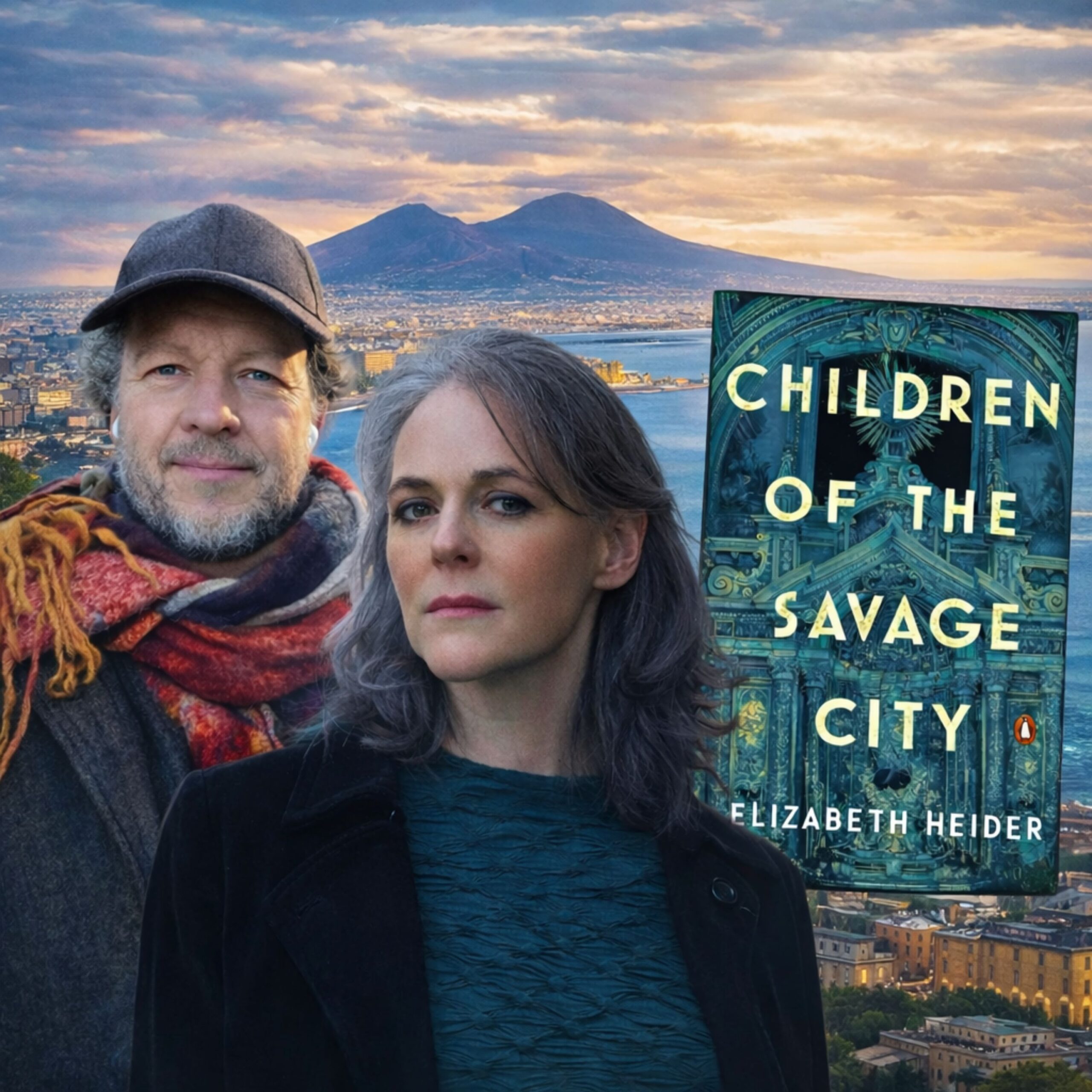
[00:08:20] Speaker B: But that's. Both of my books are based there. Sorry, I just shook the table. But the first book, which we talked about last time, which is May the Wolf Die, I think it's probably backwards on the screen here. And then the one that's coming out in two weeks, is Children of the Savage City. And these are both based in Naples, Italy.
And you can see even here. So this is the background of the COVID and is the altarpiece of the church in Chiesa del Jesu Nuovo, where the murder takes place in the book. So it's like a very central historical church in Naples.
[00:08:53] Speaker A: You know, I don't know if this. You can tell me if this is coincidental or not, but I'm looking at it right on my screen on the COVID Can you hold it up again?
[00:09:01] Speaker B: Yeah. Is it. It's probably reflecting in the.
[00:09:03] Speaker A: No, no, no, it's good, it's good.
But if I sort of do that thumbnail blurry eye thing and I just look at a little bit. It's like two eyes and a nose and a mouth.
[00:09:15] Speaker B: Oh, yeah, There's a little. It's a little sinister, isn't it? Yeah, it's kind of cool. Yeah. So It's a. Yeah, it's a really interesting geometric shape. It's a gorgeous church. It's just. And it's a really weird place, too. There's, like, the front of the church is these bizarre pyramid shapes that sort of poke out in this matrix all along the huge block. Right. And there's a hidden. There's like a secret message. Message inside them. Like, this was like a city where you had, like, secret codes inside things.
Really interesting.
[00:09:48] Speaker A: Wow.
So this book takes place there too?
[00:09:51] Speaker B: It does, yes.
[00:09:52] Speaker A: Right. And. And is based. Well, it must be. I mean, it's just so funny. We were talking about Italy and then, of course, this coincides perfectly. But that's.
Well, let me put it this way. Are you planning on. You haven't written any books about the Netherlands yet?
[00:10:08] Speaker B: No, no, I haven't. Not yet.
[00:10:12] Speaker A: Okay. But it seems like based on what we were just saying, like, Italy is sort of closer to your heart or more visceral, like you were saying.
[00:10:21] Speaker B: I do have a visceral love for it. I think that was, like. When I was there, it was one of the most intense periods of my life, actually.
So the work that I was doing was really intense and. And actually I was sort of in a really. A period of deep depression and despair, and I was just. My heart was just pouring into the work, and it mattered so much to me. And then the beauty of the city sort of, like, was sort of an antidote to pain. It really sort of. The complexity and the depth of the city sort of held me in a time when I was. I had a lot of internal chaos. And so it was really like. It was a very meaningful experience. Experience for me to be there. And every time I go back, I sort of. I come back into touch with the person that I was when I was living there and what it meant to me. And so I really love. I love the city. And I also have, like, the. The main character in the book, Nikki Serafino, she. She's a liaison between the local law enforcement and the US Military presence there. And she's actually inspired by a friend of mine who has that.
And she's really cool. She's a really cool lady. And so she and I have been friends since when I was there, you know, when I first arrived. So she. And so we're. I still. I mean, she just left a voicemail message for me yesterday, and she's. She consults, actually. She'll read the drafts of the book and, like, make sure that it's aligned with local culture. And she's also a Krav Maga expert. Her name is Sarah. And she does like, she's, she's really a. She's a badass, you know. And so when I. She's choreographed fight scenes for me and she'll read the fight scenes I write and say, oh, well, it's more like this and not like that. And I've attended some of her fighting seminars when I've gone to Naples to visit. She's really cool. Yeah. So. And she actually, she co owns a boat with an undercover police officer. And so the. And this is kind of the origin of how I. So I was like, in 2021, I was out sailing with them and she invited me to go sailing. I was like, of course I'm going to go sailing. So I'm sitting on this boat in the Bay of Naples. It was just gorgeous day. And you can see Vesuvius in the distance and then the city. And we're like getting in the water and swimming around. And I look over at her and her friend and I was like, how are you not like characters in a murder mystery? Like, you need to be. You need to be characters in a murder mystery. And so I sort of, I floated it out there because I thought this, I want to do that, you know, and. And they were like, ha, ha ha. And I said, no, seriously, like if I do this, is that okay with you?
And so they very kindly have been supporting.
She's like done a lot of cultural translation for me. She's taken me to places in Naples I could never go as an American or. Yeah. Like, I mean, even just places that are not particularly safe for a foreigner to go to. And so she's brought me. She's also a security expert. Right. So she could, she could, she could take care of us both if she needed to.
We never have to go in that situation. But she's really tough and she's also very socially capable. So she'll will go into a location and I'm just like, this is kind of dodgy. The next thing you know, she's like made friends with everybody, you know, and I'm like, do you know them? And she's like, no, no, I just met him. I was like, I'm like, cool.
So she's really capable of this. And so I really respect her. She's really cool. And so, so she's, she's consulted with me on this book and then her friend who's this police officer has taken us on tours of the, the police station, the headquarters there. And the forensics unit.
And. And yeah, so. And then she's gotten me into places. Like, there's a. In the third book that I'm writing right now, there's a scene that needs to take place in this convent that is cloistered, so you can't get into it. It's. It's a closed convent, and I really needed to get into it.
And then, like, she called me one day. It was like, last year. She's like. She's like, I got us in. You have to be out here March 16th. And so I was. So I flew out there and was able to go to, like, mass.
It was, like, open this one day, like, to go into mass. And then we were able to get a tour of the convent from the caretaker. And so she's been really. I mean, I. I couldn't do these books unless I had some, you know, people that were insiders. So I'm really grateful for that.
[00:14:42] Speaker A: Do they think it's exciting and fun to be a part of it and.
[00:14:46] Speaker B: Yeah, I think so. I hope so.
[00:14:49] Speaker A: I would think so.
[00:14:50] Speaker B: I think, yeah. So she. Yeah. They're so generous. They're so generous with everything. And so, yeah, I mean, I want to be respectful of them. Like, I don't want to take anything of their personal histories. So all of the personal background story is invented. Right. I don't take anything from their actual lives. Right. Because I don't want to violate their privacy.
So, like, the. But. But I think they. I think they think it's funny, so it's a lot of fun.
[00:15:17] Speaker A: So when you were there in 2010 working, were you already a writer or thought to be a writer or dreams?
[00:15:24] Speaker B: I've written my whole life. I've written my whole life. Yeah, so I took, like, creative writing courses when I was, like, eight.
[00:15:31] Speaker A: Okay, but, like, with your last book. But were you already, like, actually writing books and stuff like that, or is it more just, oh, I'll be a writer one day or how.
[00:15:41] Speaker B: So I had. I had. I'd written some novels in my 20s, and so that was, like, when I was still in graduate school. So I have a. My background is. So I have a undergraduate degree in physics, and then I went to Boston for a PhD in physics, and then when I finished that, I ended up working at this place called the center for Naval Analysis, which is a federally funded research and development corporation, which is kind of like. Did you do Top Gun Charlie, the researcher? She's like, a CNA analyst. Right. So that is the kind of job that. That I Would have. So I would go. And I would deploy aboard ships or go on to bases or, you know, so I would analyze exercises and things like this. Right. And so I was embedded with the military as part of that job. And so that was the job that I had in 2010-2013 when I was stationed in Naples.
Yeah. So. But I was writing the whole time. I did write the whole time, but I started. I think I'd written about. I think I'd written two books in my 20s, but I never found an agent or publisher for those. And I'm kind of glad that I did because I would not want to see those in print.
I'm very happy they were not published.
And so. But I didn't. I didn't write books again, I think, until 2019.
So I was like, I just. I did a lot of. I would do like, a lot of just journaling and short stories and things like that, but I didn't actually write another book until 2019.
And then I just. It started pouring out. Like, I just. I'd gone through a lot of, like, just done a lot of personal work, and it was like my brain started talking to itself again.
And so I just started processing all of this emotional landscape through fiction. And I just. One book after another, I just kept on, like, just churning them out. And so I think before I wrote May the Wolf Die, I had written, I want to say, seven or eight other books. I keep on saying that number and then I can't. I have to go count again. But I think that's what it is.
I'd written that many books, and so I have a bunch of manuscripts that I probably will revisit and try to get published, you know, in the next few years.
[00:17:53] Speaker A: Oh, the seven or eight were not published.
[00:17:55] Speaker B: Yeah, yeah, they're never published.
[00:17:58] Speaker A: What was then the turning point?
How did your previous book.
What was the difference? Why did the 7 or 8 were not published and then that one was. And now this one is.
[00:18:09] Speaker B: Oh, that's a good question.
[00:18:10] Speaker A: Okay.
[00:18:10] Speaker B: Well, I didn't have. I didn't have an agent for most of those other books. Right. So I went the traditional publishing route. I didn't. I didn't try to self publish. I tried to get an agent. So I had. So you just. I was querying. So I queried a bunch of people for, you know, for the first several books, a lot of things I would get like, manuscript requests, and then they would say, oh, this isn't for me.
But two books before May the Wolf Die, I did get an agent. So I had a. There's a really lovely, really intelligent woman in New York who was interested in representing that. So then she acquired that. We did a back and forth on that. And so then she helped me. She went through several rounds of edits for that one and then submitted it to a bunch of publishers. And everybody said no. So we didn't sell that first book that went on submission.
[00:19:01] Speaker A: Yeah.
[00:19:02] Speaker B: And so I wrote a second book and I sent it to her, and she read it, and she was like, I don't know what to do with this. This is really weird.
So it was really a speculative very.
Because, you know, I. I don't think. I don't think of myself as a particular genre writer. I have, like.
It's like, you know, if you have something that you need to say that you want to have said, then you find, you know, the story that comes from that. It can be any genre. Right. So the first book, the book that I sent to Sharon initially was. Was fantasy. So it was a grounded fantasy. And then the second book I sent to her was also fantasy. But I'd written some science fiction and speculative fiction as well.
But those were both kind of like, I'd never.
Like in college, I didn't take creative writing classes, which I regret. I think that would have been really helpful to understand some things about story structure and things like that.
But I kept writing. I mean, I'd been writing a lot.
But with May the Wolf Die, that was the first book that I plotted. And I think there is a difference there, because when I started getting rejections for that book that we submitted with Sharon, there were some. There were some comments about structure, There were comments about pacing. And I didn't understand the comments. I was just like, I don't really know what that means.
So I informed myself. So I read a lot of books, and I watched a lot of author interviews, and I read about editing, and I thought. And I realized that there's, you know, that I was.
What I was having trouble with was I was intuitively telling the story. I was kind of a discovery writer. But I hadn't figured out, like, how do you plan to make sure that certain beats sort of happen at a place in a way that sort of feels correct to the reader. Right.
And so the reason I plotted May the Wolf Die was because when I first suggested it to my friend Sara and her friend and asked if they would consult on it, I didn't want to commit to it unless I knew I could finish it. And the tricky bit about being A discovery writer is that you don't know if you're gonna be able to finish the book. Right?
[00:21:09] Speaker A: Yeah.
[00:21:10] Speaker B: So I needed to know I had an ending. And so I actually, when I figured out what the plot was gonna be and I structured it then I gave her a call and I said, okay, I think I really want to do this, you know. And so that was the motivation for it was simply because I knew I had consultants and I didn't want to waste their time, you know?
[00:21:30] Speaker A: You know, that's, we were talking before we hit record, we're talking what I'm up to. And I said, oh, I'm doing a lot of YouTube and stuff. And how. We were saying how, because I'm exactly like you're describing. I also like with my YouTube, I, I, I just hit a hundred thousand subscribers. Right.
[00:21:46] Speaker B: Congratulations.
[00:21:47] Speaker A: Yeah, thanks. And, and, and I'm a total discovery writer. So for those of you who don't know in the non writerly world, there's like Discovery writer or pantser they're often called because they fly by the sea of their pants.
[00:22:01] Speaker B: Right.
[00:22:02] Speaker A: And they just meet Stephen King. I don't know who came up with discovery writer, but they also, I mean, and then there's plotters or architects.
[00:22:12] Speaker B: Yeah.
[00:22:12] Speaker A: Architect. And I like another word for the pantser or discovery is gardener.
[00:22:18] Speaker B: Yeah.
[00:22:19] Speaker A: Because I like the gardener versus the architect. The gardener, like I always see it like I've got some seeds in my hand, I don't even know what they are. Might be a redwood tree, might be a strawberry. I don't know. Let's plant them and see what happens.
[00:22:30] Speaker B: Right.
[00:22:31] Speaker A: And that's all fun.
[00:22:32] Speaker B: Stephen King is, Stephen King is notoriously a discovery writer. George R.R. martin is, is a plotter. He's an architect. Right.
[00:22:40] Speaker A: Yeah.
[00:22:41] Speaker B: And I think, and I think that when you're writing mystery, you kind of have to be an architect. Like I think there can be people that do deploy do, you know, discovery writing. But like I need to know, like, I need to understand, like how, like how do these different plot lines fit together? What are the arcs I need to explore?
How do you reveal the clues over time? Because you want it to be a satisfying experience for the reader. Right. And so I think in some ways if you've, if you've plotted it properly, that can really be the case. Actually, you know, one of the best people, like the best plotters out there, like fabulous plotting. Some of the best plotting is Robert Galbraith, who is the pseudonym for J.K. rowling in her mystery series. Yeah. So Cormorant Strike and Robin Elcott. And they're fabulous, fabulously plotted books. Like, they're just. I mean, it's exquisite. And she has like, these really elaborate spreadsheets that she follows, and it's really powerful. Right. I like a.
To be that level of plotting.
But of course, the risk in plotting is that you follow the plot and you forget to sort of feel where something's supposed to go. So I think ultimately, if you want to be a good writer, you have to kind of do a little bit of both. Right?
[00:24:01] Speaker A: Yeah.
[00:24:02] Speaker B: Because you have to sort of discover and allow the things to change and flex and not be rigid in what you've plotted.
[00:24:08] Speaker A: Yeah.
[00:24:08] Speaker B: So that's my, my sense at least, you know.
[00:24:10] Speaker A: Yeah, Yeah. I really, I've like you, I'm also a student of plotting and, and I've really had fun lately. So we were talking about YouTube and how YouTube, like, I get them in and they click and they start watching. But then I think because I'm a discovery writer, like, if it just happens to be an awesome day, then it's going to be an awesome video.
[00:24:33] Speaker B: Yay.
[00:24:34] Speaker A: Right.
But if I had more structure or when I have more structure, then I can still be my discovery, fun self, but with a plot.
It helps bring them along.
Yeah, exactly.
[00:24:50] Speaker B: And I do think that there are, like, if you write with certain principles in mind, like, I think I was recently asked to write like a list of my top 10 things I've learned as a mystery writer, as a thriller writer, and I really had to think about it. And a lot of the things I've learned are about character development and about, like, how you treat the characters. And I think that they're relevant across the board. Right. So I think that you want to find certain principles that you adhere to, even as a discovery writer, even if you're not, you know, so if you don't want to. If you don't want to be. Feel boxed in or something. Right. To sort of be able to explore that. I also think it's like, it's a good experiment because I am natively like you. I'm. I'm a discovery writer too, by nature. Right. And so it's been an interesting experiment to try to be a. Try to plot things. Right.
[00:25:39] Speaker A: Yeah, yeah.
[00:25:40] Speaker B: But. But the thing I was worried about, which turns out not to be true, is I was worried that it was going to restrict my creativity. Right.
[00:25:47] Speaker A: Okay.
[00:25:48] Speaker B: No, and it doesn't. It doesn't because, like, you may know what's going to happen, but the Fun is in finding out how it happens.
[00:25:55] Speaker A: Yeah, exactly.
[00:25:56] Speaker B: Right, Exactly.
[00:25:57] Speaker A: Yes.
[00:25:57] Speaker B: That's the fun part.
[00:25:59] Speaker A: Yeah, it's a great quote. It's like constraint creates creativity.
[00:26:04] Speaker B: Yeah, yeah.
[00:26:05] Speaker A: Which for like die hard discovery writers things. No, that can't be true. You can't constrain me.
[00:26:11] Speaker B: And maybe it's not. And maybe it's not. Right. Like maybe some people just need to have nothing and they just need to plot it up. But I would say like it's a good experiment, right?
Conduct the experiment, try to plot it and see what happens. Right?
[00:26:23] Speaker A: Yeah, yeah.
[00:26:24] Speaker B: And so that's. And there's. And there's also a piece in my mind as well that's a little bit reassuring. So I'm working on books I that three right now and it's. It's complicated. It's one of the. So one of the, one of the comments everybody says about my books is that, you know, there's a lot going on. Right. And so. But in order for that to sort of hold together and for it to feel okay, like I have got to make sure I've plotted it properly. Right.
[00:26:48] Speaker A: Yeah.
[00:26:49] Speaker B: And so I actually worked and reworked and reworked the plot for book three many times.
And I would, and I would start the book and I would realize that I was starting it in the wrong location and I'd scrap it and I'd start over because I would be like, okay, now I need to start it here instead in the plot. And I think if I had tried to just do discovery writing on this one, it would have fallen apart because it's just. There's too much that has to happen, you know, So I think I had to plot it. So I just think it's an interesting experiment for somebody who's. If you're, if you're okay, if you're. I would just say this. If you're a plotter by nature, try a book where you don't plot.
[00:27:25] Speaker A: Just see what happens.
[00:27:26] Speaker B: Right. And then that sort of grows that part of you. And if you, if you don't plot, you know, give it a try and just see what it means for you too. Because I think, I think we have to develop all the sides of the skills. Right?
[00:27:38] Speaker A: Yeah.
And then use them like as you need or.
[00:27:41] Speaker B: Yeah.
[00:27:42] Speaker A: But just for the record, I stated here, for the record that I absolutely believe that even the die hard discovery writer that I am, my books and my videos and my anything, any creation I have is better when, when there's a plot of some kind. I just think it's better There's a storyline because as much as a discovery writer, I think also, I don't know, I think many like artists brains are just all over the place and so I can follow myself. Like I know where I'm going. I know I've got an end probably somewhere.
But if you, if I don't have these, you know, A to B to C to D to E to F or whatever, then you're going to lose it. You're people are going to lose the thread, you know. Yeah, I just got off a call. I'm working on a workshop for speakers and it's storytelling and I'm, I'm co.
Doing it with a, with a friend and we're talking about how do we structure the workshop? Like well, better be pretty structured because it's about structure.
[00:28:46] Speaker B: Yeah.
[00:28:47] Speaker A: And we're back, we're back to Hero's Journey.
And yet a hero's journey. Hero's Journey for me is too complicated. It's too many steps. And so I don't know if you've ever heard of this guy, but there's a guy named Donald Miller and he wrote a book called Story Brand and now he has a full on business and it's a whole, you know, philosophy and everything. And he, he brought it down to like roughly seven steps.
And he'll tell you if you follow these steps and you learn them, you'll recognize them in, you know, the Lion King and Star wars and the Hobbits, you know, you'll recognize these steps. I'm just going to tell you them because I finally sort of memorized them. It's seven steps. So there's a hero who has a problem who meets a guide who has a plan to call the hero to action to avoid failure and achieve success.
[00:29:46] Speaker B: All right, so the problem is, is those first five are in the first five, the first five chapters of the book.
That's the only problem with that particular structure, right? Yeah, that'll get you right up until like the call to adventure, right?
[00:30:04] Speaker A: Yeah, yeah, yeah. So that's where it may be for, especially for fiction then longer and more detailed like problem. You have the internal, external and philosophical problem. So you can dig into that. But these are. I also like this because I can actually remember it.
[00:30:19] Speaker B: Yeah, no, it's a good one. And I'm not saying it's bad. I think it's a great one. Yeah, for sure. And I do think you have to experiment. I don't know that you can figure out the best way to write a book unless you write a Book, right?
So, like, I think that the books I wrote previously, I learned so much by writing them, you know? Like, I. Yeah. And I figured out, like, I would write myself into corners, and I'd be like, okay, well, I don't really know what to do with this. You know, I would be able to solve problems and things, and so.
Or I had, like, some of them, too. Like, the first book that I remember trying to sell with my agent, Like, I know what's wrong with it now. Right. But at the time, I couldn't see it. Right. I understand the. So I understand what I would have to do. Do to fix that book and make it something that people felt like they were able to just jump into. Right. But I couldn't see it at the time. I was like, I don't know why I can't make it go. I don't know why nobody wants it. Right. But it's like, I think you learn by doing. Right? And so now that's part of one of the reasons why you say, I don't want to get those books published. Like, yeah, I want to fix them first. Right. Like, I wouldn't want to just publish the books and the other piece, too. And this is something that maybe people don't understand, but, like, okay, so this book, so Children of the Savage City, I wrote it during a rough period I had, like, there was a death of a friend. It was just. It was a difficult period of work, and I was just. Oh, man, I was really struggling and. But I just. I was like, okay, well, we got to get the draft done. You just get the first draft done, right?
[00:31:40] Speaker A: Yeah.
[00:31:41] Speaker B: Because there's another lesson that I had to learn. It's almost like the universe is just like, all right, Liz, you're going to have to learn this one. And I'm like, I don't want to do it. You know, you just try. You just don't want to do it. I don't want to learn this thing.
And the thing that I used to really struggle with is detail work. Right?
[00:31:58] Speaker A: Okay.
[00:32:00] Speaker B: Let's say.
Okay, so working through a sentence over and over and then working through. Let's look at this narrative thread. Let's do that analytical work of pulling out the character arc for this particular character. Let's look at the whole thing. Does it hold together line by line edits, Right. Like, that was something I just never had attention for. I would finish a book and I'd be like, okay, it's done, right?
No, it turns out you gotta rewrite. Turns out you gotta Rewrite it so many times. And I didn't. I didn't know that. And, I mean, I don't think I metabolized that. Right. I thought maybe. Oh, maybe I just change a word here and there. It's fine. Okay. So then I got this. This job of the European Space Agency.
And about two weeks into the job, I was like, oh, no. Because I'd moved to the Netherlands for this thing. It was all detail work. It was like, oh, yeah. It's like, okay, here's a spreadsheet. You gotta check line by line to make sure this. And I was like, are you kidding me? I gotta do this? Are you. This is my job. It was awful.
I was just like, I am not a detailed person. I do not want to do this.
And I hated it the whole time I was doing it, right? I did not want to be in charge of this.
What it was. It was like one of the things I had to do was account for the crew time onboard the International Space Station for individual activities, right? So let's say the astronaut Thomas Pesquet is supposed to go in, and for 10 minutes, he goes and he picks this thing up and he takes it over here, and he undoes a screw, and then he puts this thing over here. That's the whole activity, right?
[00:33:35] Speaker A: Okay.
[00:33:36] Speaker B: I was responsible for finding out how long that was going to take, accounting for how long it took and submit. And I was like, oh, my gosh, are you kidding me? And so it was like. And I was resentful of it the whole time. I did it. Like, I did it, but I was resentful. But here's the funny thing is I got really good at this, right?
I got so good at this. And so. And as much as I hated it, like, I became an expert. And so now can I sit with a manuscript and go line by line? Can I, like, really metabolize, like, a paragraph and say to myself, what is it? I mean, to say in this paragraph? Is there a better way to say it? What if I move this word around? What if I do this? Is there? And so then. So I've rewritten, like, for the Children of the Savage City. I think it took me. I mean, it took me about, I think, nine months to a year to write the first draft, right?
I rewrote it probably in that amount of time, right? Like, so I, you know, I got the comments back from my editor, and I sat down, I rewrote it page by page, word by word. Like, it's. I didn't just tweak things. I rewrote the book.
And so that was like, that was a discipline that I didn't have previously. Right. So I had to learn that. That was a hard thing is as I had to understand that I needed to know how to actually edit something.
[00:34:56] Speaker A: Okay.
[00:34:57] Speaker B: So that was a craft that I also had to learn. And so I think that's a funny thing I've understood about writing is that you can, you know, you can have great ideas and you can really want to express them and you can do your best. You can throw them down and you throw them out there and you say, okay, well, we're done now, you know, and it's like, that's the beginning, you know?
[00:35:14] Speaker A: Yeah.
[00:35:14] Speaker B: Once you've done that, then you can start doing the work. And so I understand now, like the level of work that goes into a manuscript once it's finished is huge. It's really massive. And then, you know, editors will come back and they'll say, like, oh, I don't really like this particular scene or this storyline or, you know, you need to change out or can you take those. They have two villains. Can you smush them in and make them one villain or something? You know?
[00:35:40] Speaker A: Yeah.
[00:35:40] Speaker B: And so then at that point, you have to really be able to do some of that story structure analysis. And I, I didn't know that initially, but it's a thing I've really learned.
[00:35:49] Speaker A: Have you seen the series the Bear?
[00:35:52] Speaker B: I haven't, no.
[00:35:54] Speaker A: It's. I just forget that actor's name. But it's about a restaurant. Right.
In Chicago, I think. And there's. Yeah, yeah, it's super intense.
And there's one guy, he's sort of the restaurant manager or something like that, and he's kind of a mess and it's just always unshaven and it doesn't look great. And he's sort of a disaster and he's not detail oriented. Okay.
So the episode who knows what, he leaves the restaurant and he goes to this super crazy, five star, amazing.
Sorry, I'm getting a phone call.
No, I don't want a phone call.
Sorry.
[00:36:40] Speaker B: Okay.
[00:36:42] Speaker A: He.
He gets this job at this five star, top of the line, Michelin star restaurant and his job is to clean or polish the, the knives.
Not the, not the steak knives or whatever. The. Maybe, maybe the forks too. I can't remember. It might just be the forks. And he has to, with a, with a little, little rag, has to polish each fork individually.
Okay.
And so kind of like you were saying, like, this is my job. Excel spreadsheet in 12 minutes to take the screw and open the thing or whatever.
And it's so interesting to hear your story because it's very much like this guy. And of course, it's Hollywood and they make it all fantastic, but the guy hates it. He regrets it. He's resentful. This is ridiculous. Why am I doing this? Why would anybody ever do this? It's so stupid. What a waste of time. And slowly, of course, slowly, he realizes the value of this polished fork because he's in this awesome restaurant where they expect that level of quality and service.
[00:37:51] Speaker B: Don't you hate it when you have to learn things because you're just like, I don't want to have to learn this.
[00:37:58] Speaker A: Yeah. Yeah. So he finishes his job as the fork polisher, and he goes back to the restaurant, and now he always looks amazing, and he wears a suit every day, and he's all about the quality, and he's more patient now, and he's more interested, and he's like a different person. And somebody said, dude, why are you wearing suits now? He's like, that's the person I am now.
Wow. What happened to you? And, like, the answer is, like, I polished forks for six months, you know?
[00:38:30] Speaker B: Right. No, and I think. But that's. That's. I mean, that's an interesting piece, right? Like, and I think there's, like, a balance to be struck, because I think some people, they get so lost or caught up in the details and so worried about it that they never finish the manuscript. Right? So I don't want to, like, I don't want to encourage people to. So I think that you kind of know what kind of person you are. So if you're sitting somebody that's, like, gets focused and homes in on the details and just, like, doesn't. Doesn't ever get through the planning stage or the detail stage, then the exercise for you is to just put. Put that aside and do something chaotic and crazy and just go. Right. But if you're like us, you and me, where we struggle with that and we want. We're just all creativity, and we're. We have ideas all over the place, and we're just putting them out there. Right? Like, I think that the rule for us is to try to figure out how to learn that structure to serve us, right? Not to be bound by it, but to serve us and just serve the art. Right?
So, yeah, that was a. There's an interesting book by. I don't know if I love reading books about writing. I don't know why?
[00:39:32] Speaker A: This is.
[00:39:32] Speaker B: I just. I love reading books about writing. Some of my favorites are like, there's a. Madeleine l' Engle wrote a book called Walking on Water. That's just fabulous. I'm rereading that. I read it decades ago, and I freaking love it. And I'm just listening to again. It's so good. But then Damon Voices by Philip Pullman. He was the one that wrote the. The Golden Compass.
[00:39:51] Speaker A: Okay.
[00:39:52] Speaker B: And he writes. He talks about the fact that, you know, that we have. It's almost like it's a gift that we have to be able to receive ideas. Right. It's like we. They don't. We don't really generate them. They just kind of come to us. But then we are stewards of the story.
Right? We have a responsibility to the story and that we sort of. And so we have to. And so, in a sense, like, when you.
When you hone your craft, when you practice different techniques, when you have integrity towards the story and to the characters, you're. You're being a good steward of story.
Right. And I think that's a really beautiful concept. I love that idea. And so sometimes when you put the effort into something that you feel very uncomfortable with or you don't want to do.
[00:40:38] Speaker A: Yeah.
[00:40:39] Speaker B: Like, it's important that you do it in detail.
[00:40:42] Speaker A: Yeah.
[00:40:42] Speaker B: Yeah.
[00:40:43] Speaker A: Well, I like that. Steward of story.
So it's interesting because I wanted to talk with you about your book, and we haven't really talked about, like, the story or.
But we can do that. Yeah. No, but I think this is the tease I was kind of looking for, is that I think people will want to go read your book because they're going to go look for your friend who's the. The agent who's in between the police and the military, and they're going to know. Elizabeth said that that was her. That was her friend, and. And her name is Sarah, or maybe it's not Sarah. I'm not even sure. And she does this. And I know that Elizabeth lived in Naples for three years, and so. Oh, and there's this. There's this cathedral and like that. For me, that. That's all I need to know. You know what I mean?
[00:41:29] Speaker B: Well, I hope. Yeah, I hope so. I'm happy to talk more about it, though, too, because it's a very exciting story and I really love it.
[00:41:34] Speaker A: Okay. Give us. Give us a story without. Without spoiling anything.
[00:41:37] Speaker B: Okay? I will not spoil it for you. Okay.
So in. So it's a. You can read it as a standalone. You don't have to read it in series if you don't want to, but it is part of. It's the same character and it picks up where the end of May the Wolf Die ended. Right. Okay. So at the end of May the Wolf Die, without spoiling that one, Nikki Serafino, who's our main character, has, in the investigation of this murder, really had to confront the betrayal of somebody that she trusted. Right. And also she's had to confront this concept. So, you know, we all sort of live our lives with what's, you know, a theory of control. Like, if I do this, then I'm going to be safe. If I do this, then it's going to protect me and the people around me. Right. And so Nikki sort of has lived her life with this theory of control. Like, if I follow the rules, if I do everything right, if I. If I make sure I check all the boxes, then I'm going to be able to protect myself and those around me. And at the end of May the Wolf Die, she's confronted with this violation of her theory of control. So she's kind of had to readjust her thinking and she's sort of reeling from that as she comes into Children of the Savage City. And she's also had to reach out for help from a childhood street sweetheart who is. She's not been in contact with for a very long time, who's with the Mafia, basically with the Camorra in Naples. Right. So she's already compromised her ethics at this point. So we enter Children of the Savage City where she has had this, like, breach of her sense of self, her breach of her safety, and also like a breach of her ethics that she kind of went into, and she doesn't want to go any further. She's like, I'm done. I'm not going to go into that world any further. But in the very opening scene, we see her. She's. She's teaching a Krav Maga class in the center of the city. She's. It's self defense.
And these guys come in and they like, you know, kind of are hustling to try to get her to pay security money, basically.
And then outside the studio, she's actually physically attacked and she encounters somebody from this organization that she'd asked for help from in the previous book who stops the attack. Okay. But then he wants something from her, right? So she's kind of in this situation of not wanting to be involved, but she is involved, right? She's involved. And in the meantime, there's a Murder that takes place in a cathedral that's in the historical part of the city. And one of the witnesses to the murder is the daughter of the U.S. ambassador.
And she kind of, you know, she's going to go in to the police.
But her father, who had previously worked with Nikki or had met Nikki in the previous book, knows that Nikki's liaison work and her dedication to trying to find the truth is a very important protection. Right. For his daughter.
So this, this lady refuses to talk to the police unless Nikki's there. So then Nikki gets drawn into this additional murder investigation.
And so it's a two, it's a, it's a dual point of view book.
So then the other character is Valerio Alfieri, who is a police officer in the Naples police. And he works with this really cool undercover unit that really exists. It's the Squadro Mobile, which is they. They're these motorcycle cops that are plain clothes officers and they go out into the community because Naples is this like, it's, this is very kind of a rabbit warren, like these little narrow streets. You can't even get cars in a lot of these places. And so these guys kind of, they interface with the community on a regular basis and they go out into this. And so this is what Valerio is. And we, we met him in the previous book and he gets involved in this case because his mother was, you know, at the church during mass when this murder happened. So he comes to the church, his mother was there. So this is the, the start of this. But in the previous book he also had made some compromises of himself for various reasons, you know, and so it's the books, both books, but especially this book is about what does it take to, to stay ethical inside of unethical systems or broken systems. So there's that, that, that, that, that conflict. Right.
And then another thing that I thought was really important for me as well, especially given like, what we're going through politically. What's happening in the world right now is I wanted to sort of explore this idea of how do we, how do we resist against broken systems? Like how. What is the right approach for this? And I'm starting to realize, especially when, when there's been an abuse of trust, when there's been violence or, you know, that one of the most important things that we can do is, is execute our ability for compassionate witnessing.
And so in the book, that's one of the, one of the things I propose is that, you know, you're not going to solve a crime just through a police procedural right. Is that the moments of revelation in the book is when we participate in compassionate witnessing. So I'm not sure if I'm explaining it very well, but that's sort of some of the underlying concepts of this particular book.
[00:46:50] Speaker A: Wow. Wow. I love it. It sounds. It's like you said, there's a lot in there. There's all these relationships.
And I think I'm still fascinated by the idea that you lived there and you knew these people. Some of these people, anyway. And this.
It's. It's so exciting. It's so cool. So I'm looking forward to it. Children of the Savage City by Elizabeth Heider.
And there it is.
Oh, it looks kind of blue. There it is. It's a.
[00:47:15] Speaker B: It's a bluish green. This is actually one of my favorite colors. I like this, like, deep teal. I just love the color. It's so great.
[00:47:22] Speaker A: Me, too. Me, too.
[00:47:23] Speaker B: Yeah.
[00:47:23] Speaker A: Great.
Awesome. This is super, super cool. Yeah. My pleasure. My pleasure. Looking forward to it. Best of luck and success for the book.
[00:47:32] Speaker B: Thank you.
Thank you very much. Have a lovely day.
[00:47:35] Speaker A: Thanks. You too. Bye.