Episode Transcript
[00:00:00] Speaker A: Welcome back to the Deep Dive. Today we've got a really unique stack of sources.
[00:00:05] Speaker B: It really is.
[00:00:06] Speaker A: It's not some dry academic paper. This is like a direct window into the mind of a super successful creator. Right. In a moment of what they call peak clarity.
[00:00:16] Speaker B: And it's all mixed together. We're seeing personal notes on biology, new business ideas, market analysis.
It's all in there.
[00:00:24] Speaker A: So our mission today is really to pull out the blueprints from all of this.
[00:00:27] Speaker B: The how to exactly.
[00:00:29] Speaker A: We want to figure out how you can find and capitalize on those fleeting moments of maximum energy, and crucially, how.
[00:00:36] Speaker B: That personal peak time can translate into actual results.
[00:00:40] Speaker A: Right, professionally and financially, but with surprisingly low effort. I think the core tension we're going to explore is, is success about catching that magic lightning in a bottle or is it just about building a rigid, consistent structure?
[00:00:52] Speaker B: And what I think is so interesting is that the creator doesn't separate those things. We're going from like jet lag recovery straight into investment strategy. The whole approach seems to be that your personal energy state isn't just a nice to have, it's the engine. And we have to understand that engine first.
[00:01:08] Speaker A: Okay, so let's start right there at the source of that energy. The creator says before you do anything else, you have to figure out the exact time of day.
[00:01:16] Speaker B: You're at your best and just as important when you're not. They frame it as a mandatory daily tracking exercise, not just some self help tip.
[00:01:26] Speaker A: And their own experience is a fascinating proof of concept here. They recorded these insights early on a Saturday morning, pinpointing that as their peak.
[00:01:34] Speaker B: Right. They talk about having positive high vibration ideas, but here's the twist.
They were just back from a nine.
[00:01:41] Speaker A: Week trip to the us A seven hour time difference.
[00:01:44] Speaker B: Exactly. So if you follow that old rule, you know, one day of recovery per hour of time difference, you should have.
[00:01:50] Speaker A: Been over it weeks ago.
[00:01:51] Speaker B: Well, weeks ago, the physical jet lag should be long gone. But this, this mental clarity, this confidence is only just now returning.
[00:01:59] Speaker A: So that tells us something really important.
[00:02:01] Speaker B: It's a huge insight. Physical recovery and mental confidence recovery are two totally different things. Your body might be reset, but your mind's ability to get to that creative peak, that high flying disc state, it lags behind.
[00:02:17] Speaker A: Okay, let's define that. You just mentioned it. The high flying disc, what exactly is that?
[00:02:21] Speaker B: It's a term from, I think energy work, basically being on a higher vibration. But they make it very practical.
[00:02:27] Speaker A: So it's not about physical energy, like going for a run no, not at all.
[00:02:30] Speaker B: They're very specific. It's about emotional and mental positivity. It's that feeling of this idea is brilliant and I'm hitting upload right now.
[00:02:37] Speaker A: And once you're on that disc, there's a very clear rule about what you're.
[00:02:40] Speaker B: Supposed to do, an absolute rule you must create. That is the only time for new output. For high value tasks, the creator says they had to record an upload immediately because that wave of confidence is the fuel.
[00:02:52] Speaker A: And then what happens when the energy dips, which it always does.
[00:02:55] Speaker B: That's your time to consume. That's for Netflix. Clearing out emails, reading just passive stuff.
[00:03:02] Speaker A: So you don't waste the peak.
[00:03:03] Speaker B: You can't. The source is clear that this clarity is incredibly fleeting. They expected it to be gone in like two to 10 hours. You have to be ruthless about capturing.
[00:03:12] Speaker A: That window, that urgency, it sort of forces a structure on you. They talk about a specific routine meditation, then immediately after creation.
[00:03:21] Speaker B: And to get there consistently, they point back to an even deeper structure from their book 17 Hours. The full stack is fasting, then meditating, then creating.
[00:03:32] Speaker A: Why in that order. Fasting first seems intense.
[00:03:36] Speaker B: It's about using your body's physiology. When you're fasting, your body isn't spending energy on digestion. So that energy is freed up and it often leads to this very clean, focused cognitive state.
So you get physical stillness from the fast, mental stillness from the meditation, and then you just pour all of that combined focus into your creative work. It's a very deliberate process.
[00:03:54] Speaker A: Okay, so we've got the personal energy discipline down. How does this peak clarity then get applied to, say, a business strategy? Because they pivot right into a new business idea.
[00:04:05] Speaker B: They do, and it starts with a really frank conversation with a partner about what clients actually want.
[00:04:10] Speaker A: And the conclusion was pretty blunt, brutally blunt.
[00:04:14] Speaker B: The partners assessment was that 95% of people just don't want to do the work.
[00:04:19] Speaker A: They want the result, not the process.
[00:04:21] Speaker B: Exactly. They want to pay the money, have a little bit of input and have a result.
[00:04:26] Speaker A: It's kind of a big shift though. I mean, this creator has published 40 books. You'd think their whole brand is about doing the work.
[00:04:33] Speaker B: It's a huge insight into market maturity. They realized trying to be a cheerleader for the unwilling 95% was. It was a low leverage activity.
[00:04:42] Speaker A: Instead of trying to motivate everyone, they.
[00:04:44] Speaker B: Decided to stop and to focus only on the 5% who are already serious, the ones who already have that internal drive.
[00:04:51] Speaker A: And that led to this brilliant super Low input service model.
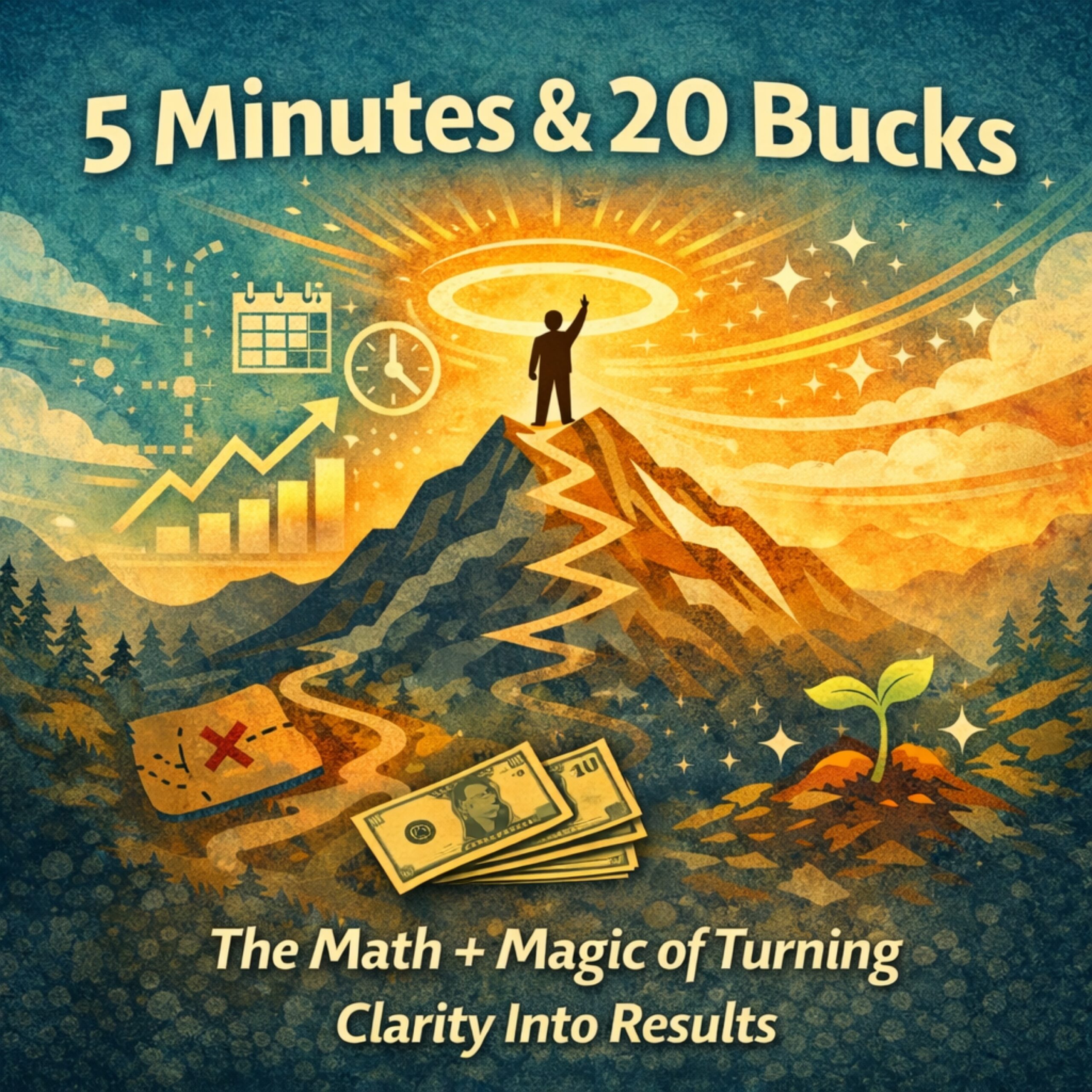
[00:04:55] Speaker B: It did. The partner distilled the client's commitment down to this. This absurdly simple line. I've got five minutes and 20 bucks.
[00:05:03] Speaker A: That's it. That's the maximum they'll give you.
[00:05:05] Speaker B: That's the boundary. So the challenge is what can you deliver for five minutes of their time and $20 that gives them massive lasting value.
[00:05:14] Speaker A: So what is the product?
[00:05:15] Speaker B: It's a physical, personalized poster. It's created after just a five minute mini interview.
[00:05:21] Speaker A: A poster?
[00:05:22] Speaker B: Yeah, but think of it as a gorgeous, high quality infographic. A beautiful set of visual notes with icons, colors, shapes. The whole point is to crystallize the client's vision for their year into something physical they can see every single day.
[00:05:38] Speaker A: And the naming is really important here. They're very specific that it's not a roadmap.
[00:05:42] Speaker B: Right. A roadmap, they argue, just gets you from A to B.
[00:05:45] Speaker A: It's linear, it's just directions.
[00:05:47] Speaker B: Exactly. This product needed to be a treasure map. Something that inspires discovery, that shows the whole journey, not just the next step.
[00:05:53] Speaker A: And it's built around an acronym to get you from A to B to csee.
[00:05:57] Speaker B: Csee, yes. Yes. And that's the internal structure for designing the poster.
[00:06:02] Speaker A: Okay, so what does it stand for?
[00:06:03] Speaker B: It stands for clarity, success, excitement and energy.
So the output that poster has to deliver clarity on their goals, define what success looks like, create genuine excitement, and act as a daily jolt of energy.
It turns a quick chat into a powerful personal tool.
[00:06:22] Speaker A: That focus on structure and long term value seems to carry right into the second venture they discussed.
[00:06:27] Speaker B: It does. It's a podcast with the same partner, but this one is all about building wealth.
[00:06:32] Speaker A: And they're targeting a very specific audience.
[00:06:34] Speaker B: A very specific and frankly underserved one. Young people, teenage and early 20s, boys specifically.
[00:06:42] Speaker A: And the goal is to teach them how to invest their money more wisely.
[00:06:45] Speaker B: Better than, you know, putting it under a mattress or just letting it die in a bank account.
[00:06:49] Speaker A: Or spending it on snow cones.
[00:06:52] Speaker B: Maybe spending it on snow cones. Exactly.
[00:06:54] Speaker A: I like that they're aiming it at the absolute beginner. The goal is to teach the concepts as if I'm a seven year old. Yeah, but how do you do that without it being too simplistic?
[00:07:05] Speaker B: Well, they start with the basic vocabulary. They draw a really clear line between being an investor.
[00:07:10] Speaker A: Okay. Which is the passive long term approach.
[00:07:13] Speaker B: Right. Put your money in safe stuff, let it sit, let it compound until retirement. And then they differentiate that from being a trader, which is more active.
[00:07:22] Speaker A: And they're not talking about day trading, right?
[00:07:24] Speaker B: No, they're very clear about that. They do not recommend day trading. It's about sustainable, structured, more active strategies if you want to be more involved.
[00:07:32] Speaker A: So the math part of this is the time commitment. It's not about watching charts all day.
[00:07:36] Speaker B: Not at all. They specifically say it's about an hour or a few hours a week. That's it. The goal is to learn the principles, build a portfolio with some safe stuff and some little riskier stuff and just learn how to grow your money consistently, even if it's a small amount of.
[00:07:51] Speaker A: And this all ties back to a metaphor the creator had during their meditation.
[00:07:56] Speaker B: It does, and it's a really powerful one. The central concept for the whole thing is the idea of the seed.
[00:08:01] Speaker A: A seed?
[00:08:02] Speaker B: Yeah. The goal is to give these young guys a seed, a core asset and the knowledge of how to grow it. It's something that can compound into something.
[00:08:11] Speaker A: Huge over decades, which is fundamentally different from a short term gift.
[00:08:15] Speaker B: Totally different. It's not a bicycle or. Yeah, an ice cream cone. It's not about consuming now, it's about investing in the future. The seed vers the snow cone. That's the whole philosophy. It's about patience and structure.
[00:08:28] Speaker A: So we've gone from personal energy to business products to building wealth.
What's the thread that ties all of these high energy ideas together? What makes them actually happen?
[00:08:40] Speaker B: It's one word really. Consistency.
I mean, if you want the creator's secret to success, they point right to their track record. They just started season seven of their weekly video series.
That's the one that means six straight years of a weekly video. That's how they got to 150,000 subscribers. It's just the consistency.
[00:08:59] Speaker A: And it's not just one habit. It's a whole system of habits. Right.
[00:09:02] Speaker B: It's a three tiered system. It's habit stacking a short video every single day, a main video every single week, and a detailed newsletter every single month.
[00:09:12] Speaker A: That is a non negotiable schedule.
[00:09:14] Speaker B: It's the engine. And they've wrapped this whole philosophy up into their word of the year for 2026.
[00:09:20] Speaker A: Which is.
[00:09:20] Speaker B: Mathematician.
[00:09:21] Speaker A: Mathematician. Okay, break that down.
[00:09:23] Speaker B: It's the perfect synthesis of everything we've talked about. It's a combination of two.
Math and magic.
[00:09:29] Speaker A: The math is the structure.
[00:09:31] Speaker B: Exactly. The math is the process, the habits, the consistency.
And the magic is the spirit. That high flying confidence, the inspired ideas we talked about at the beginning. You need both.
[00:09:43] Speaker A: So the whole philosophy is the process is the progress.
[00:09:46] Speaker B: Precisely. You stop focusing on the giant, far off goal and you focus entirely on the immediate routine.
[00:09:52] Speaker A: You win the day.
[00:09:54] Speaker B: By sticking to the process, you win the day. And if you do that every day, the long term results, whether it's publishing 40 books or building a portfolio, they just, they take care of themselves.
[00:10:03] Speaker A: So let's bring this all back to you.
We figured out how to find that personal peak time, that high flying disc. We've seen how you can package that clarity into something valuable, like the treasure.
[00:10:14] Speaker B: Map with that CSE framework. And we've covered how important it is to build wealth by planting that seed, trading short term consumption for long term growth.
[00:10:23] Speaker A: And when you put it all together, the real power becomes obvious.
[00:10:26] Speaker B: It does. Whether you're fighting a productivity slump or you're launching a new idea, or you're just starting to invest, the argument here is that real success comes from aligning that personal, confident energy, the magic, with a rigid, systematic structure. The math.
[00:10:42] Speaker A: It's the difference between just hoping for inspiration and actually scheduling progress.
[00:10:47] Speaker B: That's a perfect way to put it.
[00:10:48] Speaker A: So here's the final thought for you, Chuan.
The creator's success is this blend of math and magic. But most of us tend to lean one way or the other. All structure and no spark, or all spark and no structure. So how can you design an unbreakable structure for yourself? A daily, weekly or monthly process that's perfectly built to capture your own moments of high flying clarity? How do you make sure your math doesn't just feel like a grind, but feels like the very path that guarantees your next moment of magic turns into real tangible progress, Something to think about until the next deep dive.