Episode Transcript
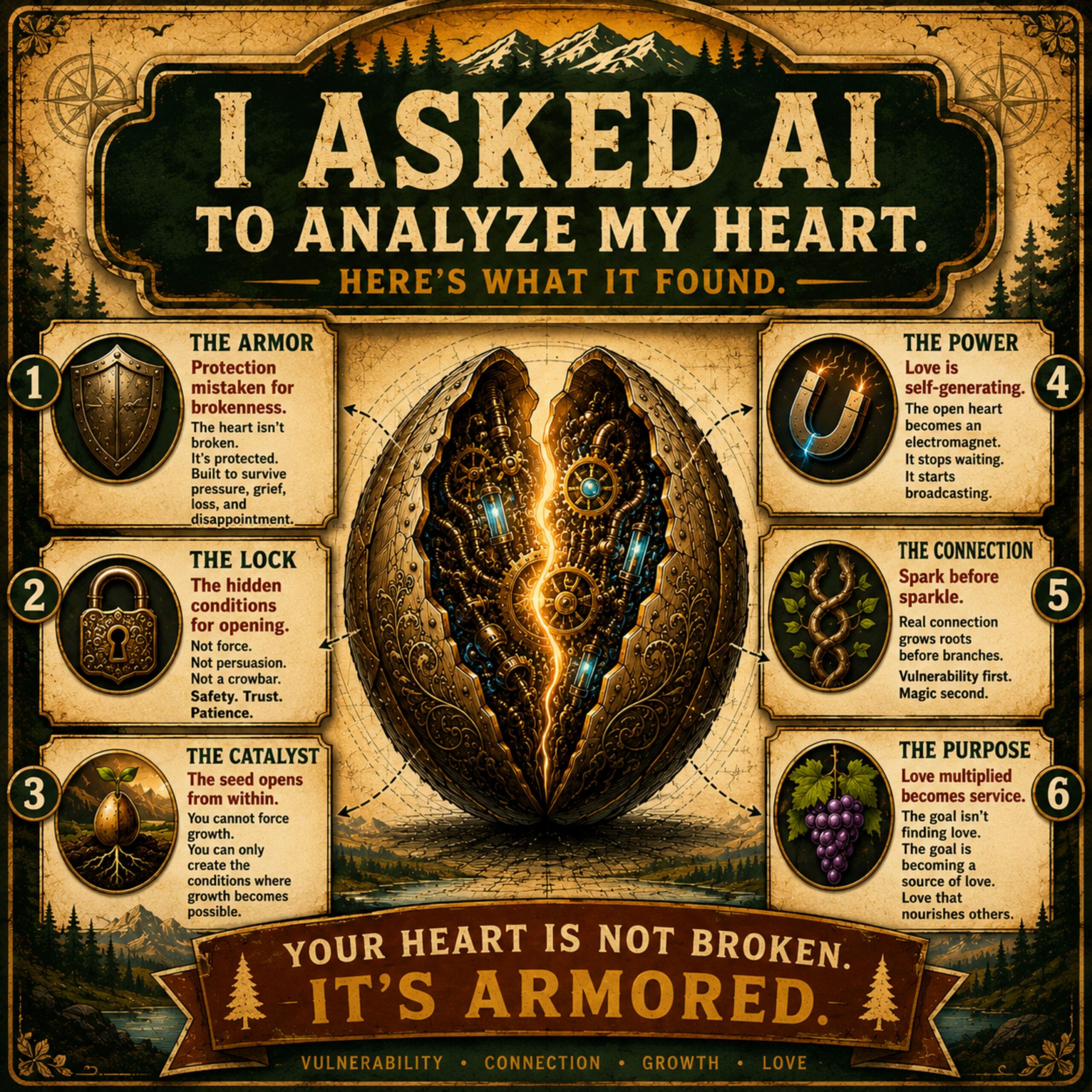
[00:00:00] Speaker A: So imagine your heart is like a steampunk submarine.
[00:00:03] Speaker B: Okay. A steampunk submarine.
[00:00:05] Speaker A: Yeah. But wait, it gets weirder. It's locked behind this old school four digit combination code.
[00:00:11] Speaker B: Like on a vintage suitcase.
[00:00:12] Speaker A: Exactly like that. And the whole thing is completely hidden inside the shell of an avocado seed.
[00:00:18] Speaker B: That is just. Wow. That is highly specific.
[00:00:21] Speaker A: Right. But that's the bizarre, incredibly profound map of. Of human vulnerability we are going to explore with you today.
Welcome to the deep dive.
[00:00:31] Speaker B: I am so ready for this one.
[00:00:32] Speaker A: So we're looking at a transcribed audio diary. It's an early morning recording from May 25, 2026 by a guy named Bradley.
[00:00:39] Speaker B: Right.
[00:00:39] Speaker A: Yes, Bradley. He calls this particular session a meditation Monday.
[00:00:44] Speaker B: Love that.
[00:00:45] Speaker A: And just picture the scene. He's sitting in this sun drenched room, looking out at a totally clear blue sky.
[00:00:51] Speaker B: Very peaceful.
[00:00:51] Speaker A: Yeah. And his dog Pepper is just fast asleep on the floor nearby.
[00:00:55] Speaker B: It sets such a calm stage for something complex.
[00:00:58] Speaker A: It really does. Because the mission of this deep dive is to sort of untangle Bradley's stream of consciousness visualization of what it actually means to have your emotional core, like, cracked wide open.
[00:01:12] Speaker B: It's such a remarkable piece of source material because, you know, he takes something totally ephemeral and turns it into physical architecture.
[00:01:19] Speaker A: Right. Like real machinery.
[00:01:20] Speaker B: Exactly. Most of us just label this feeling love or vulnerability, and we just leave it at that. I mean, we treat emotions like the weather.
[00:01:29] Speaker A: Oh, like something just happens to us.
[00:01:30] Speaker B: Yeah, exactly. But Bradley, he treats emotion like engineering. He is dissecting the anatomy of this psychological awakening.
[00:01:39] Speaker A: He really gets into the mechanics of it.
[00:01:40] Speaker B: He does. He uses this incredibly vivid, layered imagery to document not just what he's feeling, but the precise mechanical process of how that feeling operates.
[00:01:50] Speaker A: Okay, let's unpack this. Because two, to truly grasp what an open heart looks like in Bradley's universe, we have to establish the baseline first. Right.
[00:01:59] Speaker B: A closed heart.
[00:02:00] Speaker A: Yes. What it looks like when it's just bolted shut. And he doesn't just say, you know, I was guarded.
[00:02:04] Speaker B: No, that would be too simple.
[00:02:06] Speaker A: Right. He visualizes his closed heart as this brown, ordinary looking avocado seed.
[00:02:12] Speaker B: But that's just the camouflage.
[00:02:13] Speaker A: Exactly. Because once you look closer, this seed is heavily armored.
[00:02:17] Speaker B: Hence the steampunk battleship.
[00:02:19] Speaker A: Yeah. Or more specifically, he calls it a submarine. It's forged from steel. It's held together with heavy duty rivets, industrial clamps, and like military grade enclosures.
[00:02:32] Speaker B: The choice to use a submarine as the central metaphor there is just incredibly telling about his psychological state at the time.
[00:02:38] Speaker A: How so?
[00:02:39] Speaker B: Well, think about the primary function of a submarine. It's engineered to withstand and hold back immense crushing pressure from the outside environment.
[00:02:48] Speaker A: Right. While keeping the inside totally safe.
[00:02:50] Speaker B: Exactly. Keeping that fragile interior completely isolated, dark and dry.
[00:02:55] Speaker A: That makes a lot of sense.
[00:02:56] Speaker B: Right, because when we close ourselves off emotionally, it usually isn't because we're empty. It's because we feel like we are trapped under this ocean of external pressure.
[00:03:04] Speaker A: Like expectations. Or past traumas.
[00:03:07] Speaker B: Societal demands, all of it. And the only logical way to survive that kind of depth is to build a titanium hull around your most sensitive core.
[00:03:16] Speaker A: Wow. Yeah. And he goes into even more granular detail about the security measures, too.
[00:03:21] Speaker B: Oh, the combination lock.
[00:03:22] Speaker A: Yes. If you turn this armored avocado seed over, you find that vintage four number
[00:03:28] Speaker B: combination lock on the bottom, just hidden away down there.
[00:03:31] Speaker A: Yeah, and he mentions other hidden entry points, too, like a secret audio password.
[00:03:35] Speaker B: Oh, I love that detail.
[00:03:37] Speaker A: Or a highly specific chemical and emotional reaction.
He gives the example of a sudden rush of adrenaline combined with physical touch.
[00:03:45] Speaker B: It's like a biometric scanner, literally.
[00:03:48] Speaker A: Yeah, but I mean, I have to push back on his framing here a little bit.
[00:03:52] Speaker B: Okay, what do you mean?
[00:03:53] Speaker A: Well, he seems to view this extreme defense mechanism as a problem to be solved. Right, sure. But isn't a fortress actually a good thing? I mean, if you're genuinely facing submarine level pressure in your life, shouldn't you want steel rivets?
[00:04:06] Speaker B: That's a really fair point.
[00:04:07] Speaker A: Right. If you have something fragile inside, clamping it shut seems like a highly rational protective strategy to me.
[00:04:14] Speaker B: It's survival.
[00:04:16] Speaker A: Exactly. Yeah. He even talks about how outside forces try to breach the hull using aggressive, what he calls masculine tools, like the crowbar. A crowbar, a drill, a jackhammer. Like, if someone is coming at your emotional core with a metaphorical jackhammer, you absolutely want a steel hull.
[00:04:33] Speaker B: What's fascinating here is his realization about the fundamental paradox of that exact defense mechanism, though.
[00:04:38] Speaker A: Okay, tell me.
[00:04:39] Speaker B: A fortress keeps the invaders out. Right?
But a fortress is also a prison for the person living inside it.
[00:04:45] Speaker A: Oh, that's true.
[00:04:47] Speaker B: The steel hull successfully deflects the crowbar and the jackhammer. But Bradley realizes that forcing an emotional seed open with blunt trauma, it never yields a living thing.
[00:04:57] Speaker A: You can't just smash it open.
[00:04:58] Speaker B: No. You cannot hack someone's emotional defenses. If you take an actual crowbar to a real avocado seed, you don't magically sprout a plant.
[00:05:05] Speaker A: No. You just make guacamole. Well, you just obliterate the seed.
[00:05:10] Speaker B: Exactly. You destroy it. His Realization is that the armor was necessary for a time, but the violent tools people use to try and bypass that armor, they're entirely the wrong approach.
[00:05:21] Speaker A: Right, because emotional defenses can't be destroyed from the outside.
[00:05:24] Speaker B: They must be unlocked naturally.
[00:05:26] Speaker A: So if the defense mechanism is a submarine designed to repel external force, applying more external force is doomed to fail.
[00:05:35] Speaker B: It just makes the hull thicker.
[00:05:36] Speaker A: Right, which forces us to look at a completely different mechanism for opening. How does this armored steampunk seed actually bloom?
[00:05:44] Speaker B: This is where we get into the catalyst.
[00:05:46] Speaker A: Yeah. So the immediate catalyst for Bradley's current awakening is a woman named Holly.
[00:05:51] Speaker B: But he's careful to note that this isn't his first experience with the submarine hull cracking.
[00:05:56] Speaker A: Oh, right. The timeline goes further back.
[00:05:57] Speaker B: Yeah. He traces his emotional timeline back to 2014 to a moment of intense grief when his father died. He recalls crying on the shoulder of a friend named Edwina.
And in that instance, it was the overwhelming internal pressure of grief that breached the hole.
[00:06:14] Speaker A: But he didn't really understand it then, did he?
[00:06:16] Speaker B: No, he completely lacked a framework for what was actually happening to him.
[00:06:21] Speaker A: He didn't even have the vocabulary for this experience until he started absorbing outside influences much later.
[00:06:26] Speaker B: Yeah, like the Joe Dispenza stuff.
[00:06:28] Speaker A: Exactly. He specifically points to a woman named Sarah who recorded a 14 minute testimonial for the author Joe Dispenza.
[00:06:36] Speaker B: And he became obsessed with this recording.
[00:06:39] Speaker A: Obsessed? He analyzed it, listening to it 10, maybe 20 times. And Sarah's the one who actually introduced him to the specific phrase cracked open.
[00:06:49] Speaker B: Language shapes our reality so much, but initially, you know, that phrase cracked open sent his imagination to a very dark, clinical place.
[00:06:56] Speaker A: Oh, the surgical imagery.
[00:06:58] Speaker B: Yeah. He admits that he first pictured a surgical theater. Like he envisioned a surgeon literally cracking open a rib cage with metal retractors.
[00:07:06] Speaker A: Wow, that's intense.
[00:07:07] Speaker B: It was still tied to that violent mechanical imagery of the crowbars and drills.
[00:07:11] Speaker A: But the shift from that violent surgical imagery to an organic process, that is where the story completely pivots.
[00:07:18] Speaker B: And that's thanks to the meditations.
[00:07:20] Speaker A: Right. He credits a 47 minute past life regression meditation by a Spanish woman named Alessandrina.
[00:07:27] Speaker B: And there was someone else too.
[00:07:28] Speaker A: Yes, along with the influence of this mysterious, silent German sounding figure he refers to as Dexter.
[00:07:35] Speaker B: Dexter.
[00:07:35] Speaker A: Fascinating.
[00:07:36] Speaker B: Yeah. These meditations really softened his perspective. And it's at this point that a childhood memory surfaces and completely replaces the imagery of the hospital operating room.
[00:07:46] Speaker A: I love this part.
[00:07:47] Speaker B: He remembers being a kid taking an ordinary avocado seed, sticking three toothpicks into its Sides and suspending it in a glass of water.
[00:07:55] Speaker A: A classic science experiment playing. But that nostalgic image fundamentally redefines the rules of emotional engagement for him.
[00:08:02] Speaker B: How so?
[00:08:02] Speaker A: Well, sticking toothpicks in an avocado seed and placing it in water, that is an act of trust and environmental design.
[00:08:09] Speaker B: You're setting the stage.
[00:08:10] Speaker A: You're no longer forcing an outcome. You're creating the conditions for an outcome to occur spontaneously. And he draws a brilliant contrast between the climates of his past and present to illustrate this.
[00:08:22] Speaker B: Oh, the indoor plants.
[00:08:24] Speaker A: Yeah. He mentions that he currently has 40 indoor avocado plants growing in his house.
[00:08:28] Speaker B: 40 is a lot of plants.
[00:08:30] Speaker A: Right.
And he points out that his native California possesses all the sun and ambient warmth an avocado could ever want, but it lacks the necessary water.
[00:08:40] Speaker B: Right.
[00:08:41] Speaker A: Conversely, his current home in the Netherlands has an abundance of water, but completely lacks the sun and warmth.
[00:08:47] Speaker B: It serves as this perfect ecological metaphor for emotional readiness. Yes, because a seed contains the entire blueprint for a massive tree. But if the environmental conditions are unbalanced, you know, too much warmth, but no hydration, or too much hydration but no warmth, that blueprint remains locked away.
[00:09:05] Speaker A: You can't just force it.
[00:09:06] Speaker B: Exactly. You cannot demand that a seed grow simply because you desire it to. You have to balance the climate.
[00:09:11] Speaker A: It is the ultimate exercise in emotional gardening. You know, you can't scream at a seed to photosynthesize.
[00:09:17] Speaker B: No, that won't work.
[00:09:18] Speaker A: You can't take an ax to it to speed up the process.
You have to just suspend it in that glass of water. And Bradley is highly realistic about this part.
[00:09:27] Speaker B: The yucky water part.
[00:09:28] Speaker A: Yeah. He notes that the water in that glass isn't always going to stay pristine. It might get cloudy, it might get green and algae filled. It might even get, like, a little yucky.
[00:09:38] Speaker B: The waiting period is rarely glamorous.
[00:09:41] Speaker A: No, it's not. You just have to sit there, maintain the environment, and be immensely patient.
[00:09:45] Speaker B: And patience is the driving philosophy of this entire section of his diary.
[00:09:49] Speaker A: Right.
[00:09:49] Speaker B: The critical shift in his understanding is that the seed must open from within.
Bradley actually states, it is born. It exists to come out and be shared.
[00:09:58] Speaker A: Wow.
[00:09:59] Speaker B: So the water in the glass serves to soften the tough outer shell, but the kinetic energy required to actually crack the armor comes entirely from the life force expanding inside the seed.
[00:10:10] Speaker A: So it's doing the work itself.
[00:10:11] Speaker B: Yes.
Love, in his framework, is biologically designed to emerge, but it will stubbornly refuse to do so until the environment signals that it is safe to expand.
[00:10:21] Speaker A: Okay, here's where it gets really interesting.
[00:10:23] Speaker B: I know where you're going with this.
[00:10:25] Speaker A: Once the patience is paid off. Right.
The water has done its softening work, and the seed finally cracks open from the inside out.
[00:10:33] Speaker B: The whole landscape changes.
[00:10:34] Speaker A: It changes completely. What spills out of this cracked avocado seed isn't just a little green shoot. He looks inside the seed and he notes that the interior doesn't resemble an avocado at all.
[00:10:46] Speaker B: No, it looks like a walnut.
[00:10:48] Speaker A: A walnut?
[00:10:49] Speaker B: Yeah. A walnut is characterized by its complex topography. You know, it's full of winding nooks, deep crannies, and textured valleys.
[00:10:56] Speaker A: It looks like a human brain.
[00:10:57] Speaker B: Exactly. And within those valleys, Bradley doesn't see plant tissue. He sees a microcosm of an entire universe blending biology with complex machinery.
[00:11:07] Speaker A: Oh, this is the steampunk stuff again.
[00:11:09] Speaker B: Right. He describes intricate neural networks, cables and pipes. It looks like a vibrant, bubbling, active steampunk factory.
[00:11:16] Speaker A: He takes that steampunk imagery from earlier and completely flips his purpose.
[00:11:20] Speaker B: He reclaims it.
[00:11:21] Speaker A: Yeah. Before the steampunk aspect was the battleship. Cold, defensive, focused entirely on keeping threats out. But now the steampunk machinery is internal. It's warm, and it's focused entirely on creation. It's like this glowing, mechanical hive of love.
[00:11:36] Speaker B: And the power source for this internal factory is what makes the metaphor so compelling to me.
[00:11:41] Speaker A: The magnets.
[00:11:42] Speaker B: Yes. He initially compares the energy to tiny, ultra strong European magnets. But he catches his own conceptual error and corrects himself in the diary.
[00:11:52] Speaker A: Oh, why? What was the error?
[00:11:53] Speaker B: Well, a standard magnet is entirely passive. It just sits there in the dark, exerting a localized pull, just waiting for a piece of conductive metal to stumble into its field.
[00:12:02] Speaker A: Oh, I see. So what does he change it to?
Well, instead, he realizes this factory operates like an active electromagnet.
[00:12:10] Speaker B: Ah, so it needs a current.
[00:12:11] Speaker A: Exactly. It requires a current.
It is proactively sending out vibrations, broadcasting its signal out into the void, actively searching to connect with the reciprocal plus and minus charge.
[00:12:21] Speaker B: So the closed heart is a bunker, but the open heart is a radio tower.
[00:12:26] Speaker A: Exactly. That transition from passive reception to active broadcasting is the defining characteristic of emotional maturity.
[00:12:32] Speaker B: In his model, that makes total sense.
[00:12:34] Speaker A: When you open up, you stop passively waiting for the universe to deliver a connection to your doorstep.
You actively generate the frequency you wish to receive.
[00:12:43] Speaker B: And furthermore, Bradley emphasizes that this internal factory is entirely self energizing. Meaning it does not require a constant infusion of external validation to keep the machines running.
[00:12:55] Speaker A: Oh, wow. He is adamant about the resilience of this energy too. He believes that this internal love cannot be defeated, it cannot be killed.
[00:13:04] Speaker B: Yeah, he compares it to water, right?
[00:13:05] Speaker A: You can freeze it into ice, you can dam it up and put it on hold, you can force it to squeeze through microscopic cracks in a rock over thousands of years, but the substance itself will always exist.
[00:13:16] Speaker B: Always.
[00:13:17] Speaker A: And to hammer the point home, he uses this wildly different analogy. He compares it to an alien organism in a sci fi horror movie that constantly self replicates.
[00:13:26] Speaker B: I love that pivot, right?
[00:13:27] Speaker A: Like, no matter what hostile environment you put it in, it adapts, survives, and keeps growing.
[00:13:32] Speaker B: It is a deeply visceral way to conceptualize the sheer stubbornness of the human spiritual. You know, the capacity for love might go dormant for decades. It might be locked behind a four digit combination lock on the bottom of a steel submarine hull, buried in the
[00:13:46] Speaker A: mud of the ocean floor, but it never actually dies.
[00:13:49] Speaker B: Never.
And when the hull finally gives way, it thrives and multiplies. Specifically when its broadcast signal finally connects with other micro universes of love.
[00:14:00] Speaker A: Which brings us to the collision of these forces. Bradley's electromagnet heart is broadcasting its signal.
[00:14:06] Speaker B: So we are shifting from the mechanics of the individual to the architecture of the intertwined collective.
[00:14:12] Speaker A: Yeah, like how do two steampunk walnuts actually merge?
[00:14:15] Speaker B: Right. Well, he envisions these two open seeds sitting side by side. Crucially, they do not just mash together into one indistinguishable blob.
[00:14:23] Speaker A: Oh, that's important.
[00:14:24] Speaker B: Very. They retain their individual structures. Instead, they send out tentacles or roots that reach across the gap and intertwine naturally.
[00:14:31] Speaker A: And he captures the rhythm of this connection with the phrase, inhale is two, exhale is one.
[00:14:36] Speaker B: It's beautiful.
[00:14:38] Speaker A: It paints a picture of a synchronized breathing apparatus.
But Bradley is incredibly precise about the anatomy of this new growth.
He introduces this massive distinction between the roots and the branches.
[00:14:51] Speaker B: The spark and the sparkle.
[00:14:52] Speaker A: Yes. He labels the roots the spark.
The spark is the dark, deep, foundational fire. It is the core power plunging deep into the dark earth to establish a structural anchor.
[00:15:04] Speaker B: And the branches and the leaves that grow upward into the light, those are what he calls the sparkle.
[00:15:09] Speaker A: I love that the sparkle represents the glitter, the shimmer, the smiles and the lightness of the connection.
[00:15:14] Speaker B: It's the fun stuff.
[00:15:15] Speaker A: Exactly. But he makes a definitive rule for his universe. Yeah, you absolutely cannot have the le. The sparkle without the foundational spark.
[00:15:23] Speaker B: And this is a profound insight into the mechanics of long term relationships.
[00:15:27] Speaker A: I think definitely.
[00:15:28] Speaker B: The sparkle is the visible joy. It's the Instagram friendly vacations, the easy Laughter over dinner, the romantic gestures, the stuff everyone sees. Right, but without a deep, unseen root system, the spark, which represents shared vulnerability, handling conflict, mutual trust, weathering grief. Without that, the sparkle is just surface level glitter.
[00:15:51] Speaker A: It has no anchor.
[00:15:52] Speaker B: None. A storm will blow the sparkle away entirely if the spark isn't driving deep into the soil.
[00:15:57] Speaker A: So true. So these vines are growing out of the two individual seeds, intertwining their sparks and their sparkles.
[00:16:03] Speaker B: Growing externally.
[00:16:04] Speaker A: Yes. Upward and outside of their own individual hearts. The seeds are surrendering to the connection, pooling their resources to build a brand new source of love entirely outside of themselves.
[00:16:15] Speaker B: And this shared energy grows into this massive Amazon like canopy of light green leaves stretching out in all directions.
[00:16:22] Speaker A: And this canopy is heavy, heavily laden with grapes.
[00:16:25] Speaker B: Grapes. And he introduces a powerful sensory layer to this canopy, too, transitioning from the visual to the auditory.
[00:16:32] Speaker A: Oh, right, the voices.
[00:16:33] Speaker B: Yeah. He describes the merging of their two distinct vocal vibrations. His voice carries a certain foundational tone, and voice carries a completely unique tone.
[00:16:41] Speaker A: And when the vines intertwine, those vibrations
[00:16:44] Speaker B: blend to create an entirely new harmonized musical sound that resonates through the leaves.
[00:16:50] Speaker A: So what does this all mean for us? For you, the listener? I mean, we have traveled from a steampunk submarine at the bottom of the ocean to a glass of water on
[00:16:59] Speaker B: a windowsill, to a bubbling mechanical walnut,
[00:17:02] Speaker A: and finally to a giant Amazonian great canopy making harmonized music.
[00:17:08] Speaker B: It is a breathtaking visual journey. But how do you apply this to your daily life? Like, what is the actual practical purpose of this giant canopy of vines in the real world?
[00:17:19] Speaker A: If we connect this to the bigger picture, Bradley arrives at a conclusion that kind of flips the traditional narrative of romance on its head.
[00:17:27] Speaker B: Okay, how so?
[00:17:28] Speaker A: The ultimate purpose of this merged love is entirely altruistic.
[00:17:31] Speaker B: Oh, wow.
[00:17:32] Speaker A: Yeah. The massive canopy does not exist just to provide comfortable shade for the dew seeds that grew it. He explicitly states that the grapes hanging from these vines represent little bits of love that anyone else can easily pluck and eat.
[00:17:44] Speaker B: So the love they manufacture together isn't hoarded away in a private vault?
[00:17:48] Speaker A: No, it is offered up to the public.
[00:17:50] Speaker B: That's incredible. The surplus energy generated by a truly healthy, intertwined relationship naturally spills over to nourish the surrounding community.
[00:17:58] Speaker A: So the merged love exists to help other people find their own self?
[00:18:01] Speaker B: Love. Exactly. Bradley believes the purpose of this canopy is to sing to people who are struggling, to provide a navigational beacon for them and to hold out a strong branch to pull them up.
[00:18:12] Speaker A: So the ultimate realization of a cracked open Heart isn't just securing a partner for yourself.
[00:18:17] Speaker B: No, it is creating an ecosystem that feeds your friends, your family, and even strangers who wander into your orbit.
[00:18:24] Speaker A: We have mapped such an incredible evolution today.
We started with extreme self protection. A clamp shut steel avocado seed braced against the crushing pressure of the world.
[00:18:35] Speaker B: Survival mode.
[00:18:36] Speaker A: Right. Then we move to a glass of water with three toothpicks embracing the dirty, unglamorous patience of watching algae growing, which
[00:18:44] Speaker B: is so hard to do.
[00:18:45] Speaker A: But that patience allowed the seed to crack open naturally, revealing that bubbling, self energizing internal factory, the active electromagnet. Yes. And finally, those active magnetic roots reached out, found another open heart, and grew into a massive canopy of grapes meant to feed anyone hungry for connection.
[00:19:03] Speaker B: It really charts the difficult but necessary path from isolated survival to generative generosity. Because you just cannot feed others while you are locked inside a submarine.
[00:19:15] Speaker A: You really can't. So think about the relationships in your own life right now and the people you are desperately trying to connect with. Examine your entry points.
[00:19:23] Speaker B: That's the real takeaway.
[00:19:25] Speaker A: Are you standing in front of someone's emotional defenses with a jackhammer and a crowbar, getting frustrated that their steel hull refuses to yield to your force, which,
[00:19:34] Speaker B: as we know, never works.
[00:19:35] Speaker A: Or are you willing to put away the tools, provide the glass of water, balance the climate, and offer the immense patience required to let their seed from within?
[00:19:44] Speaker B: As you consider your own approach to vulnerability, I want to leave you with one final lingering thought drawn directly from Bradley's reflections under that canopy.
[00:19:52] Speaker A: Oh, please do.
[00:19:53] Speaker B: When he was visualizing his vines intertwining with, he noticed something peculiar about how they grew together.
He realized the vines did not need to be taught what to do.
[00:20:03] Speaker A: Really?
[00:20:03] Speaker B: Yeah. They didn't pause to ask him for instructions or a blueprint. They simply inherently knew how to merge.
[00:20:10] Speaker A: Wow.
[00:20:11] Speaker B: Because of the deep internal work he had done with his past life meditations, he felt this overwhelming sense that these connections had always existed in the ether, and they had simply found one another again in this timeline.
[00:20:23] Speaker A: That gives me chills.
[00:20:24] Speaker B: Right. So ask yourself this. Does true, profound connection feel like you are building a brand new structure from scratch, step by agonizing step? Or does it feel more like you are simply remembering something ancient that you already knew how to do?
[00:20:37] Speaker A: We rely on shorthand metaphors because the messy reality of human emotion is usually just too vast for simple vocabulary.
But maybe if we take the time, like Bradley did to vividly build out the cinematic universe of our own feelings, we might just uncover the exact four digit combination lock needed to crack our own hearts wide open.