Episode Transcript
[00:00:00] Speaker A: So I want you to picture a scenario, one that I think is going to feel uncomfortably familiar. It's say, 5:30pm on a Tuesday.
You've been staring at a screen for eight, maybe nine hours.
Your Slack notifications are finally dying down. Maybe the kids are asking for dinner, but you're not really hearing them. You just feel heavy.
[00:00:20] Speaker B: That specific brain fog feeling. It's not sleepy tired, it's that I'm done tired.
[00:00:25] Speaker A: Exactly. And every single fiber of your being is screaming one command at you.
[00:00:30] Speaker B: Lie down.
[00:00:31] Speaker A: Yes. Do not move. Turn on the tv. Zone out.
It feels like the only logical cure for that level of exhaustion is just total stillness. Like if you move, you might break.
[00:00:42] Speaker B: It's the universal signal for battery low. And we interpret that signal as a need for rest.
[00:00:48] Speaker A: But what if that signal is a lie? Or, you know, at the very least, a massive biological misunderstanding?
Today, we are deep diving into a source that argues the cure for that very specific type of modern fatigue in isn't rest, it's momentum. The whole core premise we're unpacking is this.
You're not tired, you're just not moving.
[00:01:06] Speaker B: It's such a counterintuitive idea, right? Because when you feel drained, spending energy feels like the absolute last thing you should be doing. It feels reckless.
[00:01:15] Speaker A: Right.
[00:01:15] Speaker B: But we're looking at a difference between mental stagnation, which is what most of us feel, and, you know, true physical exhaustion. And the cure for stagnation isn't stillness, it's motion.
[00:01:29] Speaker A: And today's a little different because our source material isn't some stale academic paper or a news article.
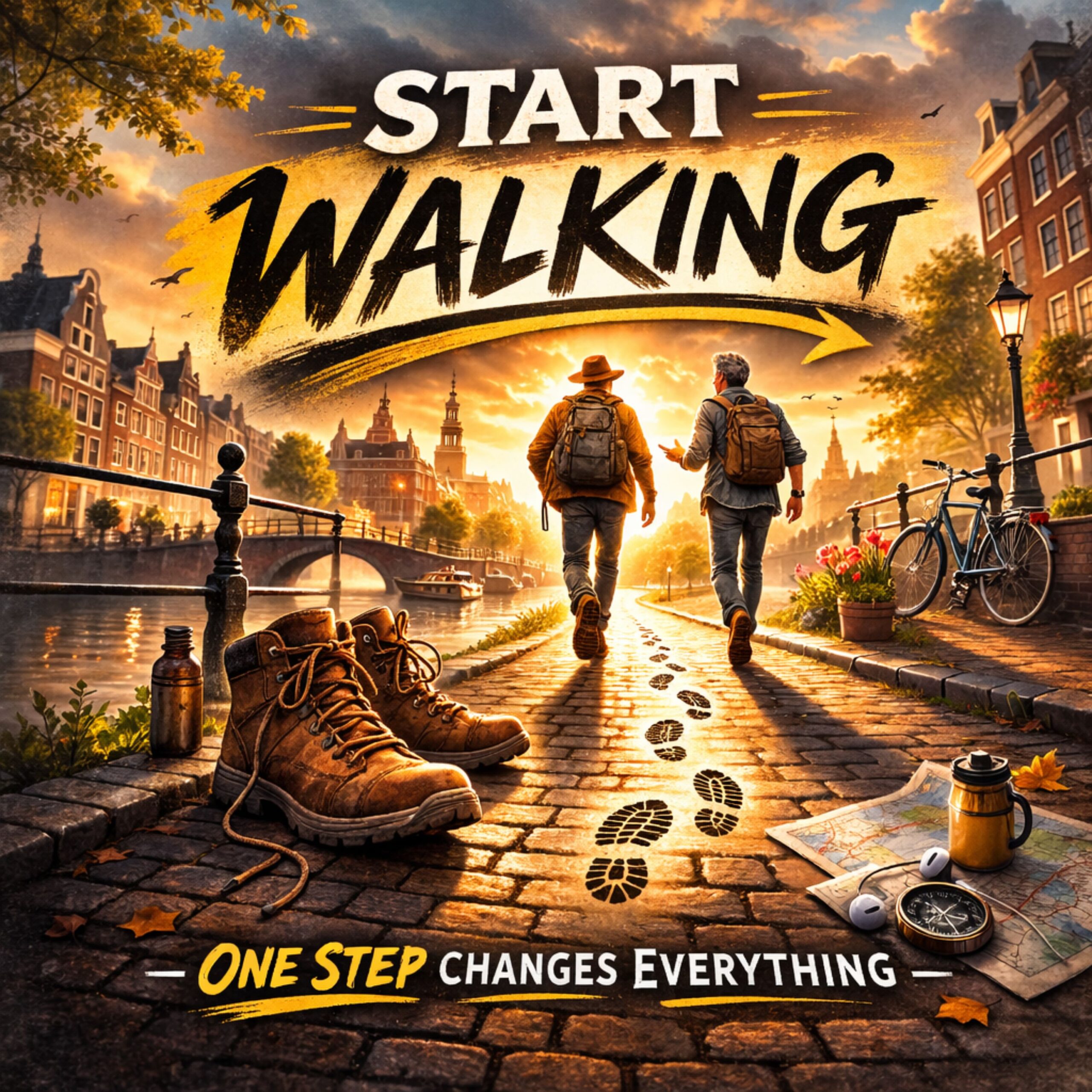
We're analyzing a conversation that was recorded literally on the move. We're virtually walking through the streets of Amsterdam, specifically through Vondelpark, listening to two people discuss the philosophy of walking while.
[00:01:50] Speaker B: They are walking, which just adds this great layer of texture to it. You can actually hear the gravel, the background noise, the rhythm of their breath. It proves the point they're making.
[00:01:58] Speaker A: It really does.
[00:01:59] Speaker B: And they make the disclaimer at the start that sounds like, I don't know, hyperbole. But they're dead serious. They say walking might just be the secret to happiness.
[00:02:07] Speaker A: I know, I know. As soon as I hear secret to happiness, my cynicism radar just pings.
[00:02:12] Speaker B: Mine too.
[00:02:13] Speaker A: It sounds like something on a Hallmark card, you know? Yeah, just walk and you'll be happy. It feels reductive. But what they're actually talking about is the barrier to entry for feeling good.
[00:02:23] Speaker B: Precisely. We complicate wellness so much, we think we need the Hundred dollar gym membership, the high tech watch that tracks our hrv, all the specialized supplements. This source just strips all of that away completely. We're talking about what they call the just put on the shoes philosophy.
And we're going to look at some incredible case studies, including a retiree who accidentally sort of biohacked his own health and a man who overcame a crippling injury with a mind game.
[00:02:54] Speaker A: And we'll break down the specific habit stacking tricks you can use to make this all stick, even if you're busy. But let's start with the setting, because I think it actually matters.
[00:03:00] Speaker B: Amsterdam, a city designed for humans, not for cars.
[00:03:03] Speaker A: Right. And the Source highlights the beauty of Vondel Park. But they make this crucial distinction right away. They basically say, look, this is beautiful, but don't let the lack of a park be your excuse.
[00:03:15] Speaker B: Oh, that's key. Because it's so easy to say, well, if I lived in Amsterdam with canals and tulips, I'd walk every day too. But the mechanism of walking, the blood flow, the bilateral stimulation, it works just as well in a suburban cul de sac as it does in a beautiful park. It's not about the view, it's about the motion.
The source is very clear.
Do not wait for the perfect setting.
[00:03:38] Speaker A: So, okay, let's get into the how. Because on paper, walking is the easiest thing in the world. Toddlers do it. We've been doing it for millions of years. But as adults in 2026, we have built this massive psychological wall around it. We don't call it movement anymore. We call it exercise.
[00:03:57] Speaker B: And that label is the kiss of death.
As soon as you label something exercise with a capital E, it becomes a chore. It becomes a should I should go to the gym, I should go for a run. It implies suffering. It implies you need to gear up.
[00:04:10] Speaker A: It implies friction. You have to change clothes, find your headphones, fill a water bottle, drive somewhere. By the time you've done all the prep, you're already tired.
[00:04:18] Speaker B: Exactly. The source material emphasizes just radical simplicity. You don't need money, you don't need a membership. You literally just need shoes.
[00:04:26] Speaker A: And even the shoes don't need to be special. They just need to be on your feet.
[00:04:30] Speaker B: Exactly.
[00:04:30] Speaker A: There's this fantastic anecdote in the Source about this mental block. One of the speakers is a writer, and they talk about an article they published years ago in Writer's Digest magazine.
[00:04:40] Speaker B: I love this part.
[00:04:41] Speaker A: The title was simply just put on the shoes.
[00:04:43] Speaker B: It's such a perfect parallel because it bridges the mental and the physical so perfectly.
[00:04:48] Speaker A: Yeah, it's brilliant.
The speaker draws a direct line between the creative struggle, you know, staring at a blank page, the cursor blinking at you, feeling like you have nothing to say, and the physical struggle of just getting out the door.
[00:05:04] Speaker B: It's all about inertia. I mean, in physics, we talk about static friction versus kinetic friction. Static friction is the force that keeps an object at rest. And it is always higher than kinetic friction, which is the force resisting an object that's already moving.
[00:05:19] Speaker A: So the hardest part of pushing a stalled car is that first inch.
[00:05:22] Speaker B: 100%. Once it's rolling, it's relatively easy to keep it rolling. The source is just applying that physics to human behavior.
[00:05:32] Speaker A: Right.
[00:05:32] Speaker B: The Just put in the shoes article argues that the victory isn't the run. It's not the chapter you write. The victory is just putting the shoes on or just uncapping the pen.
[00:05:42] Speaker A: Because once you've done that, the static friction is broken. You've crossed the threshold.
[00:05:47] Speaker B: Exactly. And the big insight from the article was that we often fail because we visualize the entire task. We stand in the living room and we imagine the sweating, the breathing hard, the full 45 minutes of effort, and our brain just goes, nope, let's watch Netflix. That seems safer.
[00:06:03] Speaker A: But if you just tell yourself, I am just putting on these sneakers, your brain says, okay, I can do that. That's low threat.
[00:06:10] Speaker B: And that leads right to the concept of the micro goal that the story brings up. They say if you feel like you can't walk more than 100 meters, then.
[00:06:16] Speaker A: Just walk 100 meters. Right. Which sounds ridiculously small. It almost sounds patronizing, doesn't it? Like, good job, you walked to the mailbox.
[00:06:24] Speaker B: It does, but that's the whole point. It has to be too small to fail. If you tell yourself you have to go for a five mile hike, you can talk yourself out of it. If you say, I'm going to walk 100 meters, you just do it.
[00:06:34] Speaker A: Yeah.
[00:06:34] Speaker B: And the source notes this universal truth about walking 100 meters eventually becomes a kilometer and then 10 kilometers. The act of starting is the catalyst for the volume that comes later.
You Rarely walk only 100 meters once you're out there.
[00:06:48] Speaker A: Speaking of volume, we have to talk about the retiree. This part of the conversation just.
It really blew my mind. It's a perfect example of what happens when you stop trying to be intense and just focus on being consistent.
[00:07:00] Speaker B: This is such a powerful case study. It's the hero's story of the deep dive, really.
[00:07:04] Speaker A: So the source Describes a friend who retired about two years ago.
And let's just set the scene on his condition at the time of retirement.
This guy was in, and I'm quoting.
[00:07:17] Speaker B: Quite bad shape, which is a very common scenario. You work a desk job for 30, 40 years, high stress, sedentary retirement hits and often health declines even faster because the structure is gone. You lose your reason to get up. The sofa beckons, Right?
[00:07:32] Speaker A: But this guy went the other way. He started walking slowly at first, probably using that micro goal approach we just talked about, but he built it up to where he is now walking. And I want you to really hear this four hours a day.
[00:07:45] Speaker B: Four hours, that's. That is a massive amount of time. It's a part time job.
[00:07:49] Speaker A: It is. He leaves his house at 8:30 in the morning and he doesn't come back until lunchtime.
And he picks a different direction every day, just wandering away from his house and then back again.
[00:07:58] Speaker B: I actually did the math on this while I was reviewing the source. If you walk at a moderate pace for four hours, that's roughly 20 to 25 kilometers.
[00:08:06] Speaker A: Wow.
[00:08:06] Speaker B: Every single day. That is like ultra marathon training volume, but spread out over a gentle timeline.
[00:08:12] Speaker A: And look at the results. The source lists them. Significant weight loss, obviously, but also a general sense of happiness. And this is the big medical win. He no longer needs his blood pressure medication.
[00:08:24] Speaker B: That's the a ha moment. No gym, no personal trainer screaming at him to do burpees until he vomits.
[00:08:30] Speaker A: No.
[00:08:31] Speaker B: No specialized diet, just walking.
[00:08:33] Speaker A: It really challenges that whole no pain, no gain mentality. We've been fed since what, the 80s?
We think if we aren't suffering, it doesn't count.
[00:08:41] Speaker B: It highlights the power of compounding. We tend to overestimate what we can do in one week of some intense boot camp, which we usually quit because it hurts. And we just massively underestimate what we can do in two years of low intensity consistency.
[00:08:56] Speaker A: He's not a hardcore gym goer. He's not running marathons. He's just moving.
[00:08:59] Speaker B: Right. And there's another aspect to his routine that the source points out that I think is crucial. He does it alone.
[00:09:05] Speaker A: Four hours of solitude.
[00:09:06] Speaker B: In a world where we are constantly bombarded by input, podcasts, news, Slack email.
Four hours of silence is practically a superpower.
[00:09:14] Speaker A: It's moving meditation.
[00:09:15] Speaker B: It is. You're processing thoughts, you're observing the world. You're disconnected from the immediate demands of the house.
That explains that sense of happiness the source mentions. It's not just the endorphins. It's the mental clarity from the solitude. He's basically washing his brain every morning.
[00:09:31] Speaker A: But okay, I can hear the listener right now. I can hear them shouting at their speakers. Sure, he's retired. He has four hours to wander around like a philosopher. I have a job. I have kids. Also, my knees hurt.
[00:09:43] Speaker B: All valid concerns. The time scarcity and the physical limitation objections.
[00:09:49] Speaker A: And the source actually addresses the physical limitation objection, which with a second story that is honestly even more impressive than the retiree.
Because it's not just about getting fit, it's about overcoming trauma.
[00:10:01] Speaker B: This is the story of the colleague with the back injury.
[00:10:03] Speaker A: Yes. So the speaker had a former colleague with a severe back injury. We're talking about the kind of injury where movement itself is associated with pain.
[00:10:12] Speaker B: Right.
[00:10:13] Speaker A: And this guy wanted to get back into running. And when he told people that, they laughed at him.
[00:10:17] Speaker B: Which is cruel, but probably came from a place of, let's be realistic. I mean, if you can barely walk without wincing, running, running seems like a fantasy.
[00:10:24] Speaker A: So he adopted a strategy that takes the just put on the shoes idea to the absolute extreme.
He set himself an impossible task that was actually tiny. Step one, put the running shoes by the bed.
[00:10:37] Speaker B: That's it. He didn't even have to put them on?
[00:10:39] Speaker A: Nope. Step one was just place shoes by bed. Step two, the next morning, just try to put them on, not go outside. Just get him on your feet.
[00:10:47] Speaker B: This is brilliant behavioral psychology. He's breaking that chain of pain and fear down into individual non threatening links.
[00:10:55] Speaker A: Exactly.
[00:10:56] Speaker B: If he thinks I need to run, his brain screams pain. But if he thinks I need to move a shoe six inches, his brain says safe.
[00:11:04] Speaker A: Exactly. Step three was walking down the stairs. Step four was opening the front door and just walking to the street. It was this agonizingly slow progression. He was tricking his nervous system into accepting that it was safe. But fast forward to when the source is telling this story.
This guy is now running seven miles.
[00:11:20] Speaker B: Every day from barely being able to put on shoes to seven miles a day. That is incredible.
[00:11:26] Speaker A: And it just proves that the barrier is often as much mental as it is physical.
He had to convince his own brain that he was safe to move one inch at a time.
[00:11:35] Speaker B: It's a masterclass in patience. If he had focused on the seven miles at the start, he would have quit immediately. The gap between his reality and his goal was just too wide.
By focusing on shoes on feet, he closed the gap. He made success inevitable for that day.
[00:11:51] Speaker A: So we've got the retiree with the time and the injured Colleague with the determination. But let's circle back to the busy person, the I don't have an hour to walk person, because that is most of us.
[00:12:02] Speaker B: The time scarcity objection is definitely the hardest one to crack. I just have too much to do.
[00:12:06] Speaker A: The source has a really interesting take on this. It's about habit stacking or double dipping, right?
[00:12:11] Speaker B: We often view time as this single channel resource. If I'm walking, I can't be doing anything else. Therefore, walking is lost time. Yeah, but the source argues that walking is actually prime time for creating or for consuming.
[00:12:23] Speaker A: The speaker mentions that while they prefer to use walking for creating, you know, generating ideas, thinking through problems, it's also perfect for consuming. If you want to be efficient, you can turn your walk into an educational hour.
[00:12:36] Speaker B: Listening to podcasts, audiobooks, learning a language. Suddenly, that hour isn't lost to exercise. It's gained for learning you're doing something you wanted to do anyway, just while moving your legs.
[00:12:46] Speaker A: But there's a more emotional example of habit stacking in the source that really, really stuck with me. It wasn't about productivity, it was about connection.
The speaker talks about using that walking time to call their mom.
[00:12:59] Speaker B: Yes. This was such a poignant moment in the conversation. It really shifted the tone from practical to personal.
[00:13:05] Speaker A: One of the speakers says, I used to do that all the time. And then they just drop this. Hey, heavy realization. I wish I could still do that.
[00:13:12] Speaker B: Oof. Yeah, it's a stark reminder. The implication is that the opportunity is gone. Now. The speaker advises the listener, literally, you and me, to do it while you still can.
[00:13:24] Speaker A: Right. Walking doesn't have to be a solitary march. It can be the time you dedicate to maintaining those relationships.
[00:13:30] Speaker B: And we're all too busy to call our parents or our friends. But if you walk for 30 minutes, you have 30 minutes.
If you combine those two things, you've just hit two major pillars of health, physical movement and social connection.
[00:13:45] Speaker A: And it distracts you from the effort, too. Yeah, you might walk further because you're just engrossed in the conversation. It effectively kills the excuse of I'm too busy.
[00:13:52] Speaker B: And there's another rule the host mentions that I think just seals the the no regrets rule.
[00:13:58] Speaker A: Oh, I love this. Yeah, I don't think there's ever been a walk I've regretted.
[00:14:02] Speaker B: It's so true. Think about it. Have you ever dragged yourself out the door, gone for a walk, come back and thought, wow, what a waste of time. I really should have stayed on the sofa.
[00:14:11] Speaker A: Never. Not once. Even if it's Raining. Even if it's cold, you come back feeling accomplished. It's like travel, you know. You never regret the trip once you're there.
You might dread the packing or the airport, but you never regret seeing the new place.
[00:14:25] Speaker B: Whereas, let's be honest, you often regret the extra hour on social media. You definitely regret the third episode of a show you're not even really watching.
[00:14:32] Speaker A: You feel gross after that. You feel energized after a walk.
Speaking of shows, we have to touch on the sponsorship joke in the Source.
[00:14:41] Speaker B: Ah yes, the banter about who is really sponsoring our lives.
[00:14:46] Speaker A: They joke that Netflix should be the sponsor of the show. Sarcastically, of course. Yeah, because Netflix, and I'm just using them as a stand in for all streaming and social media, wants you horizontal.
[00:14:57] Speaker B: Their entire business model relies on your inertia. Their stock price goes up when you don't move.
[00:15:02] Speaker A: That is a scary thought.
[00:15:03] Speaker B: It is. But on the other side, you've got Nike or just nature itself really calling you the other way. The Source jokes about Nike being on the phone saying gotta go, get outside. It's a funny visual, but it frames it as a battle for your attention and your physical state.
[00:15:18] Speaker A: It frames it as a choice between passive consumption and active participation.
And the Source is crystal clear, the secret to happiness lies in the active participation.
[00:15:28] Speaker B: And hey, nature subscription is free.
[00:15:31] Speaker A: Exactly. So let's just unpack the main takeaways here before we let our listeners go. We've covered a lot of ground, pun intended.
[00:15:37] Speaker B: Okay, to summarize. First, walking is the ultimate low barrier health hack. It's free, it only requires shoes, and you can start with just 100 meters. Don't let the lack of a perfect setting stop you.
[00:15:49] Speaker A: Second, consistency beats intensity. The retiree walking four hours a day didn't get there overnight. And he didn't do it by sprinting. He did it by showing up every morning at 8:30.
The compounding effect is massive.
[00:16:01] Speaker B: Third, mental barriers are often just disguised as physical ones. If a man with a severe back injury can go from looking at his shoes to running seven miles, you can probably manage a walk around the block. Use micro goals, break that chain of.
[00:16:15] Speaker A: Fear, and finally, stack your habits. Make the walk your educational hour or your call mom hour. Don't view it as losing time. View it as upgrading the time you're already spending.
[00:16:25] Speaker B: And above all, remember that core mantra we started with. You're not tired, you're just not moving.
[00:16:30] Speaker A: That's the one. Write it on a post it note on your monitor when you hit that wall at 5 00pm that exhaustion is often mental stagnation.
The antidote isn't a nap. It's fresh air.
[00:16:42] Speaker B: It's about breaking the state. Changing your environment changes your physiology.
[00:16:46] Speaker A: So here is our challenge to you. We want to leave you with one final thought. Something to mull over.
We talked about the guy who put his shoes by the bed as his only goal for the day, right?
[00:16:56] Speaker B: The smallest possible step.
[00:16:58] Speaker A: What are the shoes by the bed for you today?
What is that one tiny, almost laughably small step you are avoiding that could lead to a massive change a year from now? Maybe it's not walking. Maybe it's writing one sentence. Maybe it's eating one apple.
[00:17:12] Speaker B: Identifying that micro step is the key that unlocks the whole larger habit.
[00:17:17] Speaker A: So honestly, turn this deep dives off. We're done. Put your phone in your pocket, put your shoes on and go outside.
[00:17:25] Speaker B: You won't regret it.
[00:17:26] Speaker A: Not for a second. Thanks for listening. We'll see you or maybe walk past you next time.